TL;DR Quick Answers
How to dispose of an old refrigerator
Run the ENERGY STAR Rebate Finder by ZIP code first. If your utility offers a recycling program and your fridge still works, pickup is free and you may earn a $30 to $75 rebate. If not, retailer haul-away ($25 to $50), scrap metal recyclers (free or up to $30 paid), donation, or negotiated junk removal ($75 to $250) cover every other budget option.
Cheapest to most expensive, in the order to try them:
Utility company recycling program. Free pickup, $30 to $75 paid back to you, working units only.
Retailer haul-away with new appliance delivery. Lowe's charges $50, Home Depot $25 to $50.
Scrap metal recyclers. Free pickup or $5 to $30 paid, working or non-working.
Donation. Habitat ReStores and local charities, working units only.
Professional junk removal. $75 to $250 nationally, drops fast with curbside staging, bundled items, and mid-week booking.
Important: Refrigerators cannot go in regular trash. EPA Section 608 requires certified refrigerant recovery before any fridge gets crushed, scrapped, or landfilled.
From what we see on the trucks: the most expensive mistake is booking professional pickup before checking your utility's rebate program. The swing can be $200 or more.
Top Takeaways
Standard trash service won’t take a fridge. EPA Section 608 requires certified refrigerant recovery before disposal.
Utility rebate programs are the cheapest legitimate option: free pickup plus $30 to $75 paid back to you, if your fridge still works.
Lowe’s haul-away is $50 with delivery. Home Depot typically runs $25 to $50. Both require the unit uninstalled and defrosted before pickup.
Scrap metal recyclers will sometimes take a fridge for free or pay $5 to $30. Confirm they recover refrigerant on-site.
Working fridges can go to Habitat ReStores or local charities. Pre-test the cool-down before you call.
Professional junk removal runs $75 to $250 nationally. The price drops fast when you stage curbside, bundle items, and book mid-week.
Always run the ENERGY STAR Rebate Finder by ZIP code before you book any paid service.
Refrigerators count as regulated waste. Under EPA Section 608 of the Clean Air Act, the refrigerant inside any refrigerator, whether older CFCs and HCFCs or newer HFCs and HFOs, has to be recovered by a certified technician before the unit gets crushed, scrapped, or landfilled. That one rule sets the floor for every disposal price you will ever see. It also explains why curbside trash crews won’t take a fridge, and why “I’ll just put it out on the curb” usually ends in a fine or a unit that quietly disappears into illegal dumping.
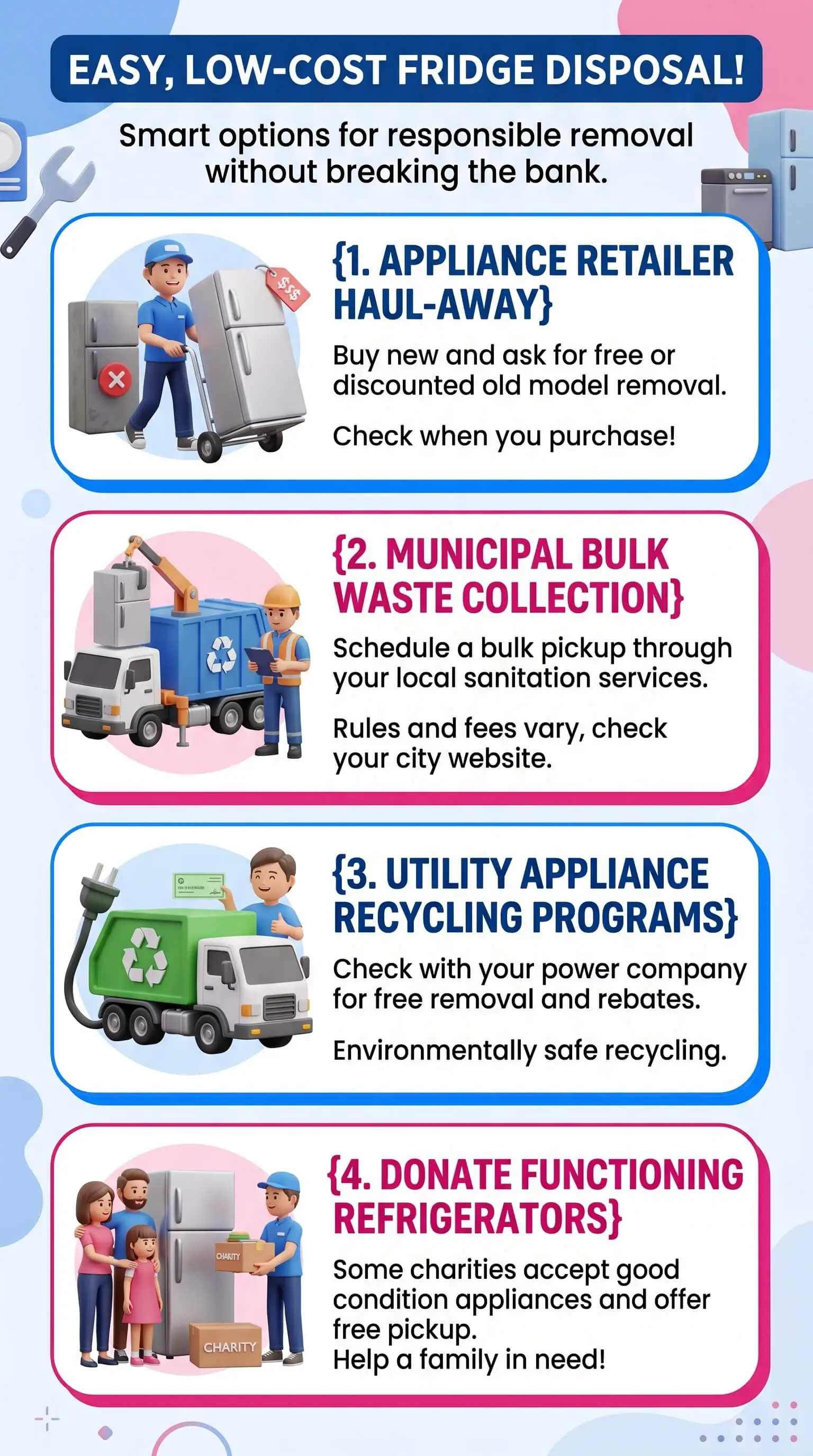
Five legitimate paths can get an old refrigerator out of your kitchen on a tight budget. The cheapest is usually free.
1. Utility company recycling programs (the cheapest free option)
Hundreds of utilities pay homeowners to take old fridges, and most homeowners don’t know about it. These rebate-and-recycle programs pick up your old, working refrigerator from your home, haul it away for free, and pay you a rebate of $30 to $75. PSE&G, Consumers Energy, DTE Energy, UGI Electric, and Minnesota Power all run programs along these lines. There’s a catch. The unit usually has to be working, between 10 and 28 cubic feet, and you usually have to be a residential customer of that utility. Use the ENERGY STAR Rebate Finder and enter your ZIP code first. If a program covers your area, this is almost always your cheapest option.
2. Retailer haul-away when you buy a replacement
Buying a new fridge anyway? Lowe’s charges $50 to haul away your old one with delivery. Home Depot typically runs $25 to $50, depending on store and region. There’s a catch here too. You have to uninstall, empty, and defrost the unit before they arrive, and the haul-away has to be one-for-one (one new in, one old out). For Lowe’s MyLowe’s Pro Rewards members and Home Depot Pro members, haul-away often comes free with the appliance purchase.
3. Scrap metal recyclers
A full-size refrigerator contains 79 to 152 pounds of recyclable steel, plus copper in the compressor coils. Scrap metal yards will sometimes pick up working or non-working units for free because the metal value covers their cost. A few will pay you $5 to $30, depending on local scrap prices. Call ahead. Confirm the yard recovers refrigerant on-site. Most do. If they don’t, walk away. You don’t want the legal exposure.
4. Donation if the fridge still works
Habitat for Humanity ReStores, local shelters, and community thrift programs accept working refrigerators. Some will even pick up. Donations are tax-deductible if the recipient is a 501(c)(3), so save the receipt. Before you call, plug the fridge in and let it run for an hour to confirm it cools. Most donation centers will not take a unit that fails their cool-down test, and you’ll be charged a return fee if they have to haul it back.
5. Professional junk removal (with negotiation)
When the fridge doesn’t work, the utility rebate doesn’t apply, and you don’t have a truck, professional junk removal is the right call. The national range is $75 to $250 for single-fridge pickup, but the final price is more flexible than most people realize. For a complete walkthrough of professional fridge pick-up options including same-day haul-away, see this guide on how to dispose an old refrigerator from Jiffy Junk.
The negotiation moves we use every day on the trucks:
Stage the fridge for fastest pickup. Move it to the garage, driveway, or curb if your municipality allows it. Clear hallways and reserve close parking. Every minute of crew labor saved is margin for a lower quote.
Bundle other items into one trip. A single-item fridge pickup hits the minimum service fee and often costs more per pound than a fuller load. Add a few other heavy items (a mattress, a dead treadmill, that broken patio set), and the per-item cost drops fast.
Ask the right questions on the call. Three phrases that consistently lower quotes: “Is this priced by load size or by item?” “What load tier am I in, and what would keep me below the next tier?” “If I move it curbside before you arrive, what does the new quote look like?”
Time the booking. Weekday off-peak (Tuesday through Thursday, mid-day) routes have the most flexible pricing. Same-day bookings sometimes price lower because they fill an existing route gap. Always ask about senior, military, and first-responder discounts. Many haulers offer them but don’t advertise.
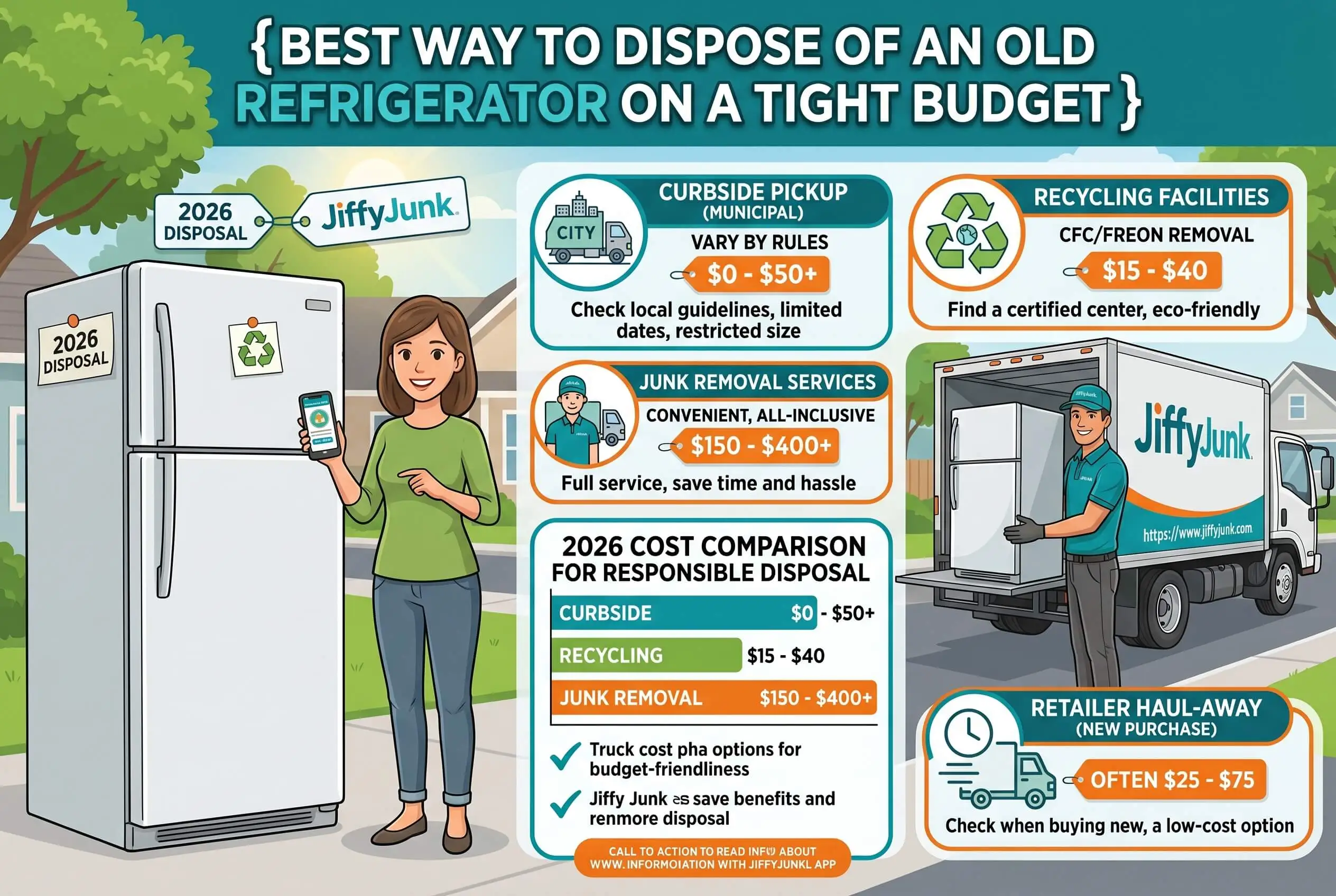
"The single biggest mistake we see is homeowners booking refrigerator removal without checking their utility’s rebate program first. We’ve watched customers pay us $150 to haul away a fridge their power company would have picked up for free and paid them $50 to take. Always run the ENERGY STAR Rebate Finder before you book anyone. If your fridge is working and your utility has a program, that’s a $200 swing in your pocket. When the rebate program isn’t an option, the negotiation rule is simple. Don’t argue about the price. Change the inputs to the price. Every minute we save on stairs, carrying distance, and labor time becomes margin we can pass back. Stage the fridge curbside, bundle a second item, book mid-week, and a $200 quote becomes a $130 quote without us giving up a dollar of operational cost."
7 Essential Resources
Every claim above traces back to a primary source. These are the seven references worth reading before you book any disposal service, starting with the federal regulation that sets the rules for everyone.
EPA Section 608, Stationary Refrigeration and Air Conditioning. The federal regulation that governs refrigerant recovery during appliance disposal. Read this first to understand why fridge removal can’t be fully DIY. epa.gov/section608
EPA Responsible Appliance Disposal (RAD) Program. EPA’s voluntary partnership with utilities, retailers, and recyclers. Includes consumer guidance for proper appliance disposal and a directory of partner programs. epa.gov/section608/appliance-disposal
ENERGY STAR Rebate Finder. Enter your ZIP code to find local utility rebates and free pickup programs. The single most useful tool for confirming whether a free option exists in your area. energystar.gov/rebate-finder
ENERGY STAR, Find a Fridge or Freezer Recycling Program. Directory of state energy office and utility recycling programs nationwide, with guidance on what to ask retailers about responsible recycling. energystar.gov/products/recycle/find_fridge_freezer_recycling_program
Wikipedia, Refrigerator. Background on refrigerator construction, refrigerant types, and the evolution from CFCs to modern HFOs. Useful context for understanding why disposal rules exist. en.wikipedia.org/wiki/Refrigerator
Angi, Appliance Removal Cost Guide (2026). Independent third-party pricing data: $60 to $180 typical range, $100 average, with breakdowns by appliance type and region. angi.com/articles/appliance-removal-cost.htm
EPA Section 608 Technician Certification Requirements. If you want to verify that a junk removal company or scrap yard handles your fridge legally, this page explains the certification anyone recovering refrigerant has to hold. epa.gov/section608/section-608-technician-certification-requirements
3 Statistics
The numbers below come straight from EPA data and independent industry pricing reports. They show why refrigerator disposal is regulated, how much volume the responsible-disposal infrastructure actually handles, and what the market price range looks like in 2026 for a practical home improvement decision.
Roughly 9 million refrigerators and freezers go to disposal each year in the United States. That’s the volume flowing through the disposal system annually, and it’s what drives the existence of utility rebate programs and the EPA’s Responsible Appliance Disposal Program. Source: U.S. EPA, Disposing of Appliances Responsibly
From 2006 through 2025, the EPA’s RAD Program processed over 9 million refrigerated appliances and recycled 1.5 billion pounds of metals, plastics, and other durable materials. That’s what the responsible-disposal infrastructure actually delivers when consumers use rebate and recycling programs instead of curb-dumping. Source: U.S. EPA, Appliance Disposal
The national average cost to remove a single household appliance through a professional service is $75 to $130, with refrigerators commonly running $75 to $250 depending on access and location. That’s the negotiable range. Nearly every customer can move within it by adjusting access, bundling items, and timing the booking. Source: Yelp Cost Guide, Junk Removal & Hauling
Final Thoughts and Opinion
The cheapest way to get rid of an old refrigerator is almost never the option people reach for first. We see it constantly. A homeowner Googles “fridge removal near me,” picks the first national chain that pops up, and pays $200. Their utility company would have hauled the same unit away for free and mailed them a $50 check.
The right order of operations runs opposite to instinct. Start with the rebate finder. Then call the retailer if you’re buying a replacement. Then call a scrap yard. Then look at donations. Only then call a junk removal company. By the time you reach professional pickup, you’ve already eliminated three or four cheaper paths. Even at that stage, the quote is more negotiable than most customers realize.
From what we see every day on the trucks, the difference between a $200 fridge removal and a $0 fridge removal isn’t luck. It’s whether the homeowner knew the order to work through.
Frequently Asked Questions
Can I put a refrigerator out with regular trash?
No. Under EPA Section 608, the refrigerant has to be recovered by a certified technician before any refrigerator gets landfilled or scrapped. Most municipal trash services will not pick one up curbside without prior arrangement, and leaving one out can result in a fine.
How much does it cost to dispose of an old refrigerator?
The path you choose decides the price. Utility rebate programs are free and may pay you $30 to $75. Retailer haul-away with new appliance delivery runs $25 to $50. Scrap metal recyclers can be free. Professional junk removal runs $75 to $250 for single-unit pickup.
Will Lowe’s or Home Depot take my old fridge?
Yes. Both offer haul-away when you buy a replacement. Lowe’s charges $50. Home Depot typically charges $25 to $50. The old unit has to be uninstalled, empty, and defrosted before delivery day, and haul-away is one-for-one (one new in, one old out).
Do scrap yards pay for old refrigerators?
Sometimes. Refrigerators contain 79 to 152 pounds of recyclable steel. Some scrap yards will pick up for free because the metal value covers their cost. A few will pay $5 to $30. Always confirm the yard handles refrigerant recovery legally before you hand the unit over.
Is it illegal to throw away a fridge?
Venting the refrigerant is illegal. That’s a federal violation under the Clean Air Act. Disposing of the unit itself isn’t illegal if you go through a legitimate channel that recovers the refrigerant first.
Can I recycle a refrigerator for free?
Yes, if your utility runs a recycling program (most major ones do, for working units), or if a local scrap yard offers free pickup. The ENERGY STAR Rebate Finder is the fastest way to confirm what’s available in your ZIP code.
Do I need to defrost the fridge before pickup?
For retailer haul-away (Lowe’s, Home Depot), yes. They require it. For professional junk removal, it depends on the company. Defrosting is recommended either way to prevent water damage during transport.
How long does professional fridge removal take?
For a curbside or driveway pickup, 10 to 15 minutes from arrival. In-home pickups with stairs or tight access can run 30 to 60 minutes. Most companies offer same-day or next-day service when routes have availability.
Ready to Save on Your Fridge Disposal?
Start with the ENERGY STAR Rebate Finder by ZIP code. It takes 30 seconds and may turn a $200 problem into a $50 payday. If your fridge doesn’t qualify or you need a same-day pickup, run the negotiation playbook above before you book. Stage curbside, bundle a second item, ask for the load-size tier, and book mid-week.
Need professional pickup? Tap here to read the full Jiffy Junk fridge pick-up guide and lock in the lowest pickup price for your location.