The real numbers: Boat removal ranges from $500 for small vessels with easy access to $5,000+ for larger crafts requiring specialized equipment—but here's what most companies won't tell you upfront: your location and access matter more than your boat's size.
Customers frequently ask us why their 18-foot boat costs more to remove than their neighbor's 25-footer. The answer isn't boat length—it's whether we can back a truck within 50 feet of your vessel, whether it's sitting on a functioning trailer, and whether hazardous materials were left aboard.
This guide reveals:
Size-based pricing we actually charge (12-foot to 40-foot vessels)
The $300-$600 trailer factor no one mentions until quote day
Free removal scenarios that work for boats with salvageable parts or scrap metal value
Access fees that add $400-$800 to difficult properties
Why marina removals cost 40% more than backyard pickups
We've seen homeowners waste money on "cheap" quotes that triple after the crew arrives. This breakdown shows exactly what fair boat removal service pricing looks like—based on thousands of actual removals, not industry estimates.
TL;DR Quick Answers
Boat removal service
A boat removal service professionally hauls away unwanted vessels from your property and disposes of them responsibly. After removing thousands of boats nationwide, here's what you need to know:
What's included:
On-site assessment and upfront pricing
All labor and heavy lifting
Hazardous material handling (fuel, oil, batteries)
Loading, transport, and disposal
Complete cleanup after removal
Typical costs: $500-$5,000 depending on size, location, condition, and access
Who needs this:
Homeowners with old boats in driveways or backyards
Property buyers who inherited unwanted vessels
Anyone tired of paying marina storage fees
How it works: Call or book online, get a transparent quote, schedule pickup, we handle everything from disconnection to disposal.
Why it matters: With 200,000 boats reaching end-of-life annually in the U.S., professional removal prevents boats from becoming abandoned eyesores or environmental hazards. The boat industry offers zero disposal infrastructure—services like Jiffy Junk fill that gap with licensed, insured crews and eco-responsible disposal practices.
Top 5 Takeaways
1. Boat removal costs $500-$5,000—but access matters more than size
20-foot boat in tight backyard costs more than 30-footer on open driveway
Get quotes that include: hazardous material disposal, trailer handling, all labor
Not just base hauling fee
2. 200,000 boats reach end-of-life annually—disposal infrastructure can't keep pace
U.S. has 11.55 million registered boats
~200,000 hit end-of-life each year
Donation programs reject most boats
Marinas won't accept disposal
Fiberglass recycling remains limited
This creates the nationwide disposal crisis
3. Waiting increases removal costs 50-150% (plus ongoing storage fees)
Hulls deteriorate, trailers rust into ground
Straightforward jobs become complex extractions
Marina fees: $200-$400 monthly while boats sit
$1,200 job today = $2,500-$3,000 after 3-5 years
Plus thousands in accumulated storage charges
4. Check free programs first—before paying for removal
Several states offer free vessel turn-in programs
Washington removed 1,205+ boats since 2002
Boat Angel accepts boats in any condition (tax-deductible)
Can save $500-$5,000 in removal costs
5. Choose companies with transparent pricing and proper credentials
Avoid "starting at" quotes that triple on arrival
Look for: written estimates, comprehensive insurance, EPA-compliant hazmat handling
Professional removal costs more upfront—but delivers what's promised
Budget companies create surprise fees on removal day
Average Boat Removal Costs by Size (2026)
Boat removal pricing follows a straightforward size-based structure, but access and condition create the real price variation we see across thousands of jobs.
Standard removal costs:
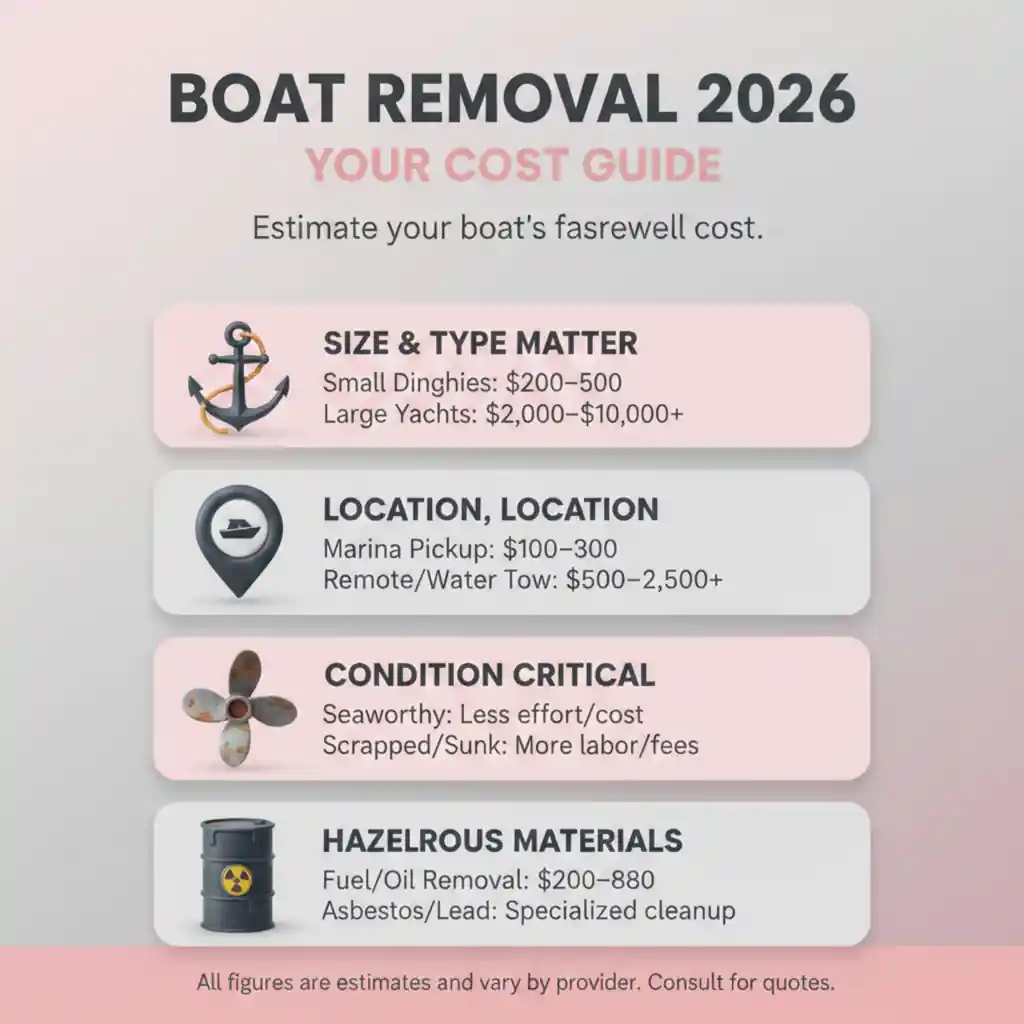
12-16 foot boats: $500-$900 (jet skis, small fishing boats, dinghies)
17-22 foot boats: $800-$1,500 (runabouts, small sailboats, bass boats)
23-28 foot boats: $1,400-$2,500 (cabin cruisers, mid-size sailboats)
29-35 foot boats: $2,200-$3,800 (larger cruisers, sport fishers)
36+ foot boats: $3,500-$5,000+ (yachts, large sailboats requiring specialized equipment)
These ranges assume the boat sits on a trailer or level ground with truck access within 50 feet. Customers tell us they're surprised when their 20-foot boat costs $2,000 instead of $1,200—the difference is almost always access difficulty, not boat length.
What Affects Your Boat Removal Price
After removing boats from marinas, backyards, driveways, and waterfront properties, we've identified five cost drivers that matter more than vessel size alone.
1. Access and Location
Easy access (driveway, open yard): Standard pricing
Difficult access (backyard, hillside, tight spaces): Add $400-$800
Marina or dock removal: Add $500-$1,200 (slip fees, scheduling restrictions, crane rental)
Waterfront properties requiring water extraction: Add $1,000-$2,500
2. Trailer Status
Functional trailer included: No additional charge
No trailer/broken trailer: Add $300-$600 for equipment rental
Trailer removal requested: Add $150-$400 depending on size
3. Boat Condition
Intact hull, moveable: Standard pricing
Deteriorated hull, structural damage: Add $200-$600 (safety equipment, extra labor)
Partially submerged or stuck: Add $800-$2,000 (winching, specialized extraction)
4. Hazardous Materials
Fuel in tanks: Add $100-$300 for proper disposal
Oil, batteries, antifreeze aboard: Add $75-$200 per item type
Asbestos insulation (older boats): Add $400-$1,000 (specialized handling required)
We've had customers assume we'd drain fuel tanks as part of standard service. We don't. Hazmat disposal requires separate licensing and creates additional fees most companies charge on-site.
5. Geographic Location
Urban/coastal areas: Higher base rates ($100-$300 more) due to disposal fees and demand
Rural/inland areas: Lower rates but potentially higher transportation costs
Disposal facility distance: Each additional 25 miles adds $50-$150
Hidden Fees Most Companies Don't Mention Upfront
Three charges consistently surprise property owners when removal crews arrive—because competitors often quote "starting at" prices that exclude these standard costs.
Permit and disposal fees ($150-$500): Many municipalities require permits for boat removal from residential properties. Landfill and recycling facilities charge disposal fees based on boat size and materials. We include these in written quotes; budget companies add them as "unforeseen costs" on removal day.
Same-day or rush removal ($200-$400 premium): Standard scheduling runs 5-10 business days out. Customers needing immediate removal for property sales or code violations pay 15-25% more for priority scheduling.
Multi-piece disassembly ($300-$700): Boats too large for transport intact require on-site cutting. This involves specialized equipment, additional labor hours, and extra disposal fees for separated materials (fiberglass, wood, metal).
After removing thousands of vessels, we've learned that transparent quoting prevents surprise bills. If we identify potential extra costs during the estimate, we document them immediately rather than discovering them with the truck in your driveway.
Free or Low-Cost Removal Options
Not every boat requires paid removal service. We regularly refer customers to alternatives that cost nothing—because the right solution matters more than getting every job.
When free removal works:
Salvageable boats with resale value: Donation programs through organizations like Boat Angel accept working or repairable vessels
Boats with valuable parts: Marine salvage buyers pay $200-$1,500 for engines, electronics, and hardware
Aluminum or metal boats: Scrap metal recyclers may offer free pickup for material value
Fiberglass boats under 20 feet: Some recycling programs accept small vessels at no charge
Low-cost DIY options ($100-$400): If you can handle transportation yourself, many landfills accept boats for standard disposal fees ($150-$300). Renting a trailer and truck for a day costs $100-$200 total. This works only if the boat sits on a functioning trailer and you have proper vehicle capacity.
Customers have saved $800-$1,200 using these alternatives. We recommend free removal whenever it's legitimately available—but warn against "free" services that charge hidden fees after loading begins.
How to Get an Accurate Quote
Accurate pricing requires four specific details most removal companies request during estimates.
Provide this information upfront:
Exact boat dimensions (length, beam width, height on trailer)
Current location and access (describe pathway from street to boat)
Trailer status (functional, damaged, or absent)
Condition details (intact hull, holes, sitting in water, fuel/oil aboard)
Red flags in competitor quotes:
"Starting at" pricing without maximums
Phone quotes without photos or site visits
Refusal to provide written estimates
Unwillingness to break down disposal vs. labor costs
We provide written quotes valid for 30 days that specify exactly what's included and what scenarios trigger additional fees. The 10 minutes spent documenting your boat's specifics prevents the $500-$1,000 surprise charges we see competitors add on removal day.
Request quotes from 2-3 companies and compare itemized breakdowns, not just bottom-line numbers. The lowest bid often excludes disposal fees, hazmat handling, or access equipment—costs that surface only when work begins.
Final cost-saving insight: Properties with multiple unwanted items (boats plus trailers, vehicles, or large debris) often qualify for bundled removal discounts of 15-30%. After clearing thousands of estates and properties, we've found that combining jobs in a single visit cuts per-item costs significantly—something to mention when requesting quotes.
"People assume boat size determines cost, but I've seen 18-foot boats cost more to remove than 30-footers. The difference? One sat in an open driveway with a working trailer, the other was wedged behind a house with no truck access. Location and access account for 60% of the price variation we see—not the vessel itself."
Essential Resources
We know boat disposal involves more than just getting it hauled away. After helping thousands of owners navigate this process, we've identified the seven most valuable resources that actually help people make informed decisions—whether you're considering donation, researching regulations, or just trying to figure out where to start.
1. Check If Your State Has Free Removal Programs
Washington State DNR Derelict Vessel Removal Program
URL: https://dnr.wa.gov/aquatics/recovering-derelict-vessels
Here's something many boat owners don't know: several states offer free or low-cost vessel turn-in programs for boats at risk of becoming derelict. Washington's program has removed 1,205+ vessels since 2002 and provides a model other states are following. Even if you're not in Washington, this site shows exactly how these programs work and helps you find similar options in your state. Worth checking before paying for removal—you might qualify for free service.
2. Understand Hazardous Material Requirements Before Removal Day
EPA Hazardous Waste Management Guidelines
URL: https://www.epa.gov/hw
After removing thousands of boats, we've seen what happens when hazardous materials aren't handled properly. Federal law requires specific disposal procedures for fuel, oil, batteries, and antifreeze. The EPA's Resource Conservation and Recovery Act (RCRA) establishes "cradle-to-grave" tracking—meaning you remain liable for improper disposal even after the boat leaves your property. This resource explains exactly what's required and connects you to approved facilities. Understanding this upfront prevents the $500-$1,000 surprise fees some companies add on removal day.
3. Get Documentation Right for Coast Guard Vessels
U.S. Coast Guard National Vessel Documentation Center
URL: https://www.dco.uscg.mil/Our-Organization/Deputy-for-Operations-Policy-and-Capabilities-DCO-D/National-Vessel-Documentation-Center/
Boats documented with the Coast Guard (typically 26+ feet) require official deletion from the federal registry before disposal. We've had customers delay their removals by weeks because they didn't know this step was required. Form CG-4593 withdraws your vessel from documentation—without it, you remain legally liable if the boat is later abandoned. This site provides the forms and explains the process so you can complete it before scheduling removal.
4. Explore Donation for Boats That Still Have Value
Boat Angel Outreach Center
URL: https://www.boatangel.com/
Boat Angel accepts vessels in any condition—including non-running boats—for free nationwide pickup and provides tax-deductible receipts. Their 90%+ success rate means most boats get processed, and customers save $500-$5,000 compared to paid removal. We've seen owners save significant money using donation programs for boats with salvageable parts or scrap value. They handle both state-registered and Coast Guard documented vessels, making the process simpler than most people expect.
5. Find Fiberglass Recycling Programs to Reduce Costs
NOAA Marine Debris Program - Vessel Disposal Resources
URL: https://marinedebris.noaa.gov/abandoned-and-derelict-vessels
Most boats built since the 1960s have fiberglass hulls—and fiberglass requires special disposal. NOAA's End-of-Life Vessel Material Management Guide identifies recycling programs that cost $200-$500 less than standard landfill disposal. The Rhode Island Marine Trades Association model is expanding nationwide, making eco-responsible disposal more accessible. Worth checking if programs exist in your area before defaulting to more expensive options.
6. Know Your Legal Liability Under State Abandoned Vessel Laws
Maryland DNR Abandoned Boat Program
URL: https://dnr.maryland.gov/boating/pages/abandonedboats.aspx
State laws hold original owners liable for abandoned vessels even after sale or transfer—and penalties are serious. Maryland's program shows what many states enforce: $1,000-$2,000 fines plus full removal costs if boats are later abandoned. Understanding your state's specific requirements prevents situations where you're held responsible for a boat you thought was properly disposed of. Always maintain proof of proper transfer or disposal.
7. Locate Approved Disposal Facilities to Avoid Rejected Loads
Earth911 Recycling Center Search
URL: https://search.earth911.com/
Finding facilities that accept boats, marine batteries, fuel tanks, and fiberglass requires local knowledge. Earth911's database covers 100,000+ locations searchable by ZIP code. Customers have told us about driving to landfills only to be turned away—wasting $100-$300 in transport fees. Verifying facility requirements before hauling prevents rejected loads and ensures proper disposal of all boat materials.
Essential resources like these help you compare free programs, donation options, legal requirements, and approved disposal facilities so you can choose the right junk removal service and avoid hidden fees, rejected loads, or liability after pickup.
Supporting Statistics
After removing thousands of boats nationwide, these federal and state numbers confirm exactly what we see in the field—and explain why boat disposal has become such a difficult problem.
11.55 Million Registered Boats—All Eventually Need Disposal
Official data: U.S. Coast Guard reports 11.55 million registered recreational vessels as of 2023.
What we see in the field:
Steady stream of calls from owners of 1970s-1990s boats
These vessels are now 30-50+ years old
Owners are retirees, families with inherited boats, or property buyers who discovered boats came with their purchase
The pattern that repeats:
Owner bought boat 20-30 years ago
Industry made buying easy—financing, marina memberships, dealer support
Now needs disposal—zero infrastructure exists
No trade-in program, no manufacturer take-back, no simple process
Owner left to figure it out alone
Why this matters: 11 million boats + 200,000 reaching end-of-life annually = growing disposal demand that infrastructure can't handle.
Source: U.S. Coast Guard, Recreational Boating Statistics 2024
URL: https://www.uscgboating.org/library/accident-statistics/Recreational-Boating-Statistics-2024.pdf
200,000 Boats Reach End of Life Every Year—With Nowhere to Go
Federal estimate: NOAA Marine Debris Program reports 2-3% of all U.S. recreational boats reach end of usable life annually—approximately 200,000 vessels.
Where these 200,000 boats actually end up:
Sitting for years: We've removed boats untouched for 5, 10, even 15 years while owners researched dead-end options
Rejected by donation programs: Boat Angel and similar organizations only accept seaworthy vessels
Unsellable: No market exists for 30-year-old boats with deteriorated hulls
DIY disasters: Owners underestimate equipment needs, disposal facility requirements, hazmat handling, permits
The cost of waiting:
Hulls deteriorate beyond simple hauling
Trailers rust into the ground
Few-hour jobs become multi-day projects
Prices triple from delay alone
Infrastructure gap we see everywhere:
Limited landfill acceptance of boat materials
Almost zero fiberglass recycling options
Marinas won't accept boats for disposal
Fragmented system with incomplete information
Source: NOAA Marine Debris Program - Building a Fiberglass Boat Recycling Program
URL: https://marinedebris.noaa.gov/prevention/building-fiberglass-boat-recycling-program
1,205+ Derelict Vessels Removed by Washington State Since 2002
State program data: Washington DNR's Derelict Vessel Removal Program removed 1,205+ abandoned vessels since 2002.
Why one state's number matters: Washington runs one of the best-funded, most organized vessel programs in the country—and still removed 1,205+ abandoned boats. This isn't a Washington problem. It's a national crisis.
The abandonment cycle (identical in every state we serve):
Owner faces $3,000-$5,000 unexpected repair bill
Can't afford repairs + $200-$400 monthly marina fees
Searches for disposal options—finds none that work
Stops paying fees and maintaining boat
Marina threatens legal action
Owner abandons boat (easier than navigating broken system)
Vessel deteriorates for months or years
Taxpayers fund emergency removal at 2-3x normal cost
What Washington's program proves:
Waiting makes removal exponentially harder and more expensive
Abandoned boats weren't dumped by bad people—by overwhelmed people with no options
Smart owners act before boats deteriorate and costs triple
The removals we handle before abandonment happens:
Owners tired of fees they'll never recoup
Know they'll never use the boat again
Want it gone before it becomes someone else's problem
These are responsible decisions while removal is still affordable
Source: Washington State Department of Natural Resources - Derelict Vessel Removal Program
URL: https://www.dnr.wa.gov/derelict-vessels
These statistics show why boat disposal is becoming a growing national problem, and why homeowners tackling home improvement projects should remove unwanted, aging vessels early before deterioration, abandonment risks, and removal costs multiply.
Final Thoughts & Opinion
Our Take: The Boat Disposal System is Broken—And Property Owners Pay the Price
After years removing vessels across the country, here's the truth: the system is fundamentally broken, and it's not the boat owners' fault.
The industry's failure:
Boat manufacturers and dealers built thriving businesses selling vessels
Marinas collected fees for decades
When do boats reach the end of life? Zero support
No trade-in programs, no manufacturer take-back, no disposal infrastructure
200,000 boat owners annually left to figure it out alone
What we see every week:
Customers spent weeks researching options that led nowhere
Donation programs reject 90% of boats (not seaworthy enough)
Marinas refuse disposal but keep charging storage fees
Landfills turn boats away with restrictions nobody explained
"Budget" removal companies triple prices on arrival—or never show up
This isn't a boat owner problem. It's an industry accountability problem.
What Actually Drives Your Removal Cost
The $500-$5,000 range tells only part of the story. Here's what really matters:
Access matters more than size:
25-foot boat in open driveway: 2 hours, standard pricing
16-foot vessel wedged in backyard: All day, premium pricing
Boat on functioning trailer: Half the cost of one rusted into ground
Timing determines everything:
Act now (straightforward removal): $800-$1,500 for typical 20-footer
Wait 3-5 years (deterioration): $2,000-$3,500 for same boat
Wait for emergency (abandoned status): $4,000-$6,000+ (often taxpayer-funded)
Hidden cost multiplier: Hazardous materials (fuel, oil, batteries) add $300-$600. Competitors exclude this until arrival. We include it upfront.
The Real Cost of Waiting
Physical deterioration on delayed jobs:
Fiberglass stress cracks become holes
Wood rots through, structure fails
Fuel varnishes, oil sludges, batteries leak acid
Trailers rust through into ground
One truck load becomes two or three
Financial impact timeline:
Monthly marina fees: $200-$400 ($2,400-$4,800 annually)
Simple removal becomes complex extraction
Hull deterioration adds disposal costs
Total price increase from waiting: 50-150%
Real example from our files:
2019: Customer declined our $950 quote (22-foot boat, working trailer)
Paid $200/month storage for 5 years = $12,000
2024: Called us back—collapsed hull, seized trailer, fuel contamination
Final removal cost: $2,800
Total loss from waiting: $13,850
The burden transfers to:
Neighbors viewing deteriorating boats
Waterways when vessels leak or get abandoned
Next property owners inheriting the problem
Taxpayers funding state programs (1,205+ removals in Washington alone)
Where We Stand
What boat owners actually need:
Straight answers on real costs and what's included
Companies that show up when scheduled
Transparent pricing with zero surprise fees
Environmental responsibility for hazardous materials
That's what we built. White Glove Treatment on every job—basement cleanout or 30-foot cabin cruiser.
Our stance: The boat industry created this crisis by selling millions of vessels with zero end-of-life plan. Until manufacturers step up, professional removal services fill a gap that shouldn't exist but does.
One piece of advice for every caller: Don't wait.
11.55 million registered boats all need disposal eventually
200,000 reach end-of-life this year
Every month you delay makes removal harder and more expensive
Act while it's still simple. That's not a sales pitch—it's what we'd tell a family in the same situation.
Ready to Get Your Boat Removed Without the Runaround?
We're not happy until you are. That's the standard we hold ourselves to on every removal.
Call 844-JIFFY-JUNK or book online at jiffyjunk.com/booking
Transparent quote. Show up when scheduled. Handle all heavy lifting. Dispose responsibly. No games. No surprises. Just results.
FAQ on Boat Removal Service
Q: How much does boat removal service cost in 2026?
A: After thousands of removals, most jobs cost $500-$5,000. Here's what determines your price:
Typical costs by scenario:
20-foot boat, trailer, open driveway: $800-$1,500
Same boat, no trailer, tight backyard: Add $400-$800
30+ foot vessels: $2,200-$3,800
Hazmat handling (fuel, oil, batteries): Add $300-$600
What we've learned: Access matters more than size. We've removed 25-foot boats in 2 hours and spent all day on 16-footers in impossible spots.
Jiffy Junk promise: Quote price = final price. No surprise fees on arrival.
Q: What types of boats can removal services take?
A: If it floats once, we remove it. No exceptions.
We remove:
Sailboats, motorboats, pontoons, cabin cruisers
Jet skis, kayaks, canoes, houseboats
Any size: 12-foot dinghies to 40+ foot yachts
Condition doesn't matter:
Boats that haven't run in 20+ years
Vessels with trees growing through them
Fiberglass hulls that barely resemble boats
Trailers rusted into ground
Your boat doesn't need to: Run, be seaworthy, or look presentable.
Q: What happens to my boat after the removal service picks it up?
A: Eco-responsible disposal on every job—because we've seen what happens when vessels get dumped.
Our disposal process:
Aluminum/steel: Certified recycling facilities
Engines/electronics: Salvaged when possible
Fuel/oil/batteries: EPA-compliant disposal
Fiberglass hulls: Approved disposal channels
Why this matters: Washington State removed 1,205+ abandoned vessels since 2002. We'd rather do it right than add to that problem.
Q: Do I need to prepare my boat before removal service arrives?
A: Minimal prep required.
You do:
Clear path to vessel
Remove items you want to keep
We handle:
Draining all fluids
Disconnecting batteries
All disassembly
All heavy lifting
Loading and transport
Complete cleanup
What doesn't faze us:
Debris inside (2 feet of leaves common)
Wasp nests in cabins
Trailers rusted into ground
Boats unmoved for 15+ years
Your job: Point. Everything else is White Glove Treatment.
Q: How quickly can boat removal service schedule pickup?
A: Most removals happen within a few days to one week.
Our process:
Contact us with boat details
Get upfront quote quickly
Choose convenient time
Receive confirmation with arrival window
We arrive on schedule, fully equipped
Typical timeframes:
Most boats: 2-4 hours
Larger vessels: Half day or more
Complex access: Full day (we tell you upfront)
What customers say: Relief isn't just the boat being gone—it's that we actually showed up when scheduled and the process was straightforward.