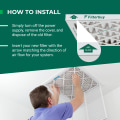
Pet dander doesn't wait in one room. It travels through your home on every breath your HVAC system takes, embedding itself in ducts, settling on surfaces, and recirculating long after your pet has moved on. In our experience manufacturing filters for over a decade and working with millions of pet-owning households, the homes that struggle most with guest allergies aren't dirty — they're simply running a filter that's already saturated with dander and no longer capturing anything new.
Here, we break down how filter changes reduce airborne pet allergens before company arrives, which MERV ratings actually trap dander at the particle level, and the pre-visit routine our customers rely on to make their homes genuinely welcoming — for guests of every sensitivity level.
TL;DR Quick Answers
air filter replacement
Replace air filters every 30 to 60 days in pet-owning homes — not the standard 90 days most packaging recommends. Pet dander saturates filter media faster than typical household dust, often well before visible signs of wear appear. For homes with allergy-sensitive guests, replace the filter 24 to 48 hours before arrival to give your HVAC system enough cycles to clear suspended dander from the air.
Key facts on air filter replacement:
Replace every 30 days with multiple pets
Replace every 60 days with one pet
Replace 24 to 48 hours before allergy-sensitive guests arrive
MERV 11 is the minimum recommended rating for pet-owning households
MERV 13 captures at least 50% of the smallest airborne allergen particles
A filter that looks clean can already be recirculating pet dander
Never rely on visual inspection alone — use a calendar-based replacement schedule
Higher MERV ratings require more frequent replacement to protect HVAC system efficiency
Top Takeaways
The allergy problem in a pet-owning home usually belongs to the guest, not the homeowner.
Homeowners acclimate to dander over time
Guests arrive with no tolerance and get the full allergen concentration
A proactive filter replacement is the single most impactful pre-visit step
Timing matters as much as changing the filter at all.
Replace your filter 24 to 48 hours before guests arrive
Not the morning of — not the week before
That window gives your HVAC system enough cycles to pull suspended dander out of the air before anyone walks through your door
MERV rating determines what your filter can actually capture.
MERV 8 misses the microscopic dander proteins that trigger most reactions
MERV 11 is the baseline recommendation for pet-owning households
MERV 13 is the preferred choice when allergy-sensitive guests are expected
A filter that looks clean can already be failing.
Pet dander saturates filter media faster than almost any other household particle
A loaded filter stops capturing and starts recirculating
Never judge a filter's effectiveness by appearance alone
No single step eliminates pet allergens entirely — but the right filter, changed at the right time, makes a measurable difference.
A fresh MERV 11 or MERV 13 handles what's airborne
Surface cleaning and vacuuming handles what has settled
Together, they give guests of every sensitivity level the best possible environment from the moment they arrive
Why Pet Dander Is a Guest Allergy Problem — Not Just a Pet Owner Problem
Most pet owners adapt to their home's air over time. Their immune systems acclimate, and the dander becomes background noise. Guests don't have that buffer. When someone with a pet allergy walks into a home where dander has been circulating unchecked for weeks, they're getting a full dose of concentrated allergens in a single visit.
What makes pet dander particularly difficult is its size. Dander particles are microscopic — small enough to stay suspended in the air for hours and light enough to travel from room to room through your HVAC system. A clogged or low-rated filter doesn't just miss those particles. It redistributes them.
How a Fresh Air Filter Reduces Airborne Pet Allergens
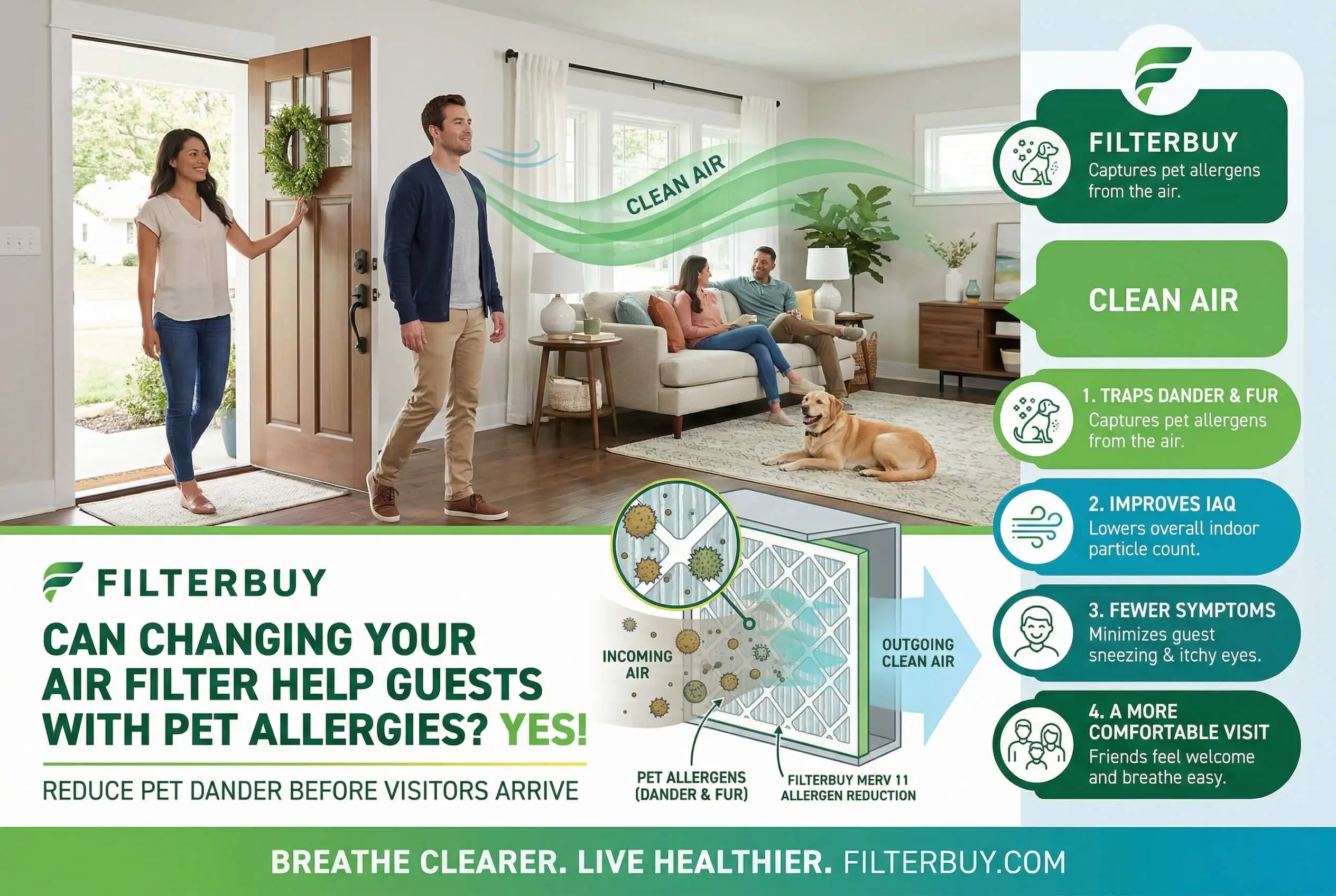
Your HVAC system is, in effect, the lungs of your home. Every time it cycles, it pulls air through your return vents, passes it through the filter, conditions it, and pushes it back through your living spaces. A clean, properly rated filter intercepts dander, pet hair, and the microscopic proteins that actually trigger allergic reactions before that air recirculates.
A saturated filter does the opposite. Once the filter media is loaded with captured particles, airflow resistance increases, filtration efficiency drops, and your system begins pushing contaminated air back into the rooms your guests will occupy. In our experience, this is the single most common reason pet-owning households struggle with guest allergies even when the home looks and smells clean.
Which MERV Rating Actually Makes a Difference for Pet Allergies
Not all filters capture dander with equal effectiveness. MERV rating — Minimum Efficiency Reporting Value — is the industry-standard measure of how small a particle a filter can trap. Here's how ratings break down for pet allergen control:
MERV 8: Captures larger particles like pet hair and lint but misses the smaller dander proteins that trigger most allergic reactions. A baseline option for homes without allergy-sensitive guests.
MERV 11: The practical sweet spot for most pet-owning households. Captures finer dander particles, pollen, and dust mite debris — meaningful protection without straining a standard residential HVAC system.
MERV 13: The highest-efficiency option for residential use. Captures particles down to 0.3 microns, including the smallest airborne allergen fragments. Recommended for homes with highly sensitive guests or multiple pets.
After manufacturing filters across all MERV ratings and working with millions of pet-owning households, we consistently find that upgrading from a MERV 8 to a MERV 11 or MERV 13 before a visit delivers the most noticeable home improvement in guest comfort.
When to Change Your Filter Before Guests Arrive
Timing matters as much as rating. Changing your filter the day guests arrive is better than not changing it at all — but it won't fully clear the dander already circulating in your home. Here's the pre-visit approach we recommend:
Replace your filter 24 to 48 hours before guests arrive. This gives your HVAC system enough run cycles to pull suspended dander out of the air and capture it in the fresh filter media.
Run your system on fan mode for several hours after installing the new filter to accelerate the air-scrubbing process throughout your home.
Don't wait until the filter looks dirty. Dander loads a filter faster than visible dust. A filter that looks relatively clean can already be operating well below its rated efficiency in a home with pets.
Do Air Filters Alone Fully Eliminate Pet Allergy Symptoms?
A clean, high-efficiency filter significantly reduces airborne dander — but it's one layer of a broader strategy. Guests with severe allergies may still react to dander embedded in upholstery, carpet, and bedding, which an air filter alone cannot address.
For best results, combine a fresh MERV 11 or MERV 13 filter with surface cleaning, washing pet bedding, and vacuuming with a HEPA-equipped vacuum before guests arrive. The filter handles what's airborne. Surface prep handles what's settled. Together, they give allergy-sensitive guests the best possible environment from the moment they walk through your door.
"One thing we see consistently across millions of pet-owning households is that allergy problems during visits aren't caused by pets alone — they're caused by a filter that stopped working weeks ago. Dander loads filter media fast, and a saturated filter doesn't hold what it's already captured. It releases it. Upgrading to a MERV 11 or MERV 13 and swapping it 24 to 48 hours before guests arrive is the single highest-impact change a pet owner can make. We've been manufacturing filters long enough to know that clean air isn't just about what you can see or smell — it's about what your system is actively removing on every cycle. That's what makes the difference between a guest who leaves comfortably and one who leaves early."
Essential Resources
After manufacturing filters for over a decade and serving more than two million households — many of them homes with pets and allergy-sensitive guests — we know that making an informed filter decision starts with the right information. These are the resources we point to when homeowners want to understand what's really happening in their air and why the right filter makes all the difference.
1. The Resource Every Homeowner Should Read Before Buying a Filter Most homeowners choose a filter based on price. In our experience, that's the single biggest mistake they make. The EPA's consumer guide to air cleaners and HVAC filters explains exactly how to evaluate filtration options by performance — including what MERV ratings mean, how often filters should be replaced, and what portable air cleaners can and cannot do alongside your HVAC system. Read this before you buy anything. https://www.epa.gov/indoor-air-quality-iaq/guide-air-cleaners-home
2. Why Upgrading Your Filter MERV Rating Changes Everything A low-efficiency filter isn't just less effective — it's actively letting the particles that matter most pass right through. This EPA fact sheet breaks down how stepping up from a basic fiberglass filter to a medium or high-efficiency MERV-rated option can meaningfully reduce the airborne particles circulating through your home on every HVAC cycle. The difference isn't marginal. It's significant. https://www.epa.gov/sites/default/files/2018-11/documents/indoor_air_filtration_factsheet-508.pdf
3. HEPA vs. MERV: What the Labels Actually Mean for Your Home We hear this question constantly from pet-owning households: "Should I just get a HEPA filter?" The answer depends on your system. The EPA's HEPA explainer clarifies what separates a true HEPA filter from a MERV 13 — and why a high-quality MERV 13 is often the smarter, system-friendlier choice for residential use. https://www.epa.gov/indoor-air-quality-iaq/what-hepa-filter
4. The EPA's Own Standard for What a Healthy Home Filter Should Do This is the resource that puts everything in context. The EPA's Indoor airPLUS technical bulletin on filtration lays out the minimum filter standards recommended for residential homes — including specific data on why MERV 11 and MERV 13 filters outperform lower-rated options when it comes to capturing fine particles and allergens like pet dander at the microscopic level. https://www.epa.gov/sites/default/files/2020-06/documents/2019.11_tech_bulletin_filtration.pdf
5. How Pet Dander Actually Moves Through Your Home — and How to Stop It Don't take your indoor air for granted. The Asthma and Allergy Foundation of America makes the invisible visible here — explaining exactly how pet dander, dust mites, and other airborne allergens travel from room to room and what practical steps, including regular filter changes, actually reduce exposure for allergy-sensitive guests. https://aafa.org/allergies/prevent-allergies/control-indoor-allergens/
6. What Board-Certified Allergists Say About Filter Selection When your guests have real allergies, generic advice isn't enough. The American College of Allergy, Asthma & Immunology breaks down why high-efficiency HVAC filters outperform low-cost fiberglass options for allergen control — and what to look for when selecting a filter specifically for a home with pets or allergy-prone visitors. https://acaai.org/allergies/management-treatment/living-with-allergies/air-filters/
7. The Engineering Standard Behind Every MERV Number on Every Filter Every MERV rating on every filter we manufacture traces back to one standard: ASHRAE 52.2. ASHRAE's filtration FAQ explains the testing methodology that determines how efficiently a filter captures particles at specific size ranges — giving you the technical foundation to understand exactly why a MERV 11 captures what a MERV 8 misses, and why that gap matters in a home with pets. https://www.ashrae.org/technical-resources/filtration-and-disinfection-faq
Supporting Statistics
After manufacturing filters for over a decade and working with millions of pet-owning households, we've found that the data on pet allergies, indoor air quality, and AC replacement cost maps directly onto what we see inside American homes every day. These statistics put real numbers behind the invisible problem a fresh, properly rated filter is designed to solve.
Approximately 6 out of 10 U.S. Households Have a Pet — But Up to 30% of Americans Are Allergic to Dogs and Cats
About 6 out of 10 U.S. households have a pet. Yet allergies to cats and dogs affect between 10 and 20 percent of the world's population. AAFA.org What that overlap tells us — and what we've observed across millions of customer households:
The allergy problem in a pet-owning home rarely belongs to the homeowner
Homeowners acclimate over months of daily dander exposure
Guests get the full concentration of airborne allergens that have built up since the last filter change
A fresh MERV 11 or MERV 13 filter, installed 24 to 48 hours before a visit, is specifically designed to close that exposure gap
Source: Asthma and Allergy Foundation of America — https://aafa.org/allergies/types-of-allergies/pet-dog-cat-allergies/
Indoor Air Can Be 2 to 5 Times More Polluted Than the Air Outside Your Front Door
Americans spend approximately 90 percent of their time indoors, where concentrations of some pollutants are often 2 to 5 times higher than typical outdoor concentrations US EPA — and the EPA explicitly names pet dander among those pollutants. What this means in practice:
Guests aren't stepping into air that's slightly more allergen-rich than the outdoors
They're entering an environment where airborne irritants can be concentrated at multiples of what they just left behind
A saturated filter doesn't reduce that concentration — it actively contributes to it by recirculating particles it can no longer capture
Changing the filter resets that equation on every HVAC cycle before guests arrive
Source: U.S. Environmental Protection Agency — https://www.epa.gov/report-environment/indoor-air-quality
A MERV 13 Filter Captures at Least 50% More of the Smallest Airborne Particles Than Lower-Rated Options
Filters with a MERV of 11 remove roughly 20% of particles between 0.3 and 1 micron. A MERV 13 filter typically demonstrates at least 50% removal efficiency for the smallest particles tested. EPA After years of manufacturing filters across every MERV rating, here is what that performance gap means for pet-owning households:
The smallest particles are exactly where pet allergens live — microscopic dander proteins that slip through lower-rated filter media
The difference between a MERV 8 and a MERV 13 is not a minor efficiency improvement
At the particle sizes that actually trigger allergic reactions, it's the difference between capturing half and missing most
MERV 11 is the baseline we recommend for pet-owning homes — MERV 13 is the preferred choice when guests with sensitivities are expected
Source: U.S. Environmental Protection Agency, Indoor airPLUS Technical Bulletin — https://www.epa.gov/sites/default/files/2020-06/documents/2019.11_tech_bulletin_filtration.pdf
Between 10 and 20% of the Global Population Is Allergic to Cats and Dogs — Making Every Guest List a Risk Calculation
Allergies to cats and dogs affect 10 to 20% of the world's population. AAFA.org Run that percentage against a gathering of ten guests and the numbers become hard to ignore:
At least one person in a typical group likely arrives with some degree of pet allergy sensitivity
Most pet owners never know which guests fall into that range until symptoms appear mid-visit
By that point, the dander is already in their airways
The filter change that should have happened two days earlier cannot undo that exposure
Proactive filter replacement before guests arrive is the only intervention that works before the problem starts
Source: Asthma and Allergy Foundation of America — https://aafa.org/allergies/types-of-allergies/pet-dog-cat-allergies/
Final Thoughts
Changing your air filter before guests arrive is a small act with an outsized impact. After manufacturing filters for over a decade and working with millions of pet-owning households, we've come to see it as one of the most consistently overlooked steps in home hospitality.
Here is what the data and our experience both confirm:
The homes that struggle most with guest allergy reactions aren't neglected homes
They're homes running a filter that quietly stopped working weeks ago
Pet dander loads filter media faster than almost any other household particle
A filter that looks passable to the eye can already be recirculating the very allergens it was installed to remove
Our honest perspective goes one step further than standard advice.
Most guides say to change your filter regularly. We'd refine that. For pet-owning households expecting allergy-sensitive guests, regular isn't the right standard. Timely.
A filter changed the week before a visit performs meaningfully better than one changed the day after
The 24 to 48-hour window before guests arrive gives your HVAC system enough cycles to pull suspended dander out of the air and trap it in fresh filter media
That window isn't arbitrary — it's the difference between cleaner air and recycled allergens
Filter rating matters as much as timing.
This comes directly from working with households that report the best outcomes:
A MERV 8 changed the day before a visit will underperform a MERV 13 changed three days earlier
Both variables work together — neither alone is enough
MERV 11 is the baseline for pet-owning homes
MERV 13 is the preferred choice when allergy-sensitive guests are expected
Clean air isn't a condition your home arrives at automatically. It's something your HVAC system actively produces on every cycle — but only when the filter inside it is capable of doing its job. Pair the right MERV rating with the right replacement schedule. Treat both as non-negotiable before the company arrives.
Your guests deserve to leave comfortably. With the right filter and the right timing, that outcome is well within your control.
FAQ on Air Filter Replacement
Q: How often should I replace my air filter if I have pets?
A: Every 30 to 60 days — not the 90-day standard most filter packaging suggests. Here is why:
The 90-day guideline was never designed with pets in mind
Pet dander loads filter media at a rate that makes standard replacement schedules inadequate
One pet in the home: replace every 60 days
Multiple pets in the home: replace every 30 days
Allergy-sensitive guests expected: replace 24 to 48 hours before they arrive — regardless of your regular cycle
The schedule matters. The timing before a visit matters more.
Q: What MERV rating is best for reducing pet allergens?
A: MERV 11 as a baseline. MERV 13 as the preferred choice when allergy-sensitive guests are expected. Here is what each rating means in practice:
MERV 8: Designed to protect HVAC equipment — not rated to capture the microscopic dander proteins that trigger allergic reactions
MERV 11: The most noticeable real-world improvement for pet-owning households — captures fine dander particles without straining most residential systems
MERV 13: The strongest residential option — captures at least 50% of the smallest airborne particles where pet allergens actually live
In our experience manufacturing filters across every MERV rating, the upgrade from MERV 8 to MERV 11 delivers the biggest practical difference for everyday air quality. The step to MERV 13 matters most when guest sensitivity is a known factor.
Q: Can changing my air filter really make a noticeable difference for guests with pet allergies?
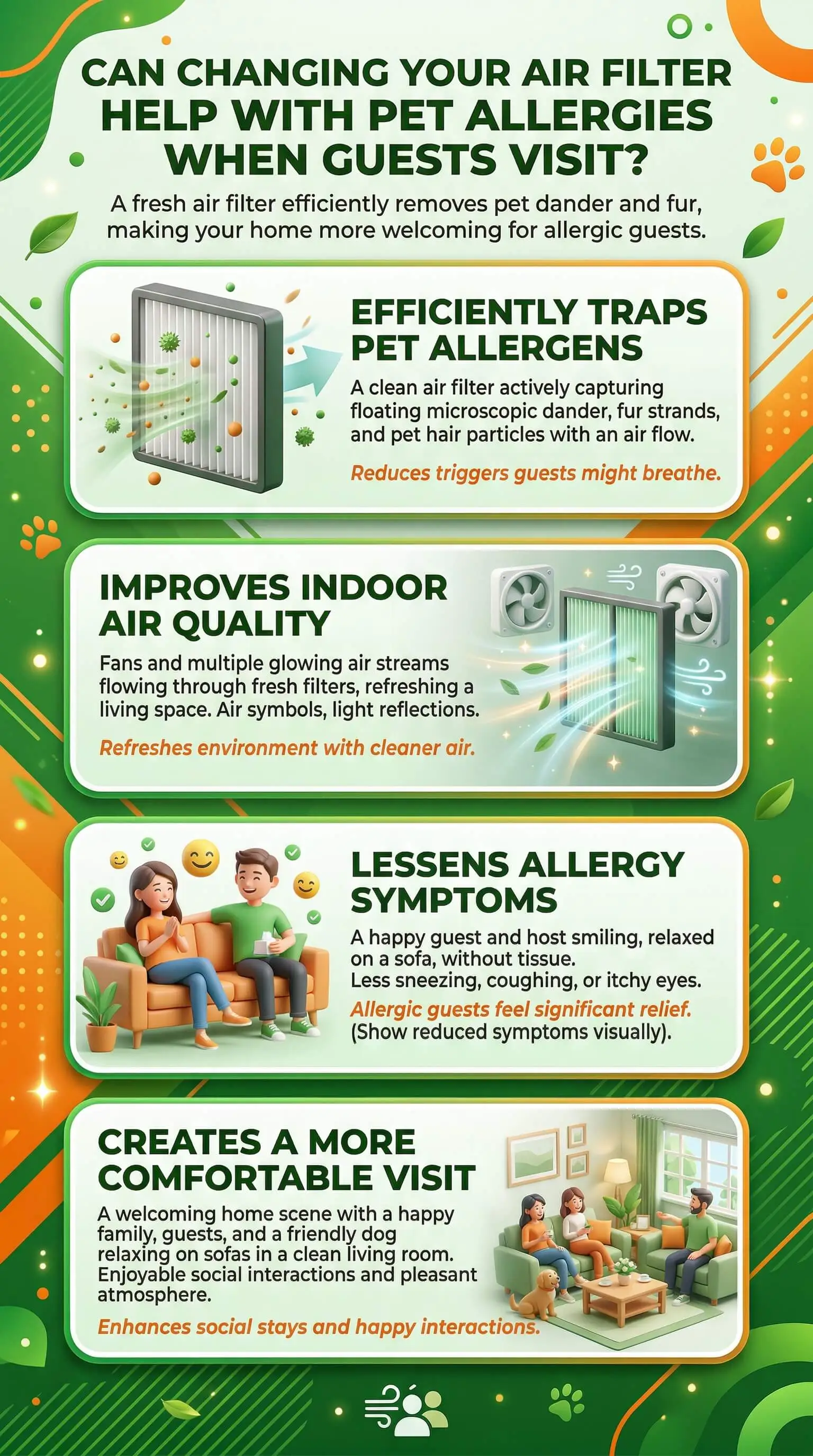
A: Yes — and the households that see the best results share two consistent habits:
They use a MERV 11 or MERV 13 filter
They replace it 24 to 48 hours before guests arrive
What that combination does:
Gives the HVAC system enough run cycles to pull suspended dander out of the air before guests arrive
Addresses the airborne exposure that triggers immediate reactions at the door
A filter change alone will not address dander settled into upholstery and carpet — that requires surface cleaning
Together, a fresh high-efficiency filter and surface prep give allergy-sensitive guests the best possible environment from the moment they walk in
Q: How do I know when my air filter needs to be replaced?
A: In a pet-owning home, visual inspection is the wrong tool for this job. What we've observed across millions of households:
A filter that looks passable to the eye can already be recirculating the particles it was installed to remove
Dander loads filter media at the microscopic level — invisibly and consistently
Visible saturation appears long after filtration efficiency has already dropped
The only reliable approach:
Use a calendar-based replacement schedule — not a visual check
One pet: set a reminder every 60 days
Multiple pets: set a reminder every 30 days
Allergy-sensitive guests arriving: replace immediately — regardless of the last change date
Q: Will a higher MERV filter damage my HVAC system?
A: A properly selected, regularly replaced high-efficiency filter will not damage a well-maintained residential system. Here is what to know by rating:
MERV 11: Compatible with the vast majority of standard residential systems — a straightforward upgrade from MERV 8
MERV 13: Slightly more restrictive — performs best in systems with adequate fan capacity — most modern residential systems handle it without issue
Where problems actually occur in pet-owning homes:
Not from the filter rating itself
From leaving a high-MERV filter in place too long
A loaded MERV 13 restricts airflow significantly more than a fresh one
In a home with pets, timely replacement is critical — for allergen control and for the long-term efficiency of the system the filter is designed to serve
Ready to Make Your Home More Comfortable for Every Guest?
If pet allergies are affecting your visitors, the fix starts with the right filter — changed at the right time. Shop Filterbuy's MERV 11 and MERV 13 air filters today and give every guest the clean, comfortable air they deserve from the moment they walk through your door.