Not every junk removal company operates the same way. Some maintain active relationships with recycling facilities, donation centers, and material processors. Others send everything to the same place regardless — and market it differently. We've seen both sides of this industry, and the gap between them is significant.
Here's what we've learned from the haul: which materials are most consistently diverted, how to spot recycling claims that don't hold up, and the questions worth asking any trusted local junk removal services company before you hand over your items. If recycling actually matters to you, this is where to start.
TL;DR Quick Answers
Local Junk Removal Services Company
A local junk removal services company picks up, hauls, and responsibly disposes of unwanted items from homes and businesses — but the best ones do significantly more than that.
What a quality local junk removal company does:
Removes furniture, appliances, electronics, yard waste, and construction debris
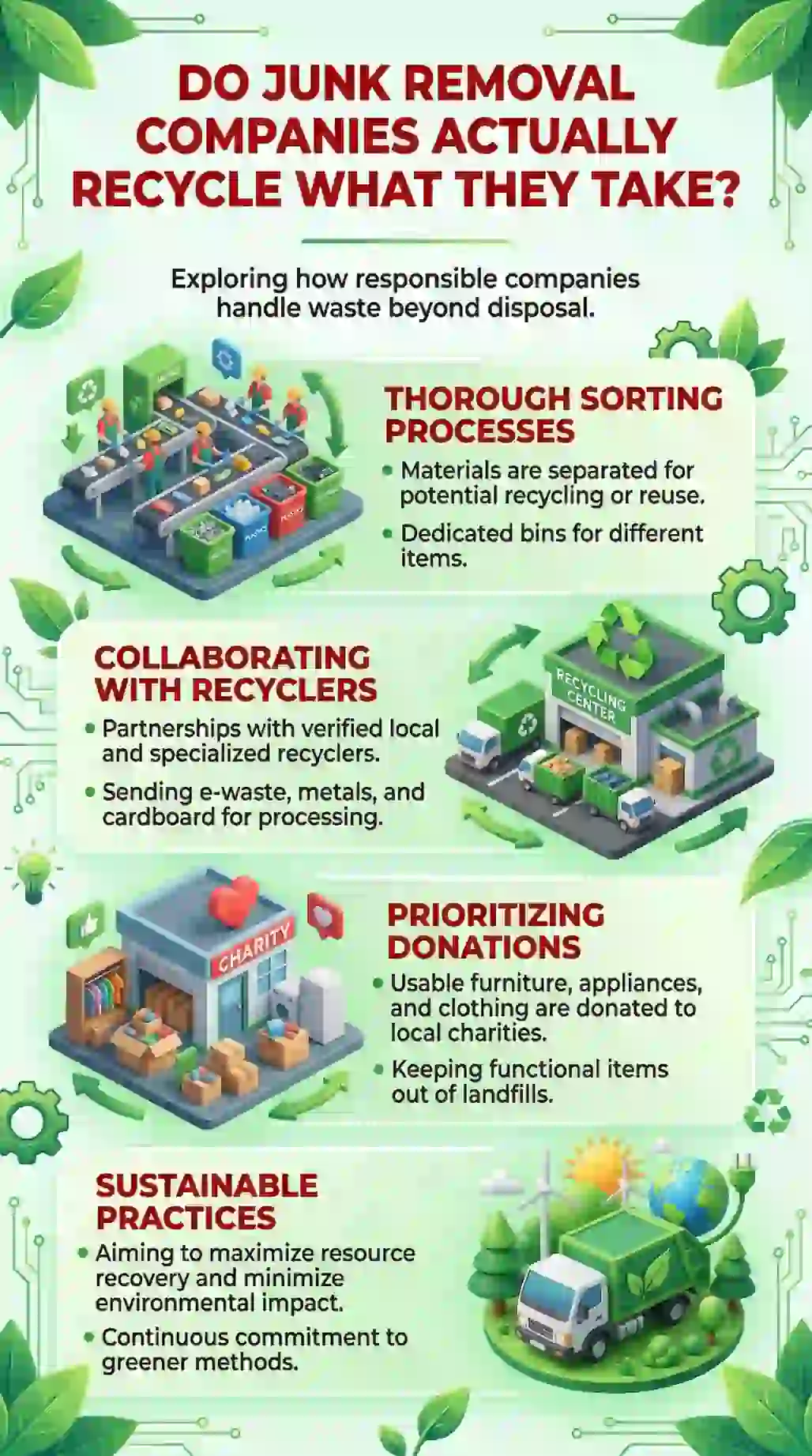
Sorts materials at pickup and routes items to recyclers, donation centers, or certified processors
Offers upfront, volume-based pricing with no hidden fees
Provides same-day or next-day scheduling in most service areas
Handles all labor, lifting, and hauling — no prep required
What separates the best from the rest:
Verified diversion rates — not just recycling claims
Active partnerships with certified e-waste and appliance processors
Crew-level sorting training so the right call gets made on the job
Transparent pricing before the truck arrives
At Jiffy Junk, we operate across 40 states with a simple standard: recycling and donation come first on every single job. We offer free video estimates, same-day availability in most markets, and a fully licensed, insured team trained to handle materials the right way — from pickup to final destination.
The bottom line: not all local junk removal companies operate the same way. Ask about diversion rates, facility partnerships, and how crews are trained to sort. The right company will answer every question directly.
Top Takeaways
Not every junk removal company recycles — regardless of what their website says. Diversion rate, facility partnerships, and crew-level sorting are what separate a real operation from a marketing claim.
The materials most likely to be mishandled are the ones that matter most. Electronics, refrigerant-containing appliances, and hazardous items all require certified handling. More than 60 percent of U.S. consumer electronics never reach a certified recycler.
Diversion rate is the only metric worth asking for. It measures actual material kept out of landfills. If a hauler can't give you a number, that's your answer.
The questions you ask before booking have real consequences. Asking about diversion rates, certified e-waste partners, and donation practices pushes the entire industry toward accountability.
Responsible diversion creates impact beyond the environment. Every 1,000 tons of recycled materials supports local jobs, wages, and tax revenues. Choosing a hauler that actually recycles is a decision that ripples outward.
How Junk Removal and Recycling Actually Work Together
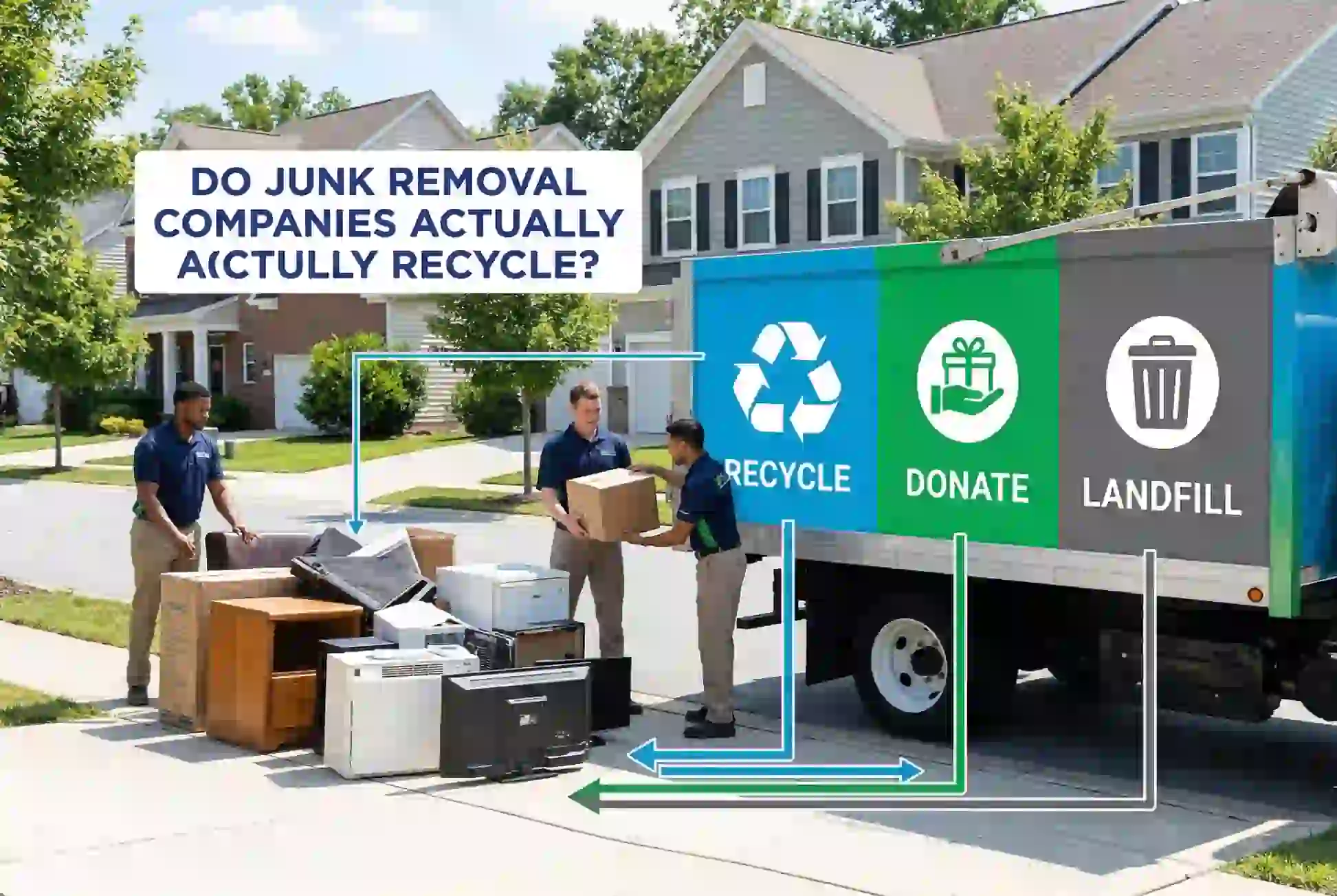
Junk removal and recycling aren't automatically the same thing. When a hauler loads your items onto a truck, those items typically go to one of three places: a recycling facility, a donation center or resale outlet, or a landfill. Which destination they reach depends almost entirely on the company's internal processes — not the language on their website.
At Jiffy Junk, every load gets sorted with diversion in mind. That means assessing items at pickup, separating materials that have a clear recycling or donation pathway, and routing them accordingly. It takes more coordination than a straight landfill run, but it's the standard we've built our operation around.
What Materials Junk Removal Companies Can Actually Recycle
Some materials have well-established recycling streams. Others are more complicated. Based on what we haul regularly, here's how common items typically break down:
Metals — Scrap metal, including steel appliances, aluminum, and copper, is among the most reliably recycled material in the industry. Metal recyclers actively purchase it, which creates a genuine economic incentive to divert it.
Electronics — E-waste requires certified processors due to hazardous components. Responsible haulers partner with certified e-waste recyclers rather than disposing of electronics with general waste.
Cardboard and Paper — Straightforward to recycle when kept dry and separated. Most established haulers have a clear pathway for these materials.
Furniture — Recyclability depends heavily on condition. Usable furniture is typically donated to nonprofits or resale organizations. Damaged pieces are broken down by material type when possible.
Appliances — Major appliances often contain refrigerants that require certified handling before recycling. A reputable company accounts for this — an irresponsible one doesn't.
Mattresses — Mattress recycling exists but requires access to a processing facility. Not every market has one, which is why this category varies by region.
What "Eco-Friendly" Claims Don't Always Mean
Greenwashing is common in the junk removal industry. Phrases like "we recycle everything we can" or "environmentally responsible disposal" are largely unregulated and easy to publish. What they don't tell you is the actual diversion rate — the percentage of collected material genuinely kept out of landfills.
A company serious about recycling can speak to their process in specific terms: which facilities they work with, what materials they actively sort, and how they handle items that fall outside standard recycling streams. Vague environmental language with no operational detail behind it is a reliable signal that the claim isn't built on much.
The Questions Worth Asking Before You Book
If recycling matters to your decision, these questions will tell you what you need to know:
What is your estimated landfill diversion rate?
Which materials do you actively sort and recycle?
Do you partner with certified e-waste processors?
Where do donated items go, and which organizations do you work with?
How do you handle appliances that contain refrigerants?
A company with real recycling infrastructure will answer these directly. One that doesn't have that infrastructure will answer them vaguely — or pivot back to marketing language.
Why Diversion Rate Is the Number That Matters
Diversion rate is the most honest metric in this industry. It reflects the actual percentage of collected material redirected away from landfill — through recycling, donation, or material recovery. At Jiffy Junk, diversion is something we track and work to improve with every operational decision we make, from our facility partnerships to how crews are trained to sort at the point of pickup.
When you're evaluating any junk removal company on their environmental practices, diversion rate is the number to ask for. If they don't have one, that's your answer.
"After thousands of pickups, the most consistent thing we see isn't what people throw away — it's the assumption that disposal and recycling are the same thing. They're not, and that gap costs materials their second life every single day. The companies doing this right aren't just hauling responsibly; they've built actual relationships with recyclers, donation partners, and processors, and they train their crews to sort before the truck ever leaves the driveway. That's not a marketing position. That's an operational commitment, and you can tell the difference the moment you ask a specific question and see whether you get a specific answer."
Essential Resources
Do Your Homework Before You Book — These Resources Make It Easy
At Jiffy Junk, we believe an informed customer is the best kind. Before you hand your items off to any hauler, these are the resources we'd point you to — the same ones that shape how we operate and hold ourselves accountable every single day.
Know What Recycling Actually Involves Before Evaluating Any Company
The EPA's Recycling Basics and Benefits page is the perfect starting point. It breaks down how the recycling loop actually works, which materials are most commonly diverted, and the real-world environmental and economic impact of keeping waste out of landfills — which is exactly what drives us to sort every load we pick up. https://www.epa.gov/recycle/recycling-basics-and-benefits
Make Sure Your Electronics Are Going to a Certified Recycler — Not a Landfill
E-waste is one of the most mishandled categories in our industry, and we take that seriously. The EPA's Certified Electronics Recyclers page outlines the R2 and e-Stewards certification standards that define what responsible e-waste handling actually looks like. It's the benchmark we hold our own electronics recycling partners to. https://www.epa.gov/electronics-batteries-management/certified-electronics-recyclers
Understand the Federal Rules That Apply to Hazardous Materials in Your Home
Appliances with refrigerants, household batteries, and certain electronics all fall under federal RCRA hazardous waste regulations. The EPA's Hazardous Waste Recycling resource explains what the law requires — and what legitimate, responsible haulers are doing to stay on the right side of it on every job. https://www.epa.gov/hw/hazardous-waste-recycling
Know How to Spot Greenwashing Before You Sign Anything
"Eco-friendly" is easy to say and hard to prove. The FTC's Green Guides are the federal standard for what companies can and cannot legally claim about their environmental practices. If a junk removal company's green claims sound vague or unverifiable, this is the resource that explains exactly why that should matter to you. https://www.ftc.gov/news-events/topics/truth-advertising/green-guides
See the Real Value in What Your Electronics Can Become
The EPA's Electronics Donation and Recycling guide details what's actually recoverable inside your old devices — metals, plastics, glass — and connects you with certified drop-off programs near you. It reinforces something we remind our customers of all the time: your old electronics have real value, and they deserve more than a landfill. https://www.epa.gov/recycle/electronics-donation-and-recycling
Verify What Recycling Infrastructure Actually Exists in Your Market
Earth911's Recycling Center Search covers more than 100,000 locations across North America and 350-plus material types. We encourage customers to use it to independently verify what recycling options exist in their area — and to see for themselves what a company's claimed recycling partners are actually capable of handling locally. https://earth911.com/recycling-center-search-guides/
New to Responsible Waste Disposal? Start Right Here
The EPA's Reduce, Reuse, Recycle hub is the most comprehensive consumer-facing resource on waste reduction available anywhere. It covers material-specific guidance, program directories, and sustainability basics — everything you need to walk into any junk removal conversation knowing exactly what questions to ask and what answers to expect. https://www.epa.gov/recycle
These essential resources help you evaluate junk removal cost more effectively by showing what responsible recycling, compliance, and verified disposal practices actually include—so you can choose a service that delivers real value beyond the price.
Supporting Statistics
We've pulled a lot of trucks up to a lot of curbs, and one thing we know for certain: the data on waste and recycling in America tells a story that most haulers don't want to talk about. Here's what the numbers actually say — and what they mean for how we operate.
Half of Everything Americans Throw Away Still Goes to a Landfill
After thousands of pickups across the country, we've seen firsthand how easy it is for a junk removal company to take the path of least resistance — load the truck, drive to the landfill, repeat. The EPA's own data shows that's exactly what most of the industry does. In 2018, more than 146 million tons of municipal solid waste — a full 50 percent of everything generated — ended up landfilled, even as nearly 94 million tons were diverted through recycling and composting. We built our operation specifically to fight that stat. Every time our crews sort a load at pickup and route materials to the right place, that number moves — even if by a fraction.
Source: U.S. Environmental Protection Agency — National Overview: Facts and Figures on Materials, Waste and Recycling https://www.epa.gov/facts-and-figures-about-materials-waste-and-recycling/national-overview-facts-and-figures-materials
Your Old Electronics Are Being Mishandled More Often Than Not
This one hits close to home for us, because we see it play out on the job constantly. Customers assume their old TVs, laptops, and devices will be properly recycled during a home improvement project. The EPA's data tells a different story: of the 2.7 million tons of consumer electronics generated in 2018, only 1.04 million tons — just 38.5 percent — were actually collected for recycling. That means more than six out of every ten tons of e-waste ends up somewhere other than a certified processor. It's why we don't hand electronics off to just anyone. We maintain active relationships with certified e-waste recyclers, because we've seen what happens when that accountability isn't there.
Source: U.S. Environmental Protection Agency — Frequent Questions: Facts and Figures about Materials, Waste and Recycling https://www.epa.gov/facts-and-figures-about-materials-waste-and-recycling/frequent-questions-regarding-epas-facts-and
What We Divert Today Has a Real Climate Impact Tomorrow
When customers ask us whether responsible junk removal actually makes a difference, we point to this: EPA data shows that recycling and composting of municipal solid waste saved over 193 million metric tons of carbon dioxide equivalent in a single year. That's the equivalent of pulling tens of millions of vehicles off the road entirely. We've seen what a single estate cleanout or commercial haul looks like when every recoverable item is sorted and routed properly versus when it isn't. The difference in material volume heading to landfill is significant — and at scale, across thousands of jobs, it adds up to exactly the kind of impact that statistic is measuring.
Source: U.S. Environmental Protection Agency — Recycling Basics and Benefits https://www.epa.gov/recycle/recycling-basics-and-benefits
Doing This Right Supports More Than the Environment — It Supports Local Economies
One thing we've learned operating across markets nationwide is that responsible diversion doesn't just help the planet — it drives real economic activity at the local level. According to EPA's 2020 Recycling Economic Information Report, every 1,000 tons of materials recycled generates approximately $65,230 in wages and $9,420 in tax revenues, supporting 1.17 jobs. When we route a load of scrap metal to a recycler instead of a landfill, or get furniture into the hands of a donation partner, that material enters a productive economic cycle rather than a dead end. The communities we serve benefit from that — and we've seen it with our own eyes in the markets where we operate.
Source: U.S. Environmental Protection Agency — Recycling Economic Information (REI) Report https://www.epa.gov/smm/recycling-economic-information-rei-report
Supporting Statistics
We've pulled a lot of trucks up to a lot of curbs. The data on waste and recycling in America tells a story most haulers don't want to talk about. Here's what the numbers say — and what they mean for how we operate.
Half of Everything Americans Throw Away Still Goes to a Landfill
We've seen firsthand how easy it is for a junk removal company to take the path of least resistance. The EPA's data confirms that's exactly what most of the industry does.
292.4 million tons of municipal solid waste were generated in the U.S. in 2018
Nearly 94 million tons were diverted through recycling and composting
More than 146 million tons — a full 50 percent — were landfilled
We built our operation specifically to fight that stat. Every time our crews sort a load at pickup and route materials to the right place, that number moves.
Source: U.S. Environmental Protection Agency — National Overview: Facts and Figures on Materials, Waste and Recycling https://www.epa.gov/facts-and-figures-about-materials-waste-and-recycling/national-overview-facts-and-figures-materials
Your Old Electronics Are Being Mishandled More Often Than Not
Customers assume their old TVs, laptops, and devices will be properly recycled. The EPA's data tells a different story.
2.7 million tons of consumer electronics were generated in 2018
Only 1.04 million tons — 38.5 percent — were collected for certified recycling
More than 6 out of every 10 tons of e-waste ended up somewhere other than a certified processor
It's why we maintain active relationships with certified e-waste recyclers. We've seen what happens when that accountability isn't there.
Source: U.S. Environmental Protection Agency — Frequent Questions: Facts and Figures about Materials, Waste and Recycling https://www.epa.gov/facts-and-figures-about-materials-waste-and-recycling/frequent-questions-regarding-epas-facts-and
What We Divert Today Has a Real Climate Impact Tomorrow
When customers ask whether responsible junk removal actually makes a difference, we point to this:
Recycling and composting saved over 193 million metric tons of CO2 equivalent in a single year
That's the equivalent of pulling tens of millions of vehicles off the road entirely
A single estate cleanout routed properly versus improperly produces a significant difference in landfill volume — and at scale, across thousands of jobs, it adds up to exactly what that statistic is measuring
Source: U.S. Environmental Protection Agency — Recycling Basics and Benefits https://www.epa.gov/recycle/recycling-basics-and-benefits
Doing This Right Supports More Than the Environment — It Supports Local Economies
Operating across markets nationwide, we've learned that responsible diversion doesn't just help the planet. It drives real economic activity at the local level.
Every 1,000 tons of materials recycled generates approximately $65,230 in wages
That same 1,000 tons produces $9,420 in tax revenues and supports 1.17 jobs
When we route scrap metal to a recycler or furniture to a donation partner, that material enters a productive economic cycle — not a dead end
The communities we serve benefit from that. We've seen it with our own eyes in every market where we operate.
Source: U.S. Environmental Protection Agency — Recycling Economic Information (REI) Report https://www.epa.gov/smm/recycling-economic-information-rei-report
Final Thoughts
Most junk removal companies will tell you they recycle. Fewer can answer what actually happens after the truck leaves.
That gap between what gets said and what actually happens is the most important thing to understand before you book.
What Separates a Real Recycling Operation From a Marketing Claim
We've seen both sides of this industry. Here's what the difference actually looks like on the ground:
Companies doing it right can name their recycling partners and diversion rates
Companies doing it wrong route everything to the same place and describe it differently
The language sounds identical. The operations don't.
The Questions That Cut Through the Noise
After thousands of jobs, we've found that specificity is the signal. Before you hire any hauler, ask:
What is your landfill diversion rate?
Which materials do you actively sort at pickup?
Who are your certified e-waste recycling partners?
Where do donated items go, and which organizations do you work with?
A company with real infrastructure answers these directly. One without it pivots back to marketing language.
What We've Learned — And What We'd Tell Every Customer
Customers have more power here than they realize. The questions you ask before you book are the same questions that push this entire industry toward accountability. When customers stop accepting vague answers, companies stop giving them.
At Jiffy Junk, recycling and donation are the first decision we make on every job — not an afterthought, not a checkbox. That's the standard we hold ourselves to. It's the same one we'd encourage you to hold every hauler to before they show up at your door.
FAQ on Local Junk Removal Services Company
Q: How do I know if a local junk removal company actually recycles what they haul away?
A: Ask one question: what is your diversion rate? After thousands of pickups, that's the fastest way to separate real recycling operations from marketing language.
What a legitimate answer looks like:
A specific diversion rate percentage
Named recycling facility and donation partners
A clear explanation of how crews sort at pickup
What a vague answer looks like:
"We recycle everything we can"
No facility names, no data, no process details
At Jiffy Junk, we sort at the point of pickup and can tell you exactly where your materials go. That transparency is what we've built our operation around.
Q: What items can a local junk removal company typically recycle or donate?
A: From our experience on the job, here's how common items break down:
Metals — Most consistently diverted. Strong recycling markets exist for scrap metal nationwide.
Cardboard — Straightforward to recycle when kept dry and separated.
Furniture — Usable pieces go to donation partners. Damaged pieces are broken down by material.
Electronics — Require certified e-waste processors. Not every hauler has these partnerships. Always ask.
Appliances — Refrigerant-containing units need certified handling before recycling. Non-negotiable.
Mattresses — Vary by market. Depends entirely on local processing facility availability.
At Jiffy Junk, our crews make the diversion call at pickup — not at the landfill gate.
Q: How much does a local junk removal service typically cost?
A: Most companies price by volume — how much truck space your items take up. Across our markets, here's what we typically see:
Single-item pickup: $75 — $150
Partial truck load: $150 — $350
Full truck load: $400 — $600
What drives costs higher:
Specialty items requiring certified disposal (electronics, appliances)
Items needing dismantling before removal
Distance from suitable disposal or recycling facilities
At Jiffy Junk, our free video estimate gives you an accurate number before we show up. No surprises.
Q: How quickly can a local junk removal company schedule a pickup?
A: For standard residential hauls, same-day and next-day availability is realistic with most established companies.
What causes delays:
Jobs involving electronics or appliances that require certified facility coordination
Large commercial cleanouts needing additional crew or equipment
Haulers without the right facility partnerships to handle specialty materials
At Jiffy Junk, same-day service is available across most of our markets. Our video estimate system gets you booked fast — without cutting corners on how we handle what we take.
Q: What should I do to prepare for a junk removal pickup?
A: Not much — that's what full-service means. But from years on the job, these steps make a real difference:
Separate recyclables and donatables from general waste before we arrive
Flag specialty items — electronics, batteries, paint, and appliances with refrigerants
Clear pathways to and from the items being removed
Have a rough inventory ready so our team can route materials correctly from the start
At Jiffy Junk, we handle the lifting, hauling, and sorting. Pointing us in the right direction upfront helps us work faster — and keeps your cost down.
Ready to Work With a Junk Removal Company That Actually Recycles?
Book your free video estimate with Jiffy Junk today and see firsthand how a local junk removal company that puts recycling and donation first handles every haul — the right way, from pickup to final destination.