TL;DR Quick Answers
junk removal cost
Junk removal cost is usually based on truck space (volume) and labor time, not just item count.
To estimate cost quickly, focus on:
Load size (¼, ½, full truck)
Bulky items (furniture, appliances)
Access difficulty (stairs, basement, long carry)
Disposal needs (mixed debris vs. special materials)
In our experience at Jiffy Junk, the best way to keep pricing predictable is to stage everything in one area and round up your load estimate—because volume and labor time are what most often change the final quote.
Top Takeaways
Negotiate the job details, not just the price.
Pricing is driven by:
Truck space (volume)
Labor time
Access difficulty
Disposal needs
Ask for volume-based or itemized estimates.
Save money by making pickup faster (stage items, improve access, curbside if possible).
Real takeaway: preparation creates leverage and lowers cost.
Negotiating junk removal costs isn’t about pressuring a company into a cheaper rate—it’s about understanding what the quote is based on and adjusting what you can control. In our experience at Jiffy Junk, the best “negotiations” happen when customers reduce truck space (volume), shorten labor time, and improve accessibility. When the job becomes easier and faster, pricing naturally becomes more flexible, and it also helps you decide whether a full-service pickup or a dumpster rental makes more sense for your project.
Know What You’re Actually Negotiating
Before negotiating, it helps to know what drives junk removal pricing. Most quotes are built around:
Load size (volume): how much truck space your junk takes
Labor time: how long the crew will need to remove and load items
Access difficulty: stairs, basements, elevators, long carries
Disposal requirements: heavier materials and special handling
Minimum fees: base pricing for dispatching a truck and crew
When you negotiate the right variables, you get real savings—without compromising service.
The Best Junk Removal Cost Negotiation Tips
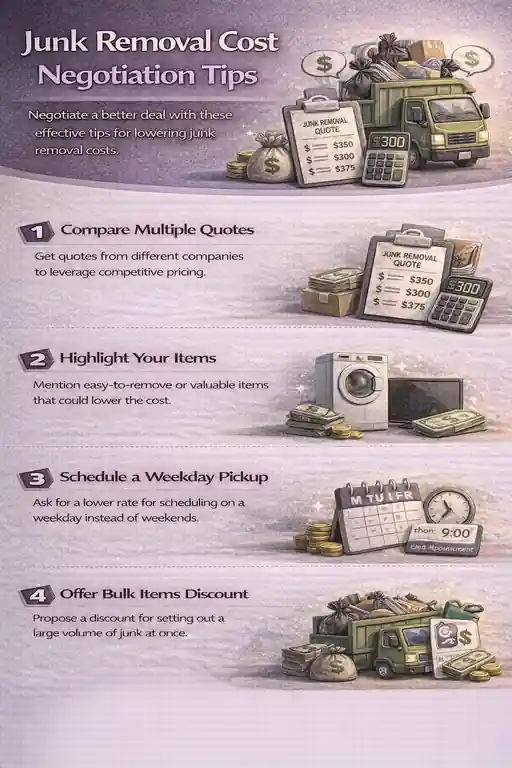
Ask for an itemized or volume-based estimate
One of the smartest negotiation moves is to ask how pricing is calculated:
“Is this quote based on load size or time?”
“What load size tier does this fall under (¼, ½, full truck)?”
“What would lower the cost?”
This helps you negotiate based on measurable factors instead of vague discounts.
Negotiate the job details, not just the price
The easiest way to lower cost is to make the pickup easier:
Move items to the garage, driveway, or curb (if safe)
Stage everything in one area
Clear hallways and stairs
Reserve close parking
In real-world hauling, fewer minutes on-site often means a lower quote.
Combine items into one pickup
If you have multiple areas to clean out, combining them into one visit can increase value. Instead of booking multiple smaller pickups, ask:
“What’s the best price if I add these extra items today?”
“Would it cost less per item if we fill more of the truck?”
A single, efficient load is often cheaper than multiple trips.
Ask about discounts the right way
Discounts are most likely when they align with operational efficiency. Ask questions like:
“Do you offer off-peak discounts?”
“Is there a lower rate for curbside pickup?”
“Is there a discount if I book today?”
“Do you have military, senior, or first-responder discounts?”
This keeps the conversation professional and increases your chances of a “yes.”
Get multiple quotes—but compare apples to apples
Comparing quotes is smart, but only if the job details match. Confirm:
The same load size estimate
The same access conditions
The same disposal included
Any additional fees (stairs, heavy items, minimum charges)
In our experience, the cheapest quote on paper often changes later if the estimate was incomplete.
What to Say When Negotiating Junk Removal Cost
Here are simple phrases that work because they’re based on real pricing drivers:
“If I move everything to the curb, can you lower the quote?”
“What load size tier is this priced under—and can we keep it under that tier?”
“If I remove a few bulky items, what would the new estimate be?”
“Is there a better rate for a weekday pickup?”
“If I book today, is there any flexibility in the price?”
These questions shift the negotiation toward measurable savings.
Red Flags to Avoid When Negotiating
Trying to negotiate too aggressively can backfire. Be cautious if:
A company refuses to explain pricing
The quote is unusually low without details
They won’t confirm what’s included
The price changes without clear reasons
A fair quote should be transparent and based on the real job conditions.
Final Tip: The Best Negotiation Is a More Efficient Pickup
The most effective negotiation strategy is simple: make the job easier. When your junk is staged, accessible, and accurately estimated, you’re more likely to receive:
Better pricing
Faster service
Fewer surprise charges
Negotiation works best when it’s grounded in how junk removal actually operates—not just asking for a discount, and it helps to compare options like valet trash service when deciding what level of removal you truly need.
“From what we see every day at Jiffy Junk, the best junk removal ‘negotiation’ isn’t asking for a random discount—it’s making the job easier to complete. When customers stage items in one area, improve access, and keep the load size accurate, labor time drops and pricing becomes far more flexible. Efficiency is what creates real savings.”
Essential Resources
1) National Pricing Benchmarks — HomeGuide Junk Removal Prices
A reliable reference for nationwide junk removal cost ranges by load size and service type. Use it to see if the quotes you receive are within typical market rates.
https://homeguide.com/costs/junk-removal-prices
2) Quick Cost Estimator — BusinessReverb Junk Removal Cost Calculator
A simple, no-cost tool that estimates junk removal pricing based on volume and item count. Helpful for early budgeting and understanding what you might expect to pay before requesting quotes.
https://www.businessreverb.com/junk-removal-cost-calculator/
3) Real Pricing Drivers Explained — Junk Commandos Pricing Guide
Breaks down the key factors that affect junk removal pricing, including truck space, labor, access difficulty, and disposal requirements—just like we consider when quoting jobs at Jiffy Junk.
https://junk-commandos.com/how-much-does-junk-removal-cost-a-complete-pricing-guide/
4) Official Waste Management Context — EPA Facts & Figures (MSW)
Government-sourced data on municipal solid waste generation and handling helps explain why most junk removal pricing is tied to volume and disposal realities—not arbitrary numbers.
https://www.epa.gov/facts-and-figures-about-materials-waste-and-recycling/national-overview-facts-and-figures-materials
5) Construction & Demolition Materials Insight — EPA C&D Debris Report
Provides authoritative context on the scale and management of construction waste, which often affects pricing for renovation cleanouts and larger junk removal jobs.
https://www.epa.gov/smm/sustainable-management-construction-and-demolition-materials
6) Practical Cost-Saving Tips — HomeAglow Junk Removal Cost Guide
A user-friendly guide that outlines cost factors and tactics to save money while still getting quality junk removal service. Good for consumers who want actionable tips alongside pricing estimates.
https://www.homeaglow.com/hub/content/junk-removal-cost
7) Waste Removal Cost Methodology — EPA Waste Estimation Guide (PDF)
A detailed EPA resource explaining how waste removal costs are calculated, including labor, hauling, and disposal components. Useful for understanding the backbone of pricing models beyond surface quotes.
https://www.epa.gov/sites/default/files/2016-03/documents/estimate.pdf
These resources help you understand junk removal pricing benchmarks, real cost drivers, and official waste data, so you can budget smarter for home improvement projects and avoid surprises when comparing quotes.
Supporting Statistics
1) Junk removal pricing is volume-based for a reason
In our experience at Jiffy Junk, the biggest pricing changes happen when the load size (truck space) is underestimated.
The U.S. generated 292.4 million tons of municipal solid waste (MSW) in 2018
That equals about 4.9 pounds per person per day
Source (EPA): https://www.epa.gov/facts-and-figures-about-materials-waste-and-recycling/national-overview-facts-and-figures-materials
2) Bulky items raise cost fast (they fill trucks quickly)
We see this constantly—furniture and appliances can push a job into a higher pricing tier fast.
37.4 million tons of durable goods (including furniture/appliances) were landfilled in 2018
Source (EPA): https://www.epa.gov/facts-and-figures-about-materials-waste-and-recycling/durable-goods-product-specific-data
3) Renovation debris is a different pricing category
C&D cleanouts usually require heavier lifting, more time, and different disposal planning.
The U.S. generated 600 million tons of construction & demolition debris in 2018
That’s more than twice MSW
Source (EPA): https://www.epa.gov/smm/sustainable-management-construction-and-demolition-materials
4) Disposal fees affect quotes (and vary by location)
Disposal is a real cost input in hauling, which is why pricing changes by region.
Average landfill tipping fees were $56.80 per ton in 2023 (342 facilities)
Source (EREF): https://erefdn.org/analyzing-municipal-solid-waste-landfill-tipping-fees/
Final Thought & Opinion
Negotiating junk removal costs isn’t about chasing the lowest price. It’s about getting a fair quote based on the real work.
Most junk removal quotes are driven by:
Truck space (volume)
Labor time
Access difficulty
Disposal needs
Our opinion from real pickups at Jiffy Junk: preparation is the best negotiation.
To create real pricing leverage:
Stage junk in one area
Improve access (clear paths, reserve parking)
Give an accurate load estimate
When the job is faster and easier, pricing is usually more flexible.
FAQ on Junk Removal Cost
Q: Can junk removal cost be negotiated?
A: Yes. In our experience at Jiffy Junk, negotiation works best by adjusting:
Volume (truck space)
Labor time
Access difficulty
Q: What should I ask when negotiating a quote?
A: Ask questions tied to pricing levers:
“Is pricing based on load size or time?”
“What tier is this (¼, ½, full load)?”
“What would lower the quote?”
Q: What lowers junk removal cost the fastest?
A: Make pickup faster:
Stage items in one area
Clear paths/stairs
Use curbside pickup (if safe)
Q: Why do junk removal quotes vary between companies?
A: Companies price differently for:
Volume measurement
Labor time
Access difficulty
Disposal fees
Q: How do I avoid surprise charges after booking?
A: Be accurate upfront:
List bulky items
Include access details
Round up load size if unsure