Commercial construction cleanup involves far more than hauling debris, and dumpster rental is one of the most important decisions that affects jobsite efficiency, safety, and cost control. Drawing from Jiffy Junk’s hands-on experience supporting commercial construction projects of varying scopes, we’ve seen that successful cleanup hinges on selecting the right dumpster size, understanding weight limits, planning placement, and aligning rental timelines with construction phases—not simply securing a container as fast as possible.
This guide breaks down how to rent a dumpster for commercial construction cleanup with a clear focus on dumpster rental strategy. You’ll learn how to manage heavy construction debris, prevent costly overage fees, keep worksites compliant, and coordinate deliveries and swaps without disrupting active crews. By the end, you’ll have the knowledge to plan dumpster rental proactively, minimize downtime, and keep cleanup costs predictable throughout your project.
Quick Answers
Dumpster Rental
Dumpster rental is a scheduled waste solution used on construction, renovation, and cleanup projects to manage debris safely and efficiently. From hands-on experience, the key to a successful rental is matching the dumpster to the job, not the other way around.
Choose a dumpster based on debris type and weight
Construction materials reach weight limits faster than expected
Proper placement improves workflow and site safety
- Planned swaps prevent jobsite delays and overage fees
When dumpster rental is planned around the project schedule and materials, cleanup stays predictable, compliant, and cost-controlled.
Top Takeaways
- Commercial projects are weight-driven.Concrete, drywall, roofing, and scrap add weight fast.
- Right sizing prevents shutdowns.Undersized dumpsters lead to overflow and downtime.
- Placement impacts productivity.Poor placement disrupts workflow and equipment access.
- Scheduling controls costs.Timely swaps prevent jobsite bottlenecks.
- Experience matters.Providers familiar with commercial construction reduce risk and delays.
Commercial Construction Cleanup Requires a Different Dumpster Approach
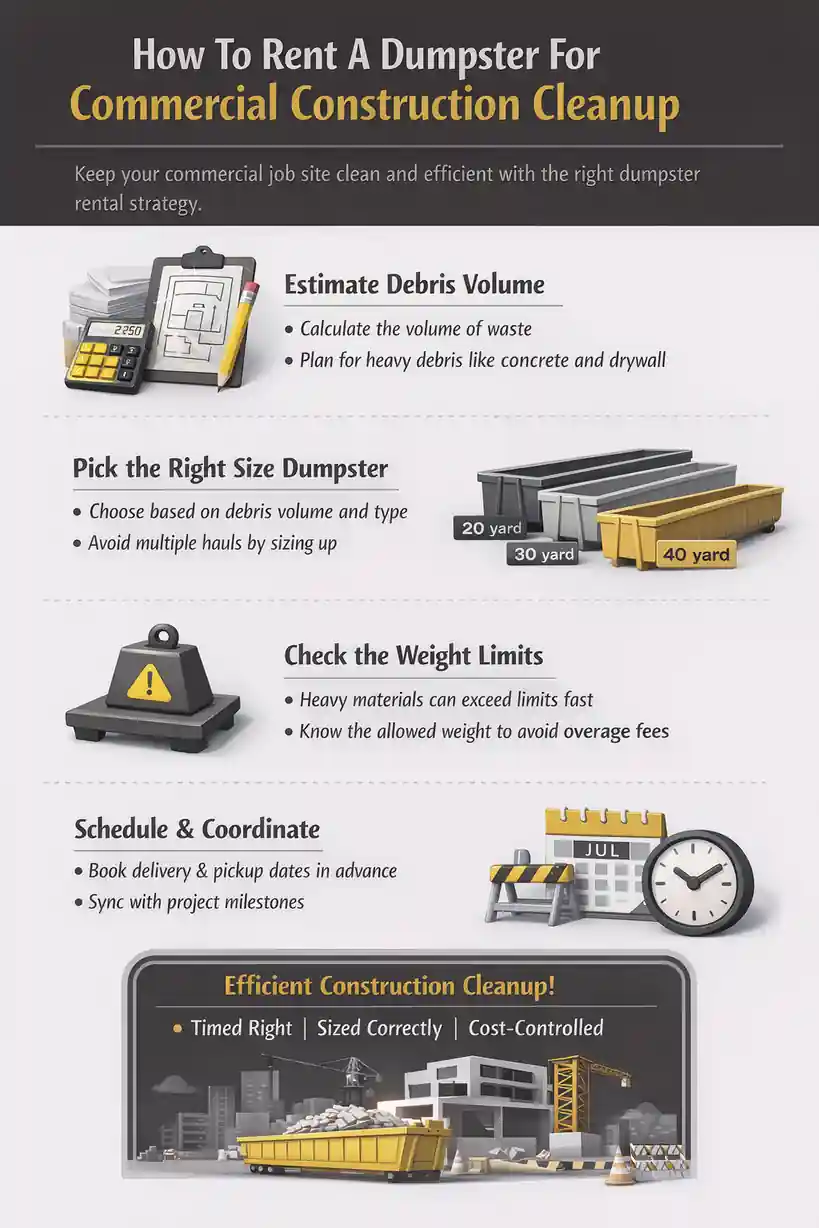
Commercial construction cleanup is fundamentally different from residential cleanouts. Instead of bulky household items, projects generate dense, heavy debris that reaches weight limits quickly. Concrete, lumber, drywall, metal, and roofing materials place far greater strain on dumpsters and hauling equipment.
Understanding these differences is essential for choosing the correct dumpster and preventing costly operational issues.
Weight Limits Matter More Than Volume
Unlike estate cleanouts, commercial construction cleanup is weight-driven.
Concrete and masonry exceed limits quickly
Roofing materials are extremely dense
Scrap metal concentrates weight
Failing to plan for weight is one of the fastest ways to incur overage fees.
Dumpster Placement and Jobsite Safety
Where the dumpster is placed directly affects productivity and compliance.
Keep dumpsters close to debris generation zones
Avoid blocking equipment paths and exits
Maintain clear access for pickups and swaps
Proper placement reduces handling time and safety risks.
Scheduling Dumpster Delivery and Swaps
Commercial sites move fast, and dumpsters must keep up.
Coordinate delivery with demolition phases
Schedule swaps before dumpsters reach capacity
Avoid idle rental days during slow periods
Smart scheduling prevents jobsite shutdowns and keeps costs predictable.
Restricted Materials on Commercial Jobsites
Commercial construction often includes materials with disposal restrictions.
Examples include:
Asbestos-containing materials
Certain treated woods
Hazardous chemicals or adhesives
Large quantities of metal
Confirming accepted materials upfront prevents rejected loads and compliance issues.
Estimating Dumpster Needs for Commercial Projects
To estimate accurately, consider:
Project scope and square footage
Type of construction or demolition
Materials being removed
Project timeline and phases
Clear estimates allow for smoother cleanup and fewer interruptions, supporting overall home improvement projects from start to finish.
“Commercial construction cleanup runs smoothly when dumpster rental is treated as part of the build plan—not an afterthought. When size, weight, placement, and timing are planned correctly, cleanup stops being a bottleneck and starts supporting productivity.”
Essential Resources
The following resources help contractors and project managers plan dumpster rental effectively for commercial construction cleanup.
Roll-Off Dumpster Size Guide – Budget Dumpster
Understand dumpster sizes, weight limits, and which containers work best for commercial debris.
https://www.budgetdumpster.com/resources/dumpster-sizes/
https://www.budgetdumpster.com/resources/dumpster-sizes/
Construction & Demolition Debris Guidance – EPA
Learn federal guidelines for disposing of construction and demolition materials responsibly.
https://www.epa.gov/smm/sustainable-management-construction-and-demolition-materials
https://www.epa.gov/smm/sustainable-management-construction-and-demolition-materials
OSHA Jobsite Housekeeping Standards
Understand cleanup requirements that affect jobsite safety and compliance.
https://www.osha.gov/laws-regs/regulations/standardnumber/1926/1926.25
https://www.osha.gov/laws-regs/regulations/standardnumber/1926/1926.25
Hazardous Waste Identification – EPA
Identify materials that require special handling before loading a dumpster.
https://www.epa.gov/hw/identify-hazardous-waste
https://www.epa.gov/hw/identify-hazardous-waste
Recycling Construction Materials – EPA
Learn which construction materials can be recycled instead of landfilled.
https://www.epa.gov/smm/sustainable-management-construction-and-demolition-materials
https://www.epa.gov/smm/sustainable-management-construction-and-demolition-materials
Landfill Tipping Fee Data – EREF
Understand how disposal costs vary by region and affect dumpster pricing.
https://erefdn.org/analyzing-municipal-solid-waste-landfill-tipping-fees/
https://erefdn.org/analyzing-municipal-solid-waste-landfill-tipping-fees/
Commercial Dumpster Rental Planning Guide – NAHB
Industry guidance on managing construction waste efficiently.
https://www.nahb.org/advocacy/industry-issues/environmental-regulations
Together, these resources help contractors plan commercial dumpster rentals more efficiently by addressing sizing, safety, disposal rules, and cost control, while also highlighting how coordination with related construction elements such as top insulation supports cleaner, safer, and more organized job sites.
https://www.nahb.org/advocacy/industry-issues/environmental-regulations
Supporting Statistics
Our experience managing dumpster rentals for commercial construction aligns closely with national data.
Construction and demolition debris exceeds 600 million tons annually
This volume makes dumpster rental essential for commercial projects.
Source: https://www.epa.gov/facts-and-figures-about-materials-waste-and-recycling/construction-and-demolition-debris-material
Demolition accounts for over 90% of C&D debris
Heavy materials dominate cleanup requirements.
Source: https://www.epa.gov/smm/sustainable-management-construction-and-demolition-materials
Landfill tipping fees vary widely by region
Disposal costs directly affect dumpster rental pricing.
Source: https://erefdn.org/analyzing-municipal-solid-waste-landfill-tipping-fees/
OSHA identifies poor housekeeping as a major jobsite hazard
Clean sites reduce accidents and delays.
Source: https://www.osha.gov/safety-management/hazard-identification
Bottom line:
Commercial construction cleanup demands dumpsters that are planned for weight, access, and timing, not just availability, and coordinated with services such as top duct cleaning to keep sites safe and efficient.
Construction and demolition debris exceeds 600 million tons annually
This volume makes dumpster rental essential for commercial projects.
Source: https://www.epa.gov/facts-and-figures-about-materials-waste-and-recycling/construction-and-demolition-debris-material
Demolition accounts for over 90% of C&D debris
Heavy materials dominate cleanup requirements.
Source: https://www.epa.gov/smm/sustainable-management-construction-and-demolition-materials
Landfill tipping fees vary widely by region
Disposal costs directly affect dumpster rental pricing.
Source: https://erefdn.org/analyzing-municipal-solid-waste-landfill-tipping-fees/
OSHA identifies poor housekeeping as a major jobsite hazard
Clean sites reduce accidents and delays.
Source: https://www.osha.gov/safety-management/hazard-identification
Final Thought & Opinion
One consistent lesson from commercial construction cleanup is that dumpster rental decisions directly affect productivity. Cleanup problems rarely stem from labor—they stem from dumpsters that are undersized, overweight, poorly placed, or unavailable when needed.
Common issues we see include:
Choosing dumpsters without weight planning
Delayed swaps during active phases
Poor placement that slows crews
Ignoring disposal restrictions
Our opinion:
Dumpster rental should be integrated into the construction schedule, not treated as a last-minute task. When dumpsters are sized correctly, placed strategically, and serviced on time, cleanup supports progress instead of slowing it down, especially when coordinated with dryer vent cleaning services to maintain safe, efficient job sites.
Choosing dumpsters without weight planning
Delayed swaps during active phases
Poor placement that slows crews
Ignoring disposal restrictions
FAQ on Dumpster Rental
Q: What size dumpster is best for commercial construction cleanup?
A: Most commercial projects use 30- or 40-yard dumpsters, depending on debris type and weight.
Q: Is weight or volume more important on construction sites?
A: Weight matters more. Construction debris reaches limits quickly even when dumpsters aren’t full.
Q: How often should dumpsters be swapped on active jobsites?
A: High-activity sites often require scheduled swaps to prevent overflow and downtime.
Q: Are permits required for commercial dumpsters?
A: Permits may be required depending on placement and local regulations—always confirm ahead of time.
Q: Can construction debris be recycled instead of landfilled?
A: Yes. Many materials can be recycled, reducing disposal costs and environmental impact.
A: Most commercial projects use 30- or 40-yard dumpsters, depending on debris type and weight.
A: Weight matters more. Construction debris reaches limits quickly even when dumpsters aren’t full.
A: High-activity sites often require scheduled swaps to prevent overflow and downtime.
A: Permits may be required depending on placement and local regulations—always confirm ahead of time.
A: Yes. Many materials can be recycled, reducing disposal costs and environmental impact.