From handling damaged, abandoned, and non-seaworthy vessels, we’ve learned that a few critical steps—like access planning, documentation, and environmental prep—make removals faster, safer, and fully compliant. This guide breaks down exactly how to prepare your boat for professional removal, so you know what to expect, what matters most, and how to avoid the mistakes we see all the time.
By following these proven steps, you’ll reduce liability, prevent surprises, and ensure your boat is removed efficiently the first time.
Quick Answers
boat removal
Professional boat removal is the process of legally and safely removing an unwanted, damaged, or abandoned boat from a property, marina, or waterway. Based on our hands-on experience, successful removal depends less on the boat itself and more on preparation—clear ownership, safe access, and hazard removal. When those steps are handled upfront, professional crews can complete removals efficiently, compliantly, and with minimal disruption.
Top Takeaways
Preparation saves time and money.
Most delays come from paperwork, access issues, or hazards.Confirm ownership first.
Proper documentation keeps removal legal and on schedule.Safety and environmental prep matter.
Fuel, batteries, and chemicals must be removed in advance.Clear access speeds up removal.
Open paths and coordinated timing prevent day-of delays.Prepared boats are removed faster.
Proper prep leads to a smooth, predictable removal process.
Confirm Ownership and Required Documentation
Before scheduling professional boat removal, make sure you have proof of ownership or legal authorization to dispose of the vessel. In our experience at JiffyJunk, missing paperwork is one of the most common reasons removals get delayed. Titles, registration documents, or marina authorization letters help ensure the removal is legal and compliant from day one.
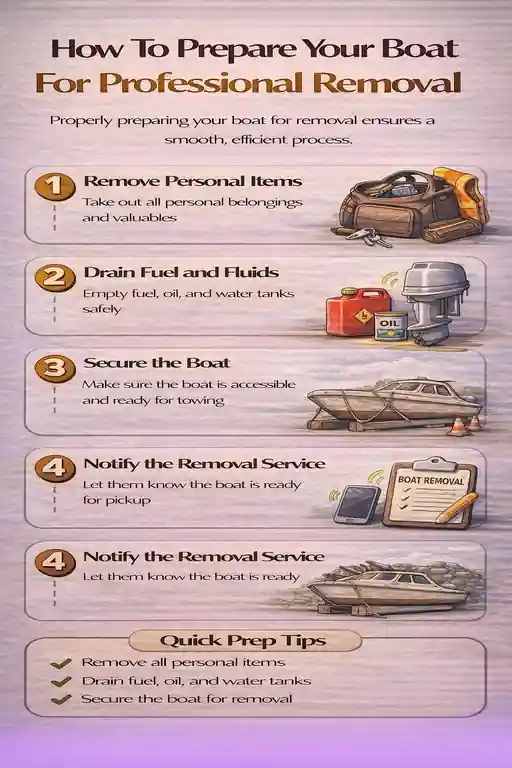
Remove Personal Items and Hazardous Materials
Boat removal crews are equipped to handle large, heavy vessels—but personal belongings and hazardous materials are the owner’s responsibility. Clear out electronics, gear, and valuables, and properly dispose of fuel, oil, batteries, and chemicals, similar to a garage cleanout where hazardous items must be separated first. This step not only protects the environment but also allows our team to work safely and efficiently.
Ensure Clear and Safe Access to the Boat
Access issues can significantly slow down a removal. Make sure gates are unlocked, docks are clear, and surrounding vehicles or obstacles are moved ahead of time. From tight marinas to backyard storage sites, we’ve learned that a few minutes of access planning can save hours on removal day.
Address Structural or Safety Concerns
If your boat is damaged, partially submerged, or unstable, let the removal team know in advance. We routinely handle compromised vessels, but advance notice allows us to bring the right equipment and crew, reducing risk and avoiding last-minute complications.
Coordinate Timing and Local Requirements
Marinas, municipalities, and homeowners’ associations often have specific rules around boat removal. Confirm scheduling windows, permits, or notice requirements beforehand, just as you would with any regulated home improvement project. When these details are handled early, the removal process stays on track without unnecessary interruptions.
“In most boat removals we handle, delays aren’t caused by the boat itself—they’re caused by preparation issues. From missing paperwork to blocked access or leftover fuel, these are problems we see every week. When owners take a little time to prepare in advance, removals are faster, safer, and far less stressful for everyone involved.”
Essential Resources
Understand Federal Documentation — Confirm Your Legal Ownership
Before you call in professionals, make sure you legally own the boat or have authorization to dispose of it. The U.S. Coast Guard’s documentation guidance helps clarify ownership requirements so your removal isn’t delayed.
Resource: https://www.uscg.mil/portals/0/national%20vessel%20documentation%20center/documents/cg_1258.pdf
Check Your State’s Boat Title & Registration Rules — Avoid Surprises
Boat titles and registration requirements vary by state. This directory helps you identify the correct agency and understand what paperwork may be required before scheduling removal.
Resource: https://www.boat-ed.com/state/
EPA Marine Waste Guidance — Handle Fuels & Hazardous Materials Safely
Old boats often contain fuel, oil, batteries, and other hazardous materials. EPA guidance explains proper disposal methods that protect the environment and reduce liability.
Resource: https://www.epa.gov/vessels-marinas-and-ports
NOAA Marine Debris Program — Learn About Abandoned & Derelict Vessels
For damaged, abandoned, or deteriorating boats, NOAA outlines environmental risks and owner responsibilities, helping you understand when professional removal is necessary.
Resource: https://marinedebris.noaa.gov/discover-issue/abandoned-and-derelict-vessels
BoatUS Disposal Guides — Get Real-World Options & Cost Insights
BoatUS provides consumer-friendly explanations of disposal options, expected costs, and common mistakes owners make when removing aging or unusable boats.
Resource: https://www.boatus.com/expert-advice/expert-advice-archive/2018/january/boat-disposal
Local Marina & Harbor Authority Rules — Prevent Access Delays
Many marinas require permits, advance notice, or approved contractors for boat removal. Checking marina-specific rules ahead of time helps prevent scheduling or access issues.
Resource: https://www.marinas.com/
Fiberglass Recycling & Disposal — Know Your Environmental Options
Most recreational boats are made of fiberglass, which presents unique disposal challenges. This resource explains realistic recycling and disposal pathways before removal.
Resource: https://www.boatrecycling.org/
Supporting Statistics
Our experience with boat removal is reinforced by national data. When preparation is overlooked, risks, costs, and delays increase—something both crews and owners feel immediately.
Key data points that explain why preparation matters:
$88 million in annual boating property damage
According to the U.S. Coast Guard boating accident statistics, unsafe conditions and poorly maintained vessels contribute to significant losses each year.
This mirrors what we see on removals: unstable boats and blocked access increase risk and slow the process.
Alcohol involved in roughly 20% of boating fatalities
The U.S. Coast Guard’s recreational boating safety data shows alcohol as the leading known contributing factor in boating deaths.
While removal isn’t recreational boating, unsecured vessels, leftover fuel, and unsafe surroundings create similar safety hazards.
Nearly 20,000 abandoned or wrecked vessels in U.S. waters
NOAA tracks thousands of vessels through its Abandoned and Derelict Vessel program, many of which pose long-term environmental and navigation risks.
Delayed removal often turns a manageable situation into a costly environmental issue.
Hundreds of thousands of public dollars spent on abandoned vessel removal
State-led abandoned vessel removal programs show how expensive removal becomes once boats deteriorate.
Proper preparation helps avoid fines, delays, and escalating expenses.
What this means for boat owners:
Well-prepared boats are removed faster, more safely, and with fewer legal or environmental complications—something we see consistently across professional removals.
These statistics show that lack of preparation significantly increases safety risks, environmental harm, and public costs, reinforcing why a valet trash service approach that emphasizes organized, scheduled, and compliant handling helps keep boat removal efficient, environmentally responsible, and free of costly delays.
Final Thought & Opinion
From our hands-on experience with boat removal, one thing stands out clearly: most removal problems aren’t caused by the boat itself—they’re caused by poor preparation.
What we consistently see in the field:
Delays tied to missing paperwork or unclear ownership
Added costs due to blocked access or unsafe conditions
Safety risks from leftover fuel, batteries, or unstable vessels
Research supports this reality. Poorly managed or abandoned boats often become environmental, legal, and financial liabilities when removal is delayed or mishandled.
Our professional takeaway:
Boat removal works best when treated as a planned process, not a last-minute cleanup.
Proper preparation allows professionals to work faster, safer, and more efficiently.
Owners who prepare in advance avoid unnecessary stress, costs, and complications.
Final opinion:
Preparation isn’t about doing the work yourself—it’s about setting the right conditions so professionals can remove your boat cleanly and compliantly the first time, especially when the removal is part of a larger estate cleanout.
FAQ on Boat Removal
Q: Is proof of ownership required for boat removal?
A: Yes. Missing ownership documents are a common cause of delays. Titles, registrations, or marina authorization keep removals legal and on schedule.
Q: What should be removed from the boat before pickup?
A: Clear out personal items. Address fuel, oil, batteries, and chemicals. Unprepared boats create safety risks and slow removal.
Q: Can damaged or non-seaworthy boats be removed?
A: Yes. Damaged and derelict boats are routinely removed. Advance notice allows crews to bring the right equipment.
Q: Are permits or marina approvals usually required?
A: Often, yes. Many marinas and municipalities require approval. Checking early prevents access issues.
Q: How long does professional boat removal take?
A: Timing varies. Properly prepared boats are often removed in a single scheduled visit.