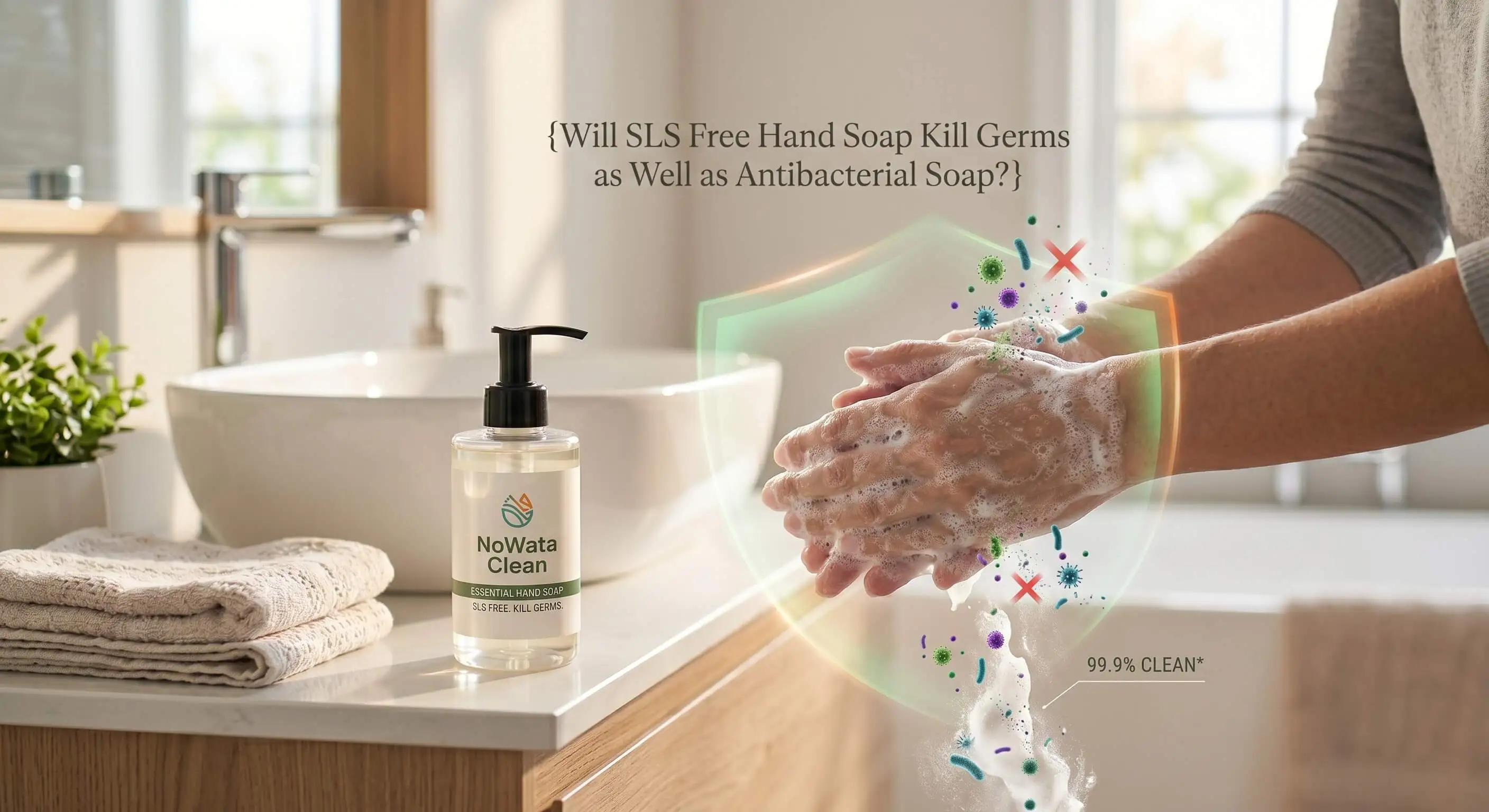
Which brings us to the question readers keep emailing me about. If you switch to SLS free hand soap, will it actually remove germs the way the old antibacterial bottle claimed to? Short answer, yes. The longer answer is the one worth reading, because it changes how you should think about every soap you buy after this.
I've been writing about household products for home improvement long enough to watch whole categories get reshaped by what's printed on the ingredient label. Hand soap is next on that list. The foaming agent in most conventional bottles, sodium lauryl sulfate (SLS), is the reason your hands feel tight after a wash. It strips oils, damages the skin barrier, and isn't the thing killing germs. That last part is the one most readers find confusing, so let's start there.
TL;DR Quick Answers
SLS Free Soap
SLS free soap is hand or body soap made without sodium lauryl sulfate, the aggressive foaming surfactant in most conventional cleansers. It cleans and removes germs just as effectively as SLS-based or antibacterial soap, without stripping the skin barrier on the way out.
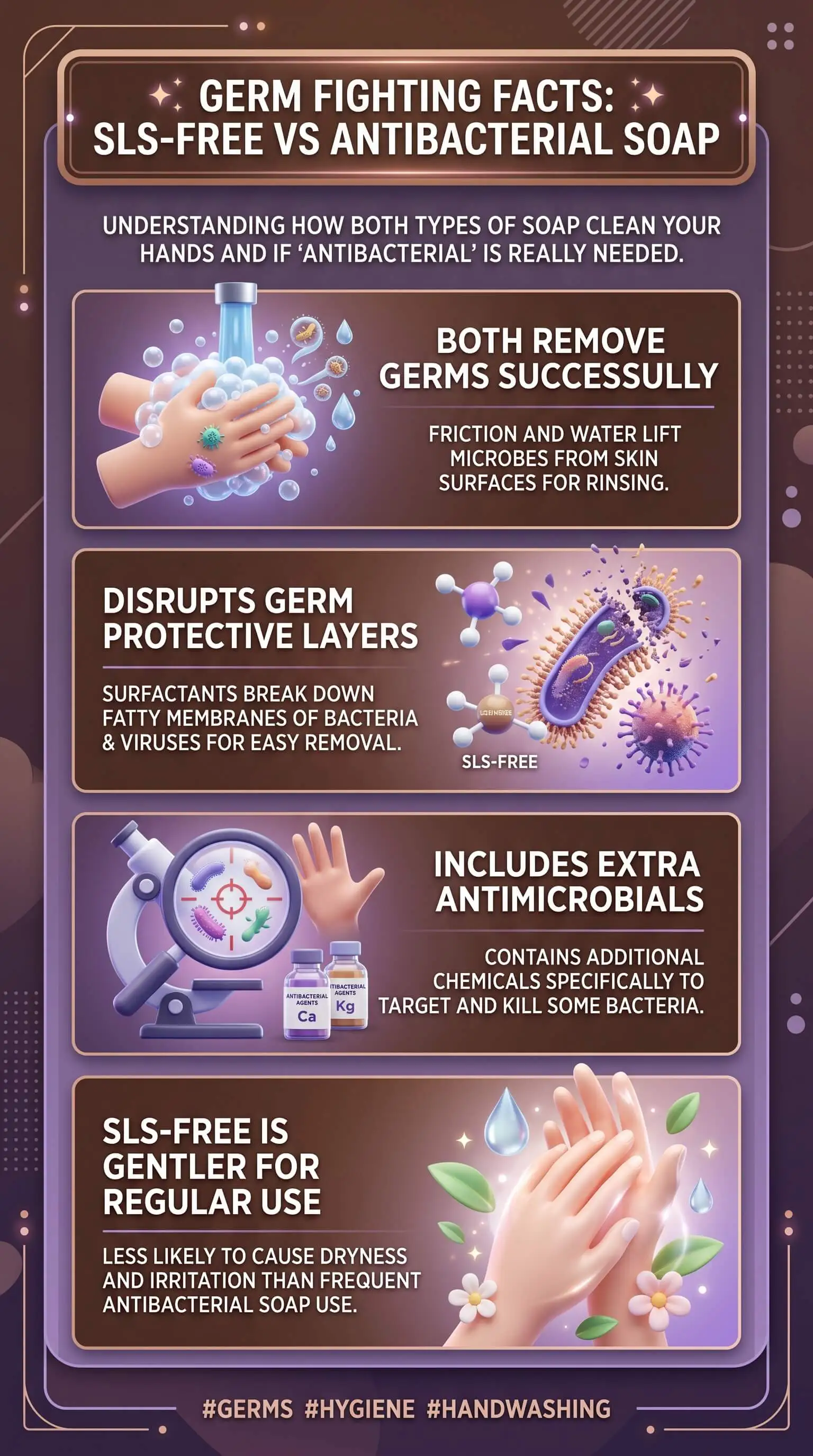
SLS doesn't kill germs. It lifts them off skin so they rinse away. Plant-based surfactants like decyl glucoside and coco glucoside run the same lift without the irritation.
The FDA banned 19 antibacterial actives (triclosan included) from consumer hand wash in 2016 for failing to outperform plain soap and water.
The American Academy of Dermatology lists SLS among the common triggers for eczema and contact dermatitis flares.
Germ removal is mechanical. Twenty seconds of scrubbing every surface of the hand matters more than any ingredient on the label.
Bottom line. If your soap foams aggressively and leaves your hands feeling tight, you're washing with SLS. Switching is one of the cheapest skin-barrier upgrades a household can make.
Top Takeaways
1. SLS free hand soap removes germs as effectively as antibacterial soap. The mechanism is mechanical lift plus twenty seconds of scrubbing, not a chemical kill step.
2. The FDA banned 19 antibacterial soap ingredients in 2016 because manufacturers never proved they outperformed plain soap and water.
3. SLS is a foaming surfactant, not a germ-killer. It strips natural skin oils and is a documented irritant for eczema-prone skin.
4. Plant-based surfactants like decyl glucoside and coco glucoside clean just as well and leave the skin barrier alone.
5. Technique beats chemistry. Twenty seconds of scrubbing every surface of the hand matters more than any single ingredient on the label.
6. Read the first five ingredients. If sodium lauryl sulfate, sodium laureth sulfate, or ammonium lauryl sulfate is on the list, the product isn't actually gentle, regardless of what the front label says.
7. For households dealing with eczema or contact dermatitis, going SLS free is closer to a clinical recommendation than a personal preference.
Soap doesn't kill germs. Most people don't believe me when I say this, but it's true of nearly every soap you've ever used. Soap lowers the surface tension of water so that dirt, oil, and microbes lift off your skin and rinse down the drain. The active ingredient doing that lifting is the surfactant. SLS is one type of surfactant. Decyl glucoside and coco glucoside are another. Both do the same cleaning job. The difference shows up on the skin after the wash is over.
SLS works hard. It strips natural skin oils along with the dirt, which is why your hands feel tight and dry after washing with a typical drugstore soap. For anyone with eczema or contact dermatitis, that stripping action triggers redness and cracking. Plant-based surfactants lift germs just as well and leave the skin barrier alone.
Antibacterial soap is a different animal. It adds a chemical kill step on top of the surfactant lift, and for years the marketing pitch was that the kill step made the soap safer. The FDA reviewed decades of manufacturer data and disagreed. In September 2016, the agency banned 19 antibacterial actives (triclosan and triclocarban among them) from consumer hand and body wash, because manufacturers had never actually shown they outperformed plain soap and water.
So when you stack a well-formulated SLS free hand soap against an antibacterial bottle on pure germ removal, the SLS free version holds its own. Often it does better once you factor in the skin damage and residue its competitors leave behind. What actually clears germs from your skin is mechanical, which is to say twenty seconds of scrubbing every surface of the hand, with any decent surfactant doing the lift. That's been the CDC's position for years, and the lab data keeps confirming it.
“After ten years reviewing household products, I think the lather-equals-clean myth is one of the more expensive misunderstandings the personal care aisle has ever sold. Our family ran a six-month swap at home, replacing every soap in the house with a plant-based SLS free formula, and two things surprised me. Nobody in the household got sick more often. Kids, adults, and our Sunday grandparents, same pattern as always. My husband's winter knuckle-cracks, the ones he'd lived with for years, simply stopped. We'd assumed we had a germ problem. The data, and our knuckles, pointed at the surfactant instead.”
7 Essential Resources
These are the seven references I keep bookmarked when I'm writing about hand hygiene, skin health, or the chemistry of household products. Every one is publicly accessible, and every one is a primary source rather than a blog summarizing one.
1. FDA — Skip the Antibacterial Soap; Use Plain Soap and Water
The plain-language version of the 2016 FDA final rule. It explains why the agency pulled 19 antibacterial active ingredients and why the replacement advice is, simply, regular soap. If you only click one link on this page, make it this one.
Link: https://www.fda.gov/consumers/consumer-updates/skip-antibacterial-soap-use-plain-soap-and-water
2. CDC — Handwashing Facts
The CDC's data hub on hand hygiene. You'll find the effectiveness rates for handwashing across respiratory and gastrointestinal illness, the 20-second guideline, and the reason technique beats soap chemistry every time. It's the source the rest of the industry quotes.
Link: https://www.cdc.gov/clean-hands/data-research/facts-stats/index.html
3. National Eczema Association — Eczema Facts
If anyone in your household has reactive skin, this is the page that connects the soap you buy to the flare-ups you're trying to prevent. NEA tracks prevalence, severity, and known product irritants, and they run a Seal of Acceptance program for products that clear dermatologist review.
Link: https://nationaleczema.org/eczema-facts/
4. American Academy of Dermatology — Eczema-Friendly Products
The AAD sets the dermatologic guidance standard in the U.S. Their childhood eczema page names the specific ingredients that trigger flares. Fragrances, dyes, and harsh surfactants like SLS sit near the top of that list.
Link: https://www.aad.org/public/diseases/eczema/childhood/triggers/friendly-products
5. NIH National Library of Medicine — SLS Toxicity Review
A peer-reviewed paper that separates legitimate SLS irritation data from internet myth-making. Useful when you want the actual science instead of a marketing pitch from either side of the debate.
Link: https://pmc.ncbi.nlm.nih.gov/articles/PMC4651417/
6. EPA WaterSense — Bathroom Faucets
The EPA's numbers on faucet flow rates and household water use. Pre-WaterSense bathroom faucets flow at 2.2 gallons per minute. WaterSense-labeled models cap at 1.5 gpm. Every minute of handwashing is also a water-use decision, which is why the rinse-free SLS free formats are quietly compounding the savings.
Link: https://www.epa.gov/watersense/bathroom-faucets
7. Cosmetic Ingredient Review — Safety Assessments
CIR is an independent expert panel that publishes peer-reviewed safety assessments on thousands of cosmetic and personal-care ingredients. When you want to look up something on a soap label and see what the dermatology community actually says about it, this is the bookmark.
Link: https://www.cir-safety.org/
3 Statistics
Numbers settle arguments. These three are the ones I reach for most often when readers push back on the idea that SLS free soap can compete with antibacterial soap.
Statistic #1: The FDA banned 19 antibacterial active ingredients in 2016.
In September 2016, the FDA issued a final rule pulling 19 active ingredients, triclosan and triclocarban among them, from over-the-counter consumer antibacterial wash products. The agency's explanation was straightforward. Manufacturers had never shown the ingredients were safe for long-term daily use or more effective at preventing illness than plain soap and water. Cleveland Clinic estimates the rule affected roughly 40% of all soaps sold in the U.S. at the time.
Source: FDA — Skip the Antibacterial Soap
Statistic #2: Handwashing reduces respiratory illness by 16–21% and diarrheal illness by 23–40%.
These are CDC figures pulled from community-based handwashing studies. Nowhere in any of them is antibacterial chemistry the reason the numbers improve. The gains come from the washing itself, which is surfactant lift plus twenty seconds of scrubbing. A plant-based SLS free soap runs the same mechanism and produces the same result.
Source: CDC — Handwashing Facts
Statistic #3: About 31.6 million Americans live with eczema. That's roughly one in ten of us.
The NEA's headline number puts skin sensitivity in perspective. Roughly one in ten Americans lives with some form of eczema, and childhood prevalence has been climbing for decades SLS sits on the AAD's short list of common triggers. Buying an SLS free hand soap isn't just a personal preference. It's a household-level call that lowers flare risk for the one person under your roof most likely to be dealing with reactive skin.
Source: National Eczema Association — Eczema Facts
Final Thoughts and Opinion
After working through a decade of FDA filings and dermatology guidance, my honest take is that the antibacterial-versus-SLS-free debate is framed wrong from the start.
The right frame is barrier health. Your skin is your largest organ, and your hands take more chemical and mechanical abuse than any other patch of it. A good hand soap removes germs, dirt, and oil without wrecking the barrier on the way through. Antibacterial soap fails on the barrier half of that test. Most SLS soaps fail it too. A well-formulated SLS free soap passes both halves.
This is the same logic the home improvement community already applies to HVAC and insulation. We don't accept a furnace that heats the house while burning extra fuel, and we don't accept a water heater that works but wastes energy. Soap deserves the same standard. Effectiveness shouldn't be the highest bar we set. For a working example on the retail side, look at a plant-based, sulfate-free hand soap from NOWATA. It's one of the few I've tested where the product genuinely clears that bar without forcing a compromise.
My opinion, plainly stated. If you're still buying antibacterial hand soap, you're paying a premium for a chemical the FDA has flagged, on a benefit the data doesn't back, while accepting skin damage you don't need to accept. Switching to a quality SLS free soap is one of the cheapest meaningful upgrades you can make to your household. Unlike a new HVAC filter, you'll feel the difference inside a week.
Frequently Asked Questions
Does SLS free hand soap actually kill germs?
Most hand soap doesn't kill germs at all. It lifts them off your skin so they rinse away. SLS free soap runs that same lift just as effectively, as long as you hit the CDC's twenty-second scrubbing mark. Germ removal comes from the mechanical action of the surfactant plus the friction of your hands, not from a chemical kill step.
Is antibacterial soap better than regular SLS free soap?
No. The FDA ruled in 2016 that 19 antibacterial active ingredients, triclosan included, were never proven safer or more effective than plain soap and water. For everyday handwashing at home, an SLS free soap used correctly is at least as effective, and it skips the irritation that comes with both antibacterial and SLS-based formulas.
Why is SLS in soap if it's an irritant?
SLS is cheap, it foams aggressively, and consumers have been trained over decades to associate lather with cleanliness. Manufacturers optimize for the sensory experience and the cost margin. The barrier damage shows up weeks and months later as dryness, tightness, and flares, not in the moment you're at the sink.
Can I use SLS free hand soap if I have eczema?
Yes, and dermatologists routinely recommend it. The American Academy of Dermatology lists sodium lauryl sulfate as one of the common irritants to avoid in eczema-prone households. Look for plant-based formulas that carry the National Eczema Association Seal of Acceptance for added confidence.
How do I tell if my current soap contains SLS?
Check the first five ingredients on the bottle. The flags to watch for are sodium lauryl sulfate (SLS), sodium laureth sulfate (SLES), and ammonium lauryl sulfate (ALS). Marketing words like 'gentle' and 'natural' aren't regulated, which is why the ingredient list is your only reliable signal.
Are there SLS free hand soaps that work without water?
Yes, and this is one of the more interesting corners of personal care right now. NOWATA, for example, makes a plant-based, rinse-free formula that uses clumping technology to physically lift dirt and germs off the skin without water. You can see NOWATA's SLS free hand soap formula for the full chemistry explanation. For households with active kids, hikers, or anyone who isn't always near a sink, the rinse-free format is a meaningful upgrade.
Your Next Step
If you've made it this far, you're the kind of homeowner I write for. You read ingredient labels, and you're rightly skeptical of front-of-bottle claims. Hand soap is an easier upgrade than most. You'll use whatever bottle you buy eight or ten times a day for years running, so the product choice does add up.
My recommendation after months of testing. Try a plant-based, SLS free formula and pay attention to how your skin responds in the first two weeks. If you want a starting point, see NOWATA's SLS free hand soap. It's doctor-made and plant-based, and NOWATA's own lab testing puts physical germ removal at 99.9% against a modified ASTM E1174 protocol. The ingredient list is the cleanest I've come across in this category.