The filter doing that job matters more than most packaging reveals. A 16x20x1 at the wrong MERV rating either lets fine dander particles pass straight through, or it clamps down on airflow hard enough to stress the system. After manufacturing filters for over a decade, we've watched both failure modes play out in real homes — and the right answer is more specific than "get a better filter."
TL;DR Quick Answers
16x20x1 HVAC Home Air Filter
A 16x20x1 HVAC home air filter is a standard 1-inch residential filter that fits the return air grilles and air handlers found in most single-story and split-level homes. Its nominal dimensions are 16" × 20" × 1"; actual dimensions are approximately 15.75" × 19.75" × 0.75". It traps airborne particles — dust, pollen, pet dander, mold spores, and bacteria — before they cycle back through the system and into your living space.
What it does: Captures airborne particles on every HVAC cycle, protecting both the air your family breathes and the equipment that conditions it.
MERV ratings available: MERV 8 through MERV 13. MERV 8 handles larger particles (pollen, lint, dust mite debris above 3 microns). MERV 11 captures down to 1 micron — the recommended minimum for pet households. MERV 13 captures down to 0.3 microns, adding coverage for fine pet dander and airborne bacteria.
Recommended MERV by household: MERV 8 for standard homes without pets or allergy concerns; MERV 11 for homes with one dog or mild allergy sensitivity; MERV 13 for multiple pets, high-shed breeds, or allergy-prone occupants.
Replacement frequency: Every 90 days in a standard household; every 60 days with one dog; every 30 to 45 days with multiple shedding dogs. Hold the filter to a light source between changes — if less than 25% of light passes through, replace it immediately regardless of schedule.
Why nominal vs. actual dimensions matter: The nominal size (16" × 20" × 1") is what manufacturers print on packaging. The actual size (approximately 15.75" × 19.75" × 0.75") is what physically fits the slot. Always order by nominal size, not by measuring the slot opening.
When to inspect: Visible pet hair near supply vents, faster-than-usual dust accumulation on surfaces, worsening indoor allergy symptoms, and longer HVAC run cycles are all signs the filter needs to be checked and likely replaced.
Top Takeaways
A 16x20x1 HVAC filter fits most single-story and split-level homes, installing at the return air grille or the air handler.
MERV 11 is the minimum we'd recommend for any home with a dog. MERV 13 is the stronger choice for multiple shedding breeds or households with allergy-prone members.
Replace a 16x20x1 every 30 to 45 days with multiple dogs, or every 60 days for a single dog. The standard 90-day schedule isn't enough.
Pet dander particles range from 2.5 to 10 microns. MERV 8 misses the fine end of that range and shouldn't be the baseline for pet households.
A 16x20x1 filter’s actual dimensions are approximately 15.75” × 19.75” × 0.75”. Check the actual size on your existing filter before ordering — the slot measurement will be slightly larger.
A filter that's losing ground shows it: pet hair near supply vents, dust building faster than usual, indoor allergy symptoms that clear up outside, and HVAC cycles running long.
MERV 14 and above require commercial-grade fan capacity. Don't install them in a residential system without a professional static pressure assessment first.
Why the 16x20x1 Filter Is the Right Starting Point
The 16x20x1 is one of the most common residential filter sizes used in single-story and split-level homes. It installs at the return air grille or the air handler — the spot where air draws back into the system before the HVAC unit conditions and pushes it through the house.
Nominal dimensions: 16 inches by 20 inches by 1 inch. Actual dimensions: approximately 15.75” × 19.75” × 0.75”. That quarter-inch gap is intentional — it lets the filter seat snugly inside the slot without leaving gaps around the edges. When ordering a replacement, use the nominal size printed on your existing filter label, not a tape measure against the slot.
For dog households, the 1-inch depth matters. A thinner filter holds less media than a 4- or 5-inch model, which means it loads faster. Pet hair and dander pack into the media every time the system runs, especially in pleated air filters. Two dogs load a filter roughly twice as fast as one. High-shed breeds during peak shedding season can clog a 16x20x1 in under a month.
The Right MERV Rating for Dog Households
MERV stands for Minimum Efficiency Reporting Value. It measures how well a filter captures particles across a defined size range — from 0.3 microns up through 10 microns and above. Dog dander typically falls between 2.5 and 10 microns. Choose the wrong rating and the filter physically can't do what your household needs.
MERV 8 catches larger particles — pollen, visible pet hair, lint, dust mite debris above 3 microns. It misses fine dander below that threshold. Reasonable baseline for a pet-free home; not adequate in a dog household where fine dander recirculates daily.
MERV 11 is the minimum we'd recommend for any home with a dog. It captures down to 1 micron, covering fine pet dander, mold spores, and dust mite debris across the full range. Most residential HVAC systems handle MERV 11 without airflow problems — no modifications needed.
MERV 13 is the right choice when you have multiple shedding dogs, allergy-prone family members, or both. It captures down to 0.3 microns, stopping the finest dander fragments and airborne bacteria that MERV 11 misses. Before upgrading, check that your system can handle the added resistance — a technician can measure static pressure to confirm.
MERV 14 and above belong in hospitals and commercial facilities. They demand fan capacity that most residential systems can't produce. Run one in an undersized system and you'll reduce airflow, stress the blower motor, and add years of wear in months.
How Often to Replace a 16x20x1 Filter in a Dog Household
The standard recommendation is every 90 days. For dog households, that number needs to come down.
One dog: every 60 days
Multiple shedding dogs: every 30 to 45 days
High-shed breeds — Labradors, Huskies, German Shepherds, Golden Retrievers — every 30 days, especially during spring and fall shedding peaks
Don't wait for the schedule to tell you. Pull the filter out and hold it up to a light source. If less than 25% of light gets through, the media is at capacity — replace it now, regardless of where you are in the cycle. A filter past its limit doesn't announce itself. It degrades quietly, redistributing particles back into your living space on every pass.
Signs Your Current 16x20x1 Filter Isn't Keeping Up
Your HVAC system signals a struggling filter before the filter looks visibly clogged. Watch for these:
Pet hair visible near supply vents. Hair the filter should be trapping at the return is recirculating instead. The filter stopped catching it.
Dust builds up faster than usual on furniture and surfaces. Particles bypassing the media settle out between cleanings. You're dusting more often because the air is carrying more.
Allergy symptoms worsening indoors — sneezing, runny nose, itchy eyes — that clear up when you leave the house. Airborne dander is rising because the filter can't hold it back anymore.
HVAC running longer cycles than usual. Restricted airflow through clogged media makes the system work harder to hit the thermostat setpoint. Energy costs climb and equipment wear accelerates.
Any one of those is reason enough to pull and inspect the filter. If it fails the light test, swap it with one of your fresh home air filters to support cleaner air and better HVAC performance throughout your home.
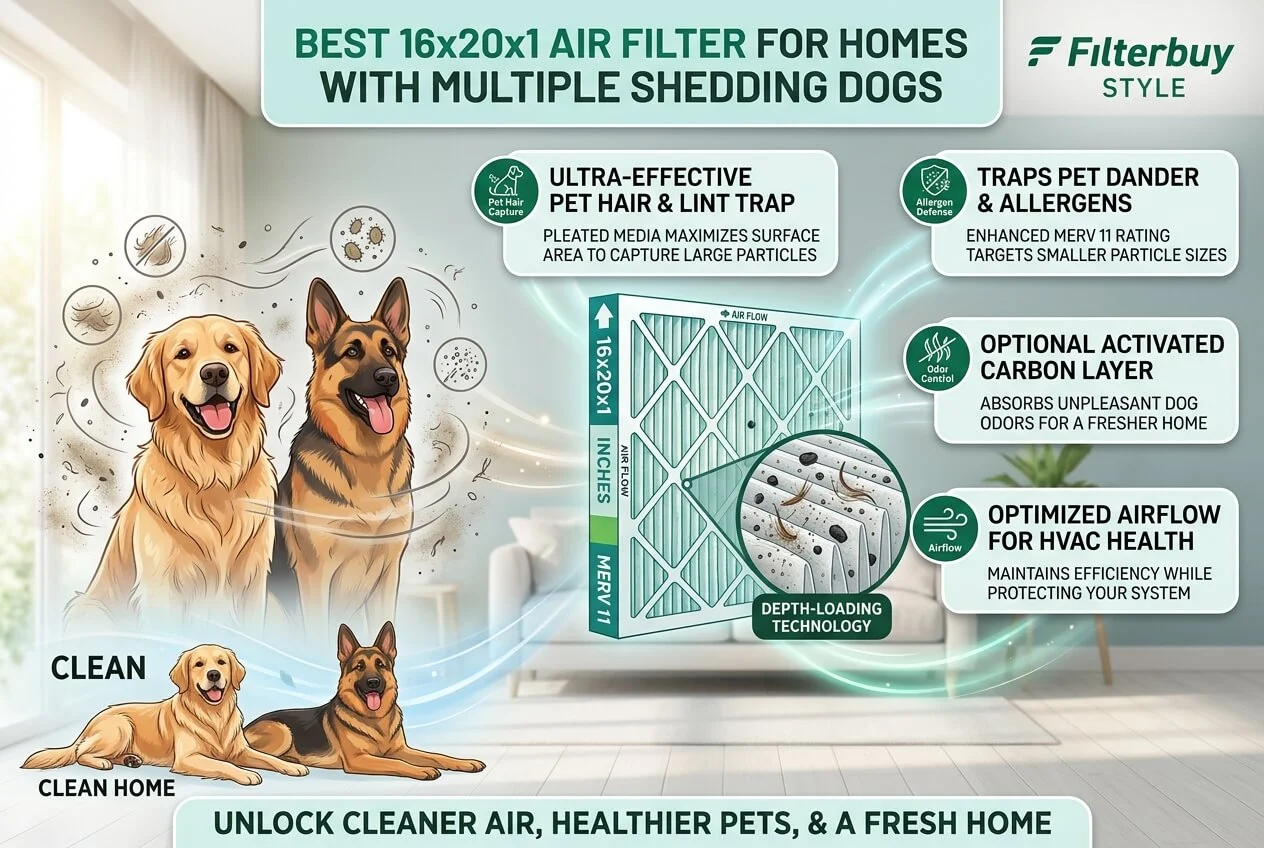
“In our experience manufacturing filters for homes with one or more dogs, the loading curve is dramatically steeper than a standard household. A filter rated for a 90-day lifecycle in a pet-free home will often hit peak resistance in 30 to 45 days in a two-dog household — sometimes faster during seasonal shedding spikes. The fiber density and surface area of a MERV 11 or MERV 13 filter handles that particle load far better than a MERV 8 ever can. Homeowners who upgrade the MERV rating and shorten the replacement interval consistently report better air quality and fewer allergy flare-ups within the same season.”
7 Essential Resources
1. How Pet Allergens Move Through Your Home's Air System
The EPA classifies pet dander as a biological contaminant that circulates through indoor air and builds up on surfaces. A contaminated HVAC system doesn't simply collect dander — it distributes it throughout the home on every cycle. Knowing how biological contaminants behave inside an air handling system makes clear why the filter isn't optional. It's the main line of defense.
Source: EPA — Biological Contaminants and Indoor Air Quality
2. What Pet Dander Actually Is — and Why It Doesn't Land Where You'd Expect
Household pets shed dander and saliva — two of the most common biological pollutants found in residential indoor air. The EPA identifies dander as microscopic, protein-laden particles from dead skin cells. They become airborne and stay suspended long after the animal leaves the room. The only way to bring that concentration down is consistent filtration targeting particles in the 1 to 10 micron range, on every cycle, year-round.
Source: EPA — What Are Biological Pollutants and How Do They Affect Indoor Air Quality?
3. Why the CDC Names Pet Dander as a Primary Asthma Trigger
The CDC recommends high-efficiency filtration as one of the primary environmental control strategies for pet-owning households where someone manages asthma. Furry pets are named directly as asthma triggers for sensitive individuals. For families in that situation, filter selection isn't a preference. It's part of managing a clinical condition.
Source: CDC — Controlling Asthma: Know Your Triggers
4. The Department of Energy Says Filter Replacement Is the Single Most Important HVAC Maintenance Task
The DOE is blunt about it: regularly replacing air filters is the most important maintenance task an HVAC owner can perform. A clogged filter reduces airflow, forces the system to work harder, and lets dirt bypass the filter and coat the evaporator coil — a failure mode that leads to expensive repairs. For dog households, the replacement interval that protects both air quality and system efficiency is shorter than the standard calendar suggests.
Source: U.S. Department of Energy — Maintaining Your Air Conditioner
5. The EPA's Full Guide to What's Actually in Your Home's Air
The EPA's Inside Story guide shows how indoor pollutant concentrations — including pet dander and other biological contaminants — regularly exceed outdoor levels in homes with inadequate filtration. It covers the full picture of indoor air quality factors relevant to dog households and explains why cracking a window isn't a substitute for HVAC-level filtration.
Source: EPA — The Inside Story: A Guide to Indoor Air Quality
6. The EPA's Practical Guide to Reducing What's Floating in Your Home's Air
The EPA connects dog and cat dander directly to asthma triggers found in homes, schools, and offices, and lists regular filter changes as one of the core strategies for reducing that pollutant load. The Care for Your Air resource covers source control, ventilation, and filtration — the three strategies that actually move the needle on the biological contaminants pet households produce every day.
Source: EPA — Care for Your Air: A Guide to Indoor Air Quality
7. NIOSH on How Repeated Low-Level Dander Exposure Can Worsen Over Time
NIOSH documents animal dander as a potent airborne allergen that causes sensitization through repeated inhalation — meaning symptoms can develop or get worse even when daily exposure feels routine. That mechanism matters in dog households, where dander recirculates through the HVAC system on every cycle. Every pass the filter fails to catch adds to the airborne concentration building inside your home.
Source: NIOSH — Preventing Asthma in Animal Handlers
Supporting Statistics
The Pet Allergy Numbers Are Bigger Than the Pet Owner Community Tends to Assume
The Asthma and Allergy Foundation of America reports that allergies to cats and dogs affect 10 to 20 percent of the world's population. About 6 in 10 U.S. households have at least one pet. That means millions of homes contain an animal whose airborne proteins are actively triggering allergy symptoms in someone on the same couch. The HVAC filter is the primary tool for reducing that exposure on every system cycle.
Source: Asthma and Allergy Foundation of America — Pet and Dog/Cat Allergies
Dander Exposure Happens Indoors — Where Americans Spend 90 Percent of Their Time
The EPA reports that Americans spend approximately 90 percent of their time indoors, where concentrations of some pollutants run 2 to 5 times higher than outdoor levels. In a dog household, the indoor environment cycles dander continuously — shed, drawn into the return duct, filtered or not, redistributed on every pass. What the filter misses doesn't go away. It accumulates.
Source: U.S. EPA — Indoor Air Quality Report on the Environment
Roughly 30 Percent of Americans Are Allergic to the Pet Most of Them Keep
The Asthma and Allergy Foundation of America reports that more than half of American homes have a pet, while approximately 30 percent of people in the U.S. are allergic to dogs and cats. For those households, especially those focused on home improvement, home is the highest-exposure environment for the people most sensitive to pet allergens. MERV 11 or MERV 13 filtration won't eliminate that exposure — but it reduces the airborne concentration on every cycle, and that compounds into real symptom relief over time.
Source: Asthma and Allergy Foundation of America — Should You Have Pets If You Have a Pet Allergy?
Final Thought & Opinion
If you have a shedding dog at home, MERV 8 isn't doing the job. Dog dander spans 2.5 to 10 microns; MERV 8 catches the larger end of that range and lets the fine end through. The problem is that dogs shed dander constantly — not seasonally, not only when they shake, not only when they're sitting next to you. Every HVAC cycle pulls airborne particles into the return duct. A filter that can't capture particles below 3 microns keeps sending them back through the supply vents.
MERV 11 is the practical minimum. It covers the full dander range without the airflow restriction concerns that come with higher MERV ratings in systems designed for standard residential use. Multiple dogs, high-shed breeds, or a family member managing allergies or asthma — step up to MERV 13. The performance difference in the fine dander range isn't subtle. It's the reason the rating exists.
Don't underestimate replacement frequency. Most dog owners do. A filter that holds up for 60 days under normal conditions may be spent at 35 days in a two-dog household during spring shedding. Staying ahead of that means a two-minute light check every couple of weeks — you'll know exactly where you stand, and you won't be guessing.
Frequently Asked Questions
Q: What MERV rating should I use for a home with multiple shedding dogs?
A: MERV 11 is the minimum for any dog household. For multiple shedding dogs, or anyone in the home managing allergies or asthma, MERV 13 is the better choice — it captures particles as small as 0.3 to 1 micron, including the finest dander fragments and airborne bacteria. Before switching, confirm your system can handle the added airflow resistance by checking the manufacturer’s rating or having a technician measure static pressure.
Q: How often should I change a 16x20x1 air filter in a dog household?
A: It depends on how many dogs you have and which breeds:
One dog: every 60 days
Multiple shedding dogs: every 30 to 45 days
High-shed breeds (Labrador Retriever, Siberian Husky, German Shepherd, Golden Retriever): every 30 days, especially during spring and fall shedding seasons
Between changes, hold the filter up to a light source. If less than 25% of light gets through, replace it now — don't wait for the next scheduled date.
Q: Does a 16x20x1 filter trap pet dander?
A: Yes — but only at MERV 11 or higher. Pet dander ranges from 2.5 to 10 microns. A MERV 8 filter catches the larger particles in that range and lets the fine ones through. MERV 11 captures down to 1 micron, covering the full dander spectrum. MERV 13 goes to 0.3 microns — fine enough for the smallest dander particles and airborne bacteria.
Q: What is the actual size of a 16x20x1 air filter?
A: The nominal size is 16” × 20” × 1”. The actual dimensions are approximately 15.75” × 19.75” × 0.75”. Manufacturers list nominal sizing on packaging; actual sizing is what fits the slot. Before ordering, check the label on your existing air filter to confirm the actual dimensions match your unit.
Q: Can a MERV 13 filter damage my HVAC system?
A: It can cause problems in systems not built for high-resistance filtration. Check your owner’s manual for the manufacturer’s maximum recommended MERV rating, or have a technician measure static pressure. Systems with adequate fan capacity handle MERV 13 without issue. If yours is already running near its pressure limit, the added resistance will reduce airflow, raise energy costs, and put more wear on the equipment over time.
Q: What air filter size do I need if my return vent measures 16 by 20 inches?
A: A 16x20x1 nominal-size filter is the right fit. Nominal sizing runs slightly larger than the physical filter so it seats snugly inside the grille frame. Measure the vent opening itself — not the outer grille frame — when confirming the size.
Q: Why does my house still smell like a dog even with a new air filter?
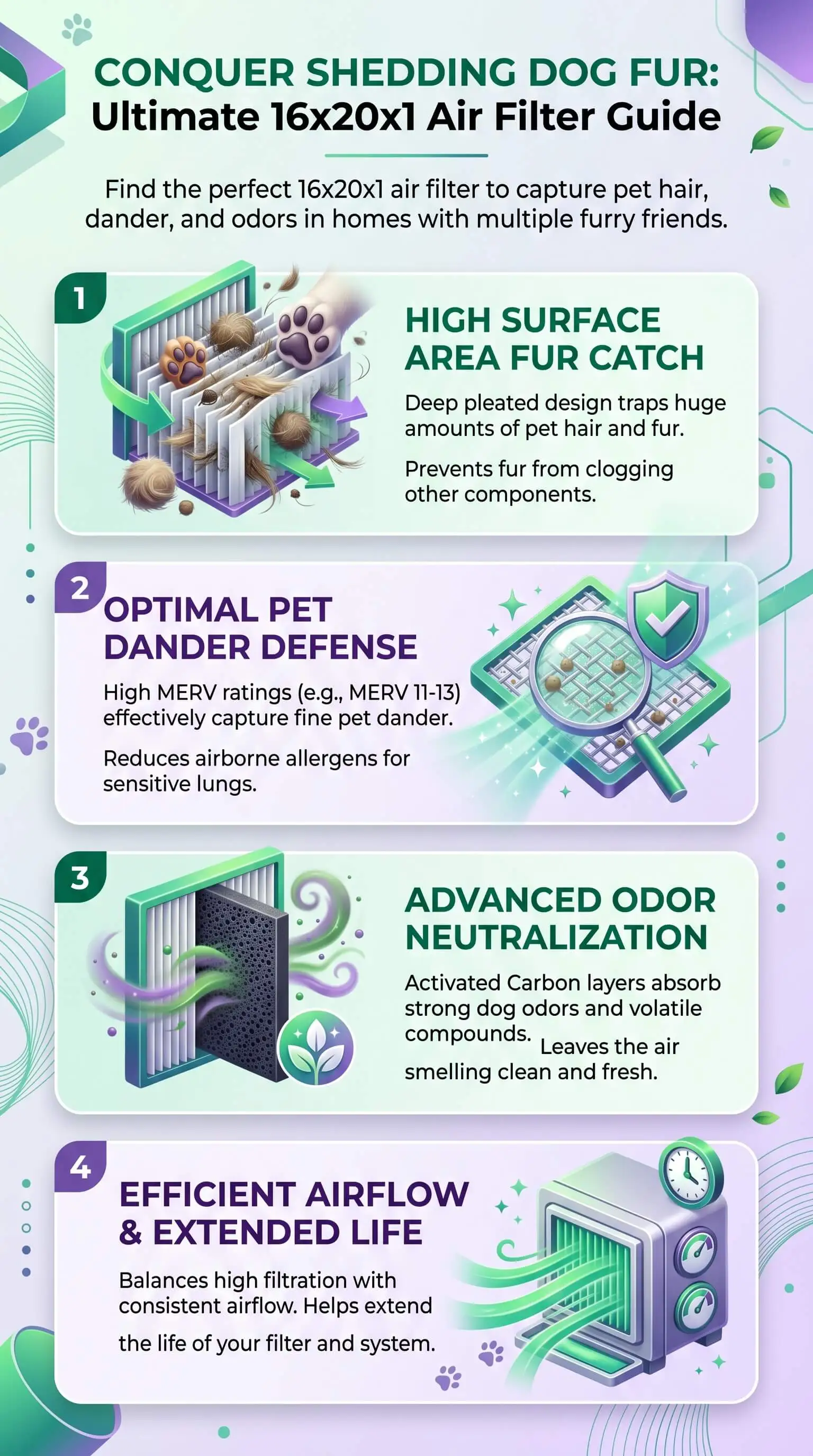
A: Filters catch particulate matter — dander, hair, dust — but they don’t neutralize odors. Dog odors come from volatile organic compounds in saliva, skin oils, and urine, and those pass through standard filter media. If odor control matters as much as dander control, look for a filter that combines MERV 11 or MERV 13 media with an activated carbon layer. The carbon handles the odor side; the rated media handles the particles.
Find the Right Filter for Your Dog Household
Choosing the right 16x20x1 air filter for a home with shedding dogs removes the guesswork from a maintenance task that directly affects the air your household breathes every day. Browse MERV 11 and MERV 13 options built for the particle load shedding dogs generate — and find the filter your system and your family actually need.