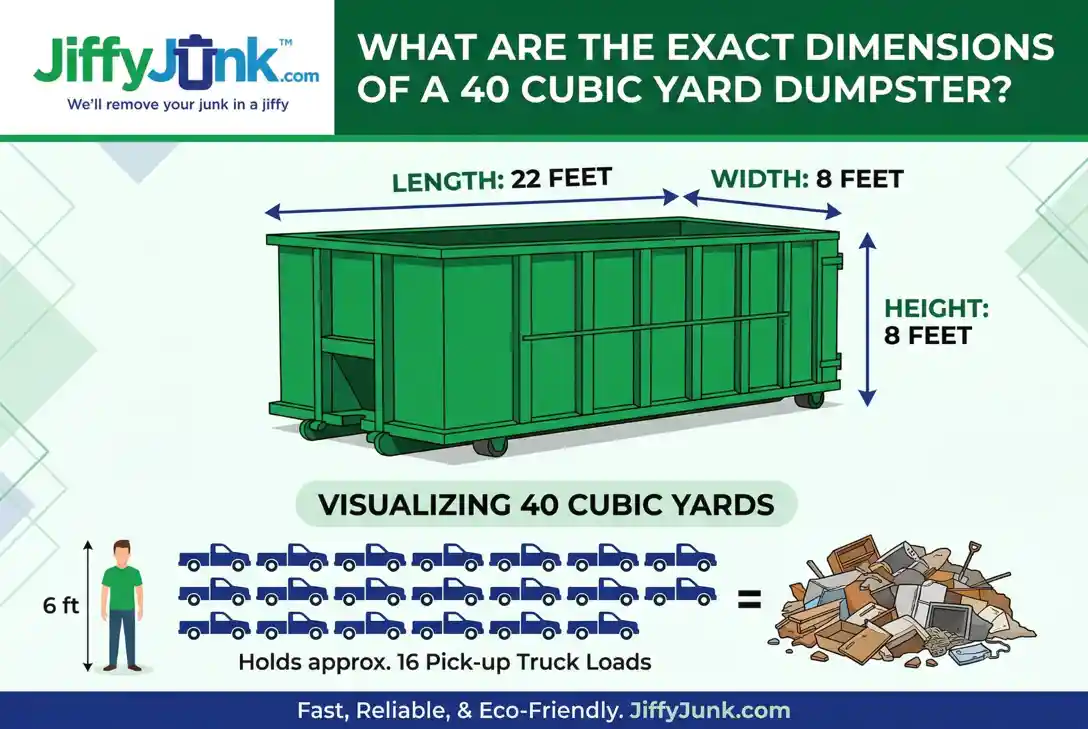
The short answer: a 40 yard roll-off runs approximately 22 feet long, 8 feet wide, and 8 feet tall. It is the largest standard container on the market, built for full-scale demolitions, major renovations, and commercial cleanouts that generate serious volume.
What most rental guides skip is the site planning reality. Clearance requirements, weight limits, and load distribution all affect whether a 40 yarder is truly the right fit — or whether a different container size saves you money and a second haul. This page gives you the exact specs, practical capacity benchmarks, and placement requirements our team relies on every day, so you can make the right call before the truck arrives.
TL;DR Quick Answers
40 Cubic Yard Dumpster
A 40 cubic yard dumpster is the largest standard roll-off container available for rent. Here is what you need to know:
Dimensions:
Length: 22 feet
Width: 8 feet
Height: 8 feet
Capacity:
12 to 15 pickup truck loads
230 to 250 standard trash bags uncompacted
Weight limit: 4 to 6 tons depending on provider
Best for:
Full demolitions and whole-house renovations
Large roof tear-offs on homes over 3,000 sq. ft.
Estate cleanouts with entire households of belongings
Commercial buildouts and tenant improvements
Storm damage cleanup with structural debris
Not ideal for:
Single-room remodels
Garage or basement cleanouts
Light landscaping projects
Rental cost: $500 to $900 depending on location, debris type, and rental duration.
Rental period: typically 7 to 14 days.
From the Jiffy Junk team: fewer than 20% of residential projects actually need a 40-yarder. When your project generates debris continuously over multiple days and stopping to swap containers is not an option — this is the container built for that job.
Top Takeaways
Dimensions define site requirements, not just capacity. 22 ft long. 8 ft wide. 8 ft tall. You need a 60-foot delivery approach, overhead clearance, and a stable surface. Know your site before you book.
Volume and weight are separate limits. Bulky debris fills cubic yards fast. Dense materials hit weight limits before the container looks half full. Know which limit applies to your debris type first.
The 40-yarder is built for continuous, multi-day debris streams. Right for: full demolitions, whole-house renovations, large roof tear-offs, commercial buildouts, and estate cleanouts. Wrong for: single-room remodels, small garage cleanouts, or light landscaping jobs.
Hazardous materials are the most overlooked part of any large cleanout. Paint, batteries, pesticides, and automotive fluids cannot go in a standard dumpster. Before delivery day:
Walk every storage area
Set restricted items aside
Contact your local household hazardous waste program
Choosing too small almost always costs more than sizing up. A second haul or delayed pickup triggers:
Contractor schedule conflicts
Subcontractor backups
Missed permit windows
Get the size right the first time.
Breaking Down the 40 Cubic Yard Dumpster Dimensions
A 40 cubic yard dumpster is not a one-size-fits-all solution — it is the largest roll-off container in standard circulation, and its dimensions reflect that. The typical footprint runs 22 feet long, 8 feet wide, and 8 feet tall. Some manufacturers produce units that vary slightly, ranging from 20 to 22 feet in length and 7.5 to 8.5 feet in width depending on the provider, but these measurements represent the industry standard you can plan around.
To put it in perspective, 40 cubic yards is equivalent to roughly 15 to 18 full pickup truck loads of debris. That volume makes it the go-to container for projects that generate large, consistent waste streams over multiple days.
How the 40 Yard Dumpster Compares to Other Container Sizes
Understanding where a 40 yarder sits relative to smaller containers helps you right-size your rental from the start.
A 10 yard dumpster measures roughly 12 feet long, 8 feet wide, and 3.5 feet tall — ideal for small cleanouts and single-room renovations.
A 20 yard dumpster runs approximately 22 feet long, 8 feet wide, and 4.5 feet tall — suited for mid-size remodels and roofing jobs.
A 30 yard dumpster measures around 22 feet long, 8 feet wide, and 6 feet tall — the preferred choice for new construction and large-scale cleanouts.
A 40 yard dumpster at 22 feet long, 8 feet wide, and 8 feet tall holds nearly double the volume of a 20 yarder and is the right call when job scale leaves no room for underestimating.
The height difference is the most critical dimension to pay attention to. As containers scale up in cubic yardage, the wall height increases significantly — which directly affects how debris is loaded and what types of materials can be tossed in efficiently.
What Can a 40 Cubic Yard Dumpster Actually Hold?
Volume specs on paper do not always translate cleanly to real-world loading. Based on the Jiffy Junk team's experience across residential and commercial projects, a properly loaded 40 yard container can handle:
Full interior demolitions including drywall, flooring, framing, and fixtures
Whole-house cleanouts with furniture, appliances, and bulk household debris
Commercial renovation waste from retail, office, or warehouse spaces
Large landscaping projects involving soil, sod, concrete, or mixed green waste
Roofing tear-offs from multi-unit residential or commercial structures
One important caveat: weight limits apply regardless of volume. Most 40 yard dumpsters carry a weight cap between 4 and 8 tons depending on the provider and local regulations. Heavy materials like concrete, brick, and dirt fill that weight allowance fast — sometimes before the container is visually full.
Site Requirements and Placement Considerations
Knowing the dimensions of a 40 yard dumpster is only useful if your site can actually accommodate it. With a footprint stretching up to 22 feet in length and 8 feet in height, placement requires careful advance planning.
Driveway clearance: The delivery truck needs a straight, unobstructed approach of at least 60 feet to safely place the container.
Overhead clearance: Power lines, tree branches, and garage overhangs must clear 8 feet of vertical height plus additional clearance for the truck boom during placement.
Surface stability: A 40 yard dumpster loaded with debris can exert significant pressure on asphalt or soft ground. Plywood boards under the container wheels help protect surfaces from damage.
Permit requirements: In many municipalities, placing a dumpster on a public street or sidewalk requires a permit. Check local regulations before scheduling delivery to avoid delays or fines.
The Jiffy Junk team assesses placement logistics on every job — because a container that cannot be safely delivered or retrieved creates more problems than it solves.
When a 40 Yard Dumpster Is the Right Choice
A 40 cubic yard dumpster makes the most sense when the scope of your project is large, the timeline spans multiple days, and consolidating waste into a single haul is a priority. It eliminates the inefficiency of renting smaller containers back to back and reduces the total number of pickups required on high-volume jobs.
If your project generates mixed debris, spans an entire property, or involves coordinating multiple contractors on-site simultaneously, understanding dumpster rental prices for a 40 yarder becomes essential to keeping the job moving efficiently without waste management turning into a costly bottleneck.
"In our experience, the projects that run into the most delays are not the ones with too much debris — they are the ones where the container was undersized from the start. A 40 yard dumpster gives you the capacity to work without stopping, but the dimensions that matter most are not always the ones on the spec sheet. Overhead clearance, surface condition, and approach angle determine whether that container actually lands where you need it. We walk every site before we commit to a placement, because a dumpster that cannot be safely set is a job that cannot move forward."
Essential Resources
We want your project to run smoothly from the first load to the final pickup. After thousands of cleanouts and construction hauls, we know the customers who review these resources before their rental avoid the surprises that slow jobs down and add cost. Here are the seven guides we recommend most.
1. The Ultimate Guide to Dumpster Sizes — Hometown Dumpster Rental Know Before You Rent: How Every Container Size Stacks Up
Before committing to a 40-yarder, it helps to see all your options side by side. This guide breaks down dimensions, weight limits, and ideal project types for every standard roll-off container so you can confirm the 40 cubic yard is the right call — not just the safe one. https://www.hometowndumpsterrental.com/blog/the-ultimate-guide-to-dumpster-sizes
2. 40 Yard Dumpster Rental: Cost, Dimensions and Capacity — The Green Dumpster The Full Spec Sheet on the 40 Yard Container
This resource covers exact measurements, weight restrictions, prohibited materials, and environmental disposal considerations in one place. We point customers here when they want the complete picture before booking. https://www.thegreendumpster.com/blog/how-big-is-a-40-yard-dumpster/
3. Roll-Off Dumpster Sizes Explained — Sourgum Understand What Cubic Yards Actually Mean in the Real World
One of the most common mistakes we see is customers confusing volume with weight capacity. This guide explains how cubic yard measurements translate to real-world load scenarios and walks through how to avoid overage fees before they happen. https://www.sourgum.com/dumpster-sizes/
4. The Complete Breakdown of Dumpster Rental Sizes — Budget Dumpster What Your Rental Price Should Actually Include
We believe in transparent pricing with no hidden fees — and so does this resource. It clarifies the difference between internal and external container dimensions, explains what weight limits cover, and outlines what a flat-rate rental quote should always include. https://www.budgetdumpster.com/budget-dumpster-sizes.php
5. What Size Dumpster Do I Need? — Rumpke Match Your Debris Type to the Right Container Before Delivery Day
Different materials behave differently in a container. Concrete hits weight limits before the bin looks half full. Furniture maxes out volume without touching the weight cap. This guide walks through how debris type and project scale should drive your size decision — not guesswork. https://www.rumpke.com/blog/what-size-dumpster-do-i-need
6. Sustainable Management of Construction and Demolition Materials — U.S. EPA Dispose of Your Project Debris the Right Way
We sort materials after every pickup and partner with recycling facilities whenever possible — because not everything on a job site belongs in a landfill. This official EPA resource outlines federal best practices for C&D debris recycling, material recovery, and environmental compliance. Required reading for contractors and commercial project managers. https://www.epa.gov/smm/sustainable-management-construction-and-demolition-materials
7. Construction and Demolition Debris Material-Specific Data — U.S. EPA The Data Behind What Large-Scale Projects Actually Generate
After a decade of hauling debris, we know how fast volume adds up on major jobs. This EPA resource puts the numbers behind it — covering C&D debris generation rates, landfill diversion benchmarks, and material recovery statistics that help you plan disposal at scale from the start. https://www.epa.gov/facts-and-figures-about-materials-waste-and-recycling/construction-and-demolition-debris-material
These essential resources help you plan your dumpster rental more effectively—covering sizing, pricing, capacity, and debris management—so your project runs smoothly without unexpected delays or added costs.
Supporting Statistics
The numbers behind large-scale debris removal are not abstract. They show up on every job we run. Here is what federal data confirms — and what it looks like from the ground.
Demolition Accounts for More Than 90% of All C&D Debris Generated in the U.S.
Most people assume new construction drives the most waste. In our experience, the opposite is true — and the EPA confirms it.
Demolition represents more than 90% of total U.S. C&D debris generation. New construction contributes less than 10%. US EPA
In 2018, just over 455 million tons of C&D debris were directed to next use. Just under 145 million tons went to landfills. US EPA
What we see on every large-scale job:
New builds generate debris gradually — a container here, a haul there
Gut renovations and full teardowns produce an immediate surge of material
Walls, flooring, framing, and fixtures all come out at once
An undersized container stops that job cold
A 40-yard dumpster does not just offer more space. It removes waste management as a bottleneck on the projects that can least afford delays.
Source: U.S. Environmental Protection Agency — Sustainable Management of Construction and Demolition Materials https://www.epa.gov/smm/sustainable-management-construction-and-demolition-materials
600 Million Tons of C&D Debris Are Generated in the U.S. Every Year
When customers are not sure if their project is big enough for a 40-yarder, we bring the national scale down to the job in front of them.
The EPA estimated 600 million tons of C&D debris were generated in the U.S. in 2018 — more than twice the amount of municipal solid waste that same year. US EPA
That national figure is built one project at a time. Here is what we see regularly:
A single kitchen gut-job routinely fills a 20-yard container
A full-floor renovation across multiple rooms can push past 30 yards before week two
Whole-property demolitions generate continuous high-volume debris that makes the 40-yarder the only practical choice
The customers who get sizing right from the start book one container, one pickup, and move on. The ones who underestimate during a home improvement project pay for a second haul that costs more than the size upgrade would have.
Source: U.S. Environmental Protection Agency — Construction and Demolition Debris Material-Specific Data https://www.epa.gov/facts-and-figures-about-materials-waste-and-recycling/construction-and-demolition-debris-material
The Average U.S. Household Accumulates Up to 100 Pounds of Hazardous Waste
This is the statistic that surprises customers most — until they start pulling things out of the garage.
The EPA reports the average U.S. household generates more than 20 pounds of household hazardous waste per year. As much as 100 pounds can accumulate over time — often sitting undisturbed until a major cleanout begins. EPA
What our crews find on virtually every whole-house cleanout:
Half-empty paint cans stacked in corners
Corroded batteries in junk drawers
Pesticides and solvents pushed to the back of garage shelves
Automotive fluids stored near the water heater
None of it belongs in a standard dumpster. Finding it after loading has started causes delays and unexpected costs.
Our advice before any large-scale rental:
Walk every storage area before the container arrives
Pull out anything restricted
Contact your local household hazardous waste program for proper disposal
It takes an hour. It saves the kind of problems that derail project timelines.
Source: U.S. Environmental Protection Agency — Household Hazardous Waste, Pacific Southwest Region https://19january2017snapshot.epa.gov/www3/region9/waste/solid/house.html
Final Thoughts
After thousands of deliveries, pickups, and job site assessments, we have arrived at a straightforward conclusion: the container size a customer chooses reveals more about their project planning than almost any other decision they make.
The 40-yarder is not a safety net. It is a precision tool — and the customers who use it most effectively understood their project scope before the truck pulled up.
The Dimensions Are Only the Starting Point
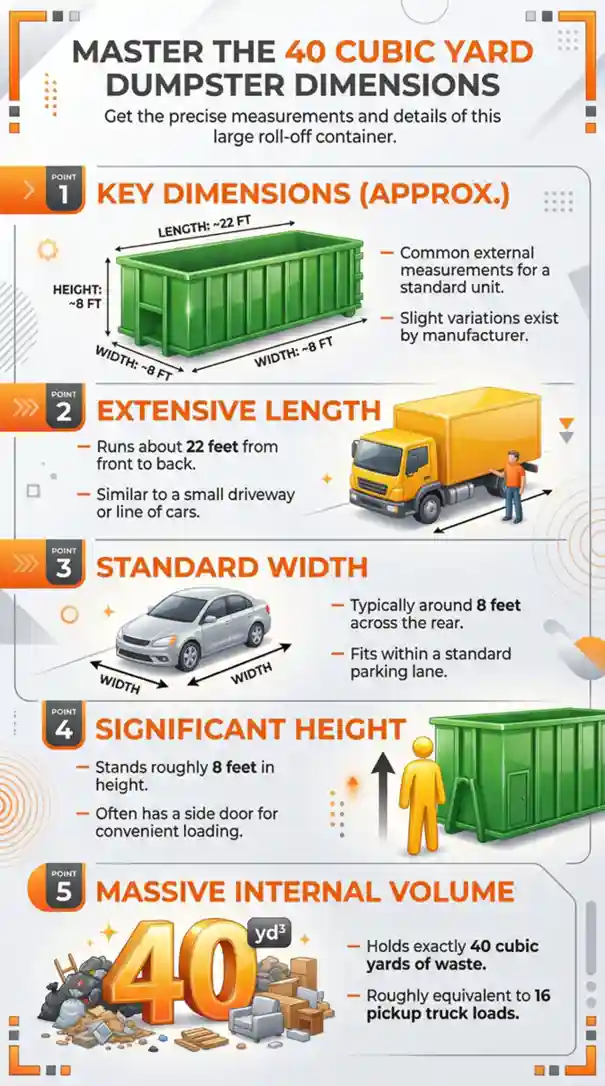
Standard measurements: 22 feet long, 8 feet wide, 8 feet tall
Footprint equals roughly two parking spaces end-to-end
Height demands overhead clearance planning before every delivery
Site conditions determine whether placement is even possible
Knowing the numbers matters. The customers who run into trouble are rarely the ones who got the dimensions wrong. They are the ones who never walked their placement area before booking.
Volume and Weight Are Two Different Problems
This is the insight most rental guides skip — and the one our crews discuss most.
Bulky, lightweight materials like furniture and drywall fill volume fast
Dense materials like concrete, brick, and roofing shingles hit weight limits before the container looks full
A 40-yarder loaded with demolition debris behaves very differently than one loaded with estate cleanout furniture
Right-sizing is not just about cubic yards. It is about knowing what your debris weighs — and planning for the limit that gets reached first.
The Projects That Genuinely Need a 40-Yarder Share These Traits
Debris generates continuously over multiple days
Materials are structural — not just surface-level cleanout items
The scope spans multiple rooms, floors, or the entire property
The job cannot pause while a smaller container gets swapped out
When all four conditions are present, the 40-yarder pays for itself — not just in capacity, but in uninterrupted project momentum.
Our Honest Opinion
Most residential customers do not need the largest container available. We would rather give you the right recommendation than the most expensive one.
But here is the perspective that does not show up in spec sheets: the cost of choosing too small is almost always higher than the cost of sizing up. Consider what a second haul, a delayed pickup, or an overloaded container means on an active job site:
Contractor schedules stall
Subcontractor dependencies back up
Permit windows close
A waste management bottleneck compounds into a project-wide delay
The 40 cubic yard dumpster exists because some projects produce debris at a scale that smaller containers cannot absorb. When your project is one of them, there is no substitute.
Not sure where your project falls? Send us photos of what you are removing. We have seen enough jobs to give you a straight answer — and we are not happy until you are.
FAQ on 40 Cubic Yard Dumpster
Q: What are the exact dimensions of a 40 cubic yard dumpster?
A: Standard dimensions: 22 feet long, 8 feet wide, 8 feet tall.
Key facts:
Length varies from 20 to 22 feet depending on the manufacturer
Width is consistent at 8 feet across most providers
Height of 8 feet is the dimension that surprises customers most
What our drivers check before every delivery:
Overhead clearance for branches and utility lines
Surface stability under loaded weight
Approach angle and turning radius for the delivery truck
A container that cannot be safely placed is a job that cannot move forward. Walk your placement area before booking.
Q: How much can a 40 cubic yard dumpster actually hold?
A: Capacity: 12 to 15 pickup truck loads. Roughly 230 to 250 standard trash bags uncompacted.
What our crews see consistently:
Furniture, drywall, and bulk household items max out volume first
Concrete, brick, and roofing shingles hit the weight cap before the container looks full
Mixed demolition loads can reach weight limits at half capacity
Weight allowance: typically 4 to 6 tons depending on provider and disposal facility.
One rule we share with every customer: confirm the weight allowance before loading starts. Overages appear on your invoice after the fact and are almost always avoidable.
Q: What projects is a 40 cubic yard dumpster best suited for?
A: The 40-yarder works best when debris generates continuously over multiple days and swapping containers is not an option.
Best suited for:
Full interior demolitions across multiple rooms
Whole-house and estate cleanouts with furniture and appliances
Large roof tear-offs on homes over 3,000 square feet
Commercial renovations and tenant buildouts
Storm damage cleanup with significant structural debris
Not the right fit for:
Single-room remodels
Garage or basement cleanouts
Light landscaping projects
Not sure which size fits your project? Send us photos of what you are removing. We will recommend the right container based on similar jobs we have completed.
Q: Do I need a permit to place a 40 cubic yard dumpster?
A: It depends on placement location.
General rule:
Private driveway or personal property — typically no permit required
Public street, sidewalk, or right-of-way — almost always requires one
What to expect:
Processing time: one to two weeks in most municipalities
Permit fees: $25 to $150 depending on location
Additional restrictions may apply near fire hydrants, crosswalks, and intersections
HOA communities often have separate placement requirements
Our advice:
Call your local public works department before booking
Apply at least one week before your scheduled delivery
Ask specifically about 40-yard container restrictions
Check HOA requirements if applicable
One phone call prevents last-minute delays that push back an entire project start date.
Q: What items cannot go in a 40 cubic yard dumpster?
A: Most construction debris and household items are accepted. Prohibited materials are the detail most customers miss until loading is already underway.
Prohibited items:
Paint cans, stains, and solvents
Batteries of all types
Pesticides, herbicides, and household chemicals
Refrigerators and AC units containing Freon
Automotive fluids, motor oil, and propane tanks
Electronics and medical waste
What our crews find on nearly every large cleanout: paint cans, batteries, and chemical bottles — stored in garages and basements for years and forgotten until a big project surfaces them.
Before your container arrives:
Walk your garage, basement, and all storage areas
Pull out anything on the restricted list and stage it separately
Contact your local household hazardous waste program for disposal options
It takes less than an hour. It prevents disposal fees, container rejections, and the project delays that follow.