I have taught these five steps to my own household, to guests during flu season, and to more than a few contractors who have tracked through my kitchen. The steps themselves are easy to remember, and the follow-through is where most of us come up short every day.
TL;DR Quick Answers
What is hand washing?
• Hand washing is the practice of cleaning the hands with soap, clean running water, and at least 20 seconds of friction to remove germs, dirt, and chemicals.
• The five CDC steps, in order, are: wet, lather, scrub, rinse, and dry.
• Scrub for a minimum of 20 seconds, which is about the time it takes to hum "Happy Birthday" twice.
• Water temperature does not affect germ removal, so warm and cold water work equally well.
• When soap and water are not available, use a hand sanitizer with at least 60% alcohol as a backup.
• The most important moments to wash are before eating, after the bathroom, before and after food prep, after coughing or sneezing, and after caring for anyone sick.
Top Takeaways
• The five steps in CDC order are: wet, lather, scrub, rinse, dry.
• Scrub time is at least 20 seconds. Humming "Happy Birthday" twice is the standard cue.
• Water temperature does not affect germ removal. Soap and friction do the actual cleaning.
• Hand sanitizer with at least 60% alcohol is the backup when soap and water are not available.
• Drying counts. Damp hands transfer germs faster than dry ones.
• Highest-priority moments: before eating, after the bathroom, before and after food prep, after coughing or sneezing, and after caring for someone sick.
The 5 Steps of Hand Washing, Explained
Hand washing has been an infection-control practice for well over a century. Wikipedia covers the broader history if you want that depth, and you can find a solid rundown of what is hand washing, including its types and benefits, over on Nowata Clean. My focus here is execution, because the CDC method only works when you follow it step by step.
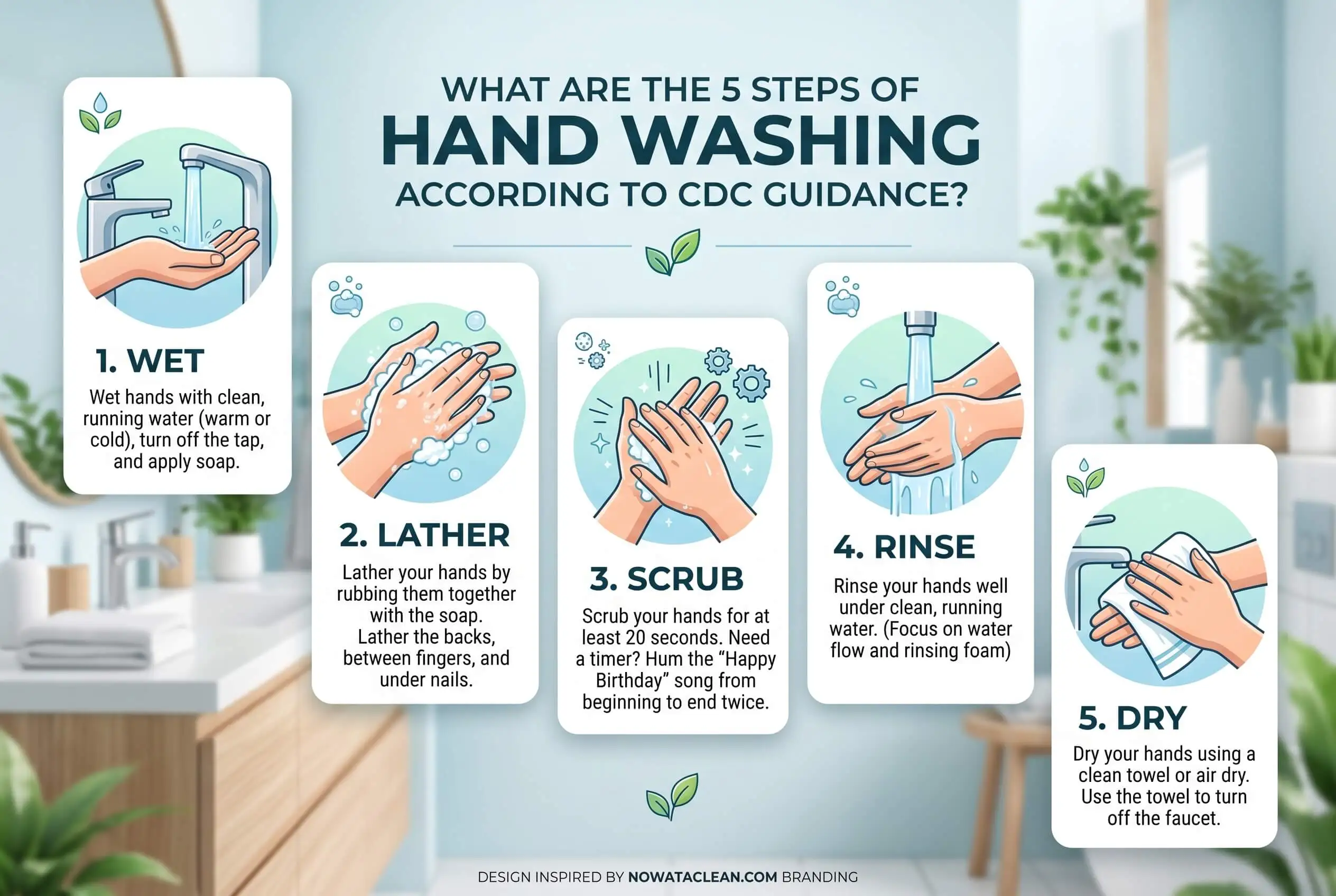
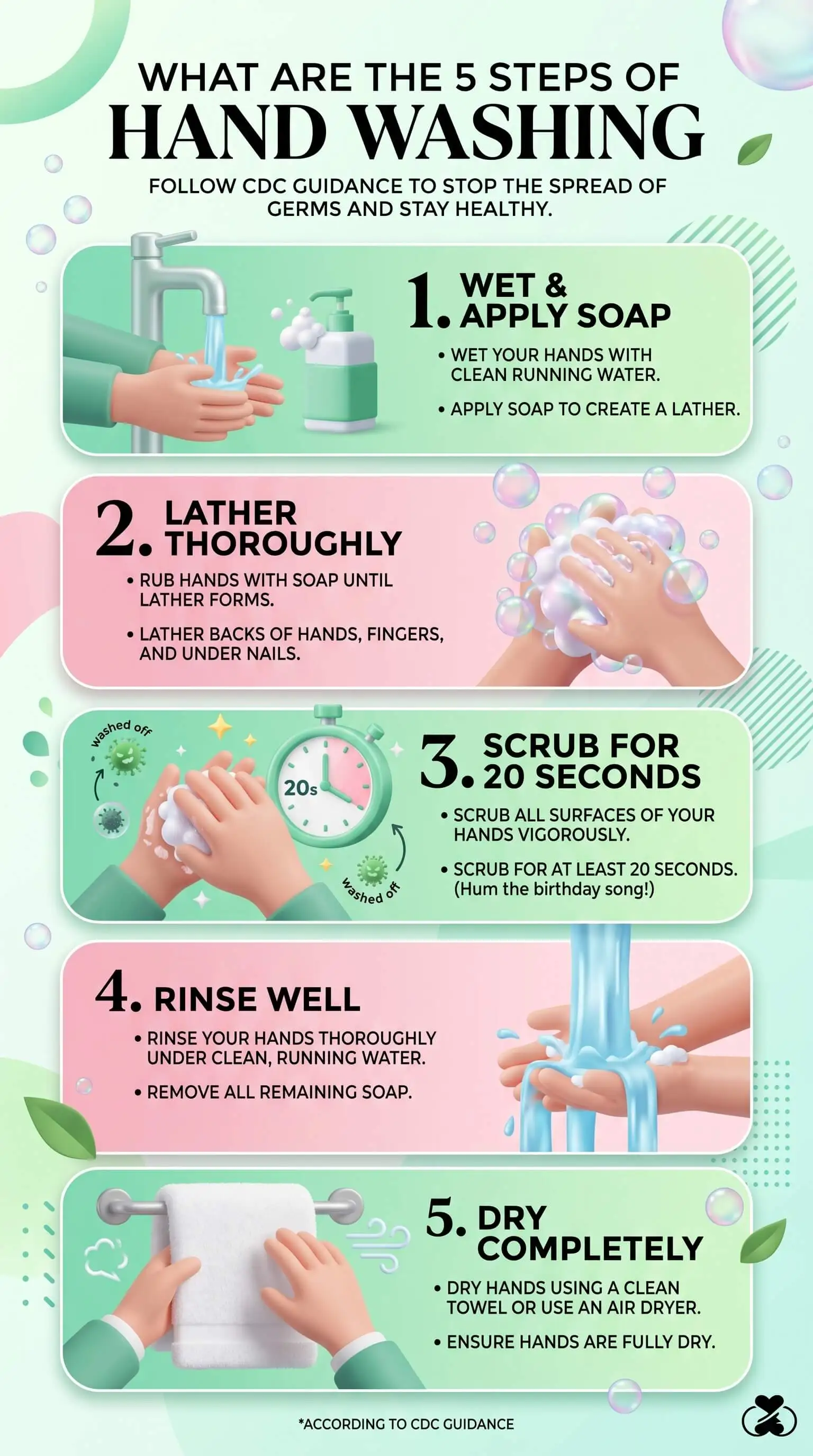
At a glance, here are the steps in the order the CDC wants you to follow them:
1. Wet your hands with clean, running water.
2. Lather with soap, covering the backs of your hands, between your fingers, and under your nails.
3. Scrub for at least 20 seconds.
4. Rinse well under clean, running water.
5. Dry with a clean towel or air dry.
Here is how to do each one the way the CDC intends.
1. Wet
Turn the tap on and wet your hands under clean running water. Water temperature does not matter for germ removal, so use whichever feels most comfortable. Turn the tap off before you pick up the soap to save water. Avoid standing water in a bowl or basin, since it can carry germs from whoever used it last.
2. Lather
Work the soap into a real lather. The spots people miss most often are the backs of the hands, the webbing between fingers, the thumbs, and underneath the nails. Lather traps germs in little pockets that get carried down the drain during the rinse, which only works if the soap is genuinely everywhere.
3. Scrub
This is the twenty-second step, and the one most people cut short. Count silently, hum a song, or use a phone timer. "Happy Birthday" sung from start to finish twice works, and so does any chorus you know by heart. Twenty seconds feels long the first few times you do it. After a week, it starts to feel right.
4. Rinse
Rinse under clean running water until all the soap is gone. The running water is doing two jobs: it carries the germs and chemicals away, and it keeps your clean hands from re-contacting the ones you already lifted off. If you want to avoid touching a shared faucet handle on the way out, a clean paper towel works for turning the tap off.
5. Dry
Dry your hands with a clean towel or let them air dry. This is the step I see skipped most often, usually in favor of a quick wipe on pants or a dishtowel that has been hanging near the sink all week. Damp hands transfer germs faster than dry ones, so the dry step is doing real work on every wash. Treat it accordingly.
"After a rough flu season a few winters back, I started paying attention to the home improvement habits of households in my circle that stayed healthy. The pattern had less to do with what they were buying and more to do with how much time they spent at the sink. If I had to give any family one habit to install, it would be a slow, deliberate twenty-second scrub on every wash, no exceptions. That is the change I have seen show up in fewer sick days year after year."
7 Essential Resources
These are the references I keep bookmarked when I write about hand hygiene. Every link below is live.
• CDC — About Handwashing: the five-step baseline every household guide traces back to. https://www.cdc.gov/clean-hands/about/index.html
• CDC — Handwashing Facts, Data & Research: the evidence base for how and why it works. https://www.cdc.gov/clean-hands/data-research/facts-stats/index.html
• CDC — Hand Hygiene Frequently Asked Questions: a solid reference for the edge-case questions. https://www.cdc.gov/clean-hands/faq/index.html
• CDC — Global Handwashing Day: campaign materials and family-friendly shareables. https://www.cdc.gov/clean-hands/globalhandwashingday/index.html
• CDC — Communication & Health Promotion Materials: printable posters, step guides, and kid-friendly graphics. https://www.cdc.gov/clean-hands/communication-resources/index.html
• CDC — Global Hygiene (WASH): hand washing in the wider context of water, sanitation, and hygiene. https://www.cdc.gov/global-water-sanitation-hygiene/about/about-global-hygiene.html
• NFID — #WashYourHands: short educational videos that show each step in real time. https://www.nfid.org/washyourhands-to-help-prevent-disease/
3 Statistics
The numbers below made me treat hand washing with the same seriousness I give any other household health habit.
• Regular hand washing can prevent about 1 in 3 diarrhea-related illnesses and about 1 in 5 respiratory infections like colds and the flu, according to the CDC. That is meaningful household protection from a free habit. Source: CDC Global Handwashing Day.
• Per the CDC, a single gram of human feces, roughly the weight of a paper clip, can contain one trillion germs. That is the scale of what a quick post-bathroom hand wash actually handles. Source: CDC Handwashing Facts.
• About 1.8 million children under age 5 die each year from diarrheal diseases and pneumonia, the two leading causes of death for young children worldwide. The CDC identifies hand washing as one of the most effective prevention tools we have. Source: CDC Handwashing Facts.
Final Thoughts and Opinion
The single change that would lower the germ load in an average American household more than any product upgrade I can name is a properly executed hand wash before every meal and after every bathroom trip. That is the habit that compounds. If one person in a house does it right, colds travel less far. Once the whole family is doing it right, flu seasons start to look different.
Hand washing belongs in the same category as changing your HVAC air filter or testing your indoor air quality. They are quiet, recurring household habits that do real work without needing any fanfare.
This page is for general informational purposes. If you have a health condition or specific medical questions, please talk to a qualified healthcare professional.
Frequently Asked Questions
How long should I wash my hands?
At least 20 seconds of active scrubbing, according to the CDC. That means 20 seconds between the moment your hands are fully lathered and the moment you start to rinse. If you need a built-in timer, two rounds of "Happy Birthday" gets you there.
Does hot water kill more germs than cold water?
No. The CDC is clear that warm and cold water remove germs equally well. Water hot enough to kill germs on your skin would scald you, which is not safe for washing. Soap and friction do the heavy lifting.
Is hand sanitizer as effective as washing with soap and water?
In most household situations, no. Soap and water is the CDC's first recommendation. Sanitizer helps when a sink is not available, and it should contain at least 60% alcohol to be effective. Sanitizer also does not work well on visibly dirty or greasy hands.
When are the most important times to wash my hands at home?
Wash before and after handling food, before eating, after using the bathroom, after changing a diaper, after blowing your nose, after coughing or sneezing, after handling pets, and after caring for someone sick. The CDC flags these as the highest-risk moments for germ transfer at home.
How do I teach kids to wash their hands correctly?
Run through the same five steps alongside them using eco-friendly soap. Sing together for the 20-second scrub, which makes it feel less like a chore. Show them the backs of the hands and under the nails, because those are the spots kids almost always miss. Gentle, regular reminders go further than strict rules here.
Should I turn off the faucet with a paper towel?
You can, and some people prefer to. The CDC notes that this practice uses more paper and does not have strong evidence behind it for health outcomes. If re-contamination worries you, use a paper towel or your elbow. If not, a normal tap-off is fine.
Your Next Step
Walk to your most-used sink right now, count to twenty the next time you wash, and see how close you were. Most people are off by at least half. If you want to keep building a household routine that supports your family's health, our guide on indoor air quality testing in your home is a natural next read. Clean hands and clean air solve a surprising amount before you ever need to call a professional.