The answer is more interesting than yes or no. True one-day rentals exist, and the pricing is real. The math often surprises homeowners, though: a single-day rate frequently lands within $25 of a weeklong rate from the same hauler. Below is what one-day pricing actually means in 2026, what counts as "small," and when paying for the longer window quietly saves you money.
TL;DR Quick Answers
How much does it cost to rent a small dumpster?
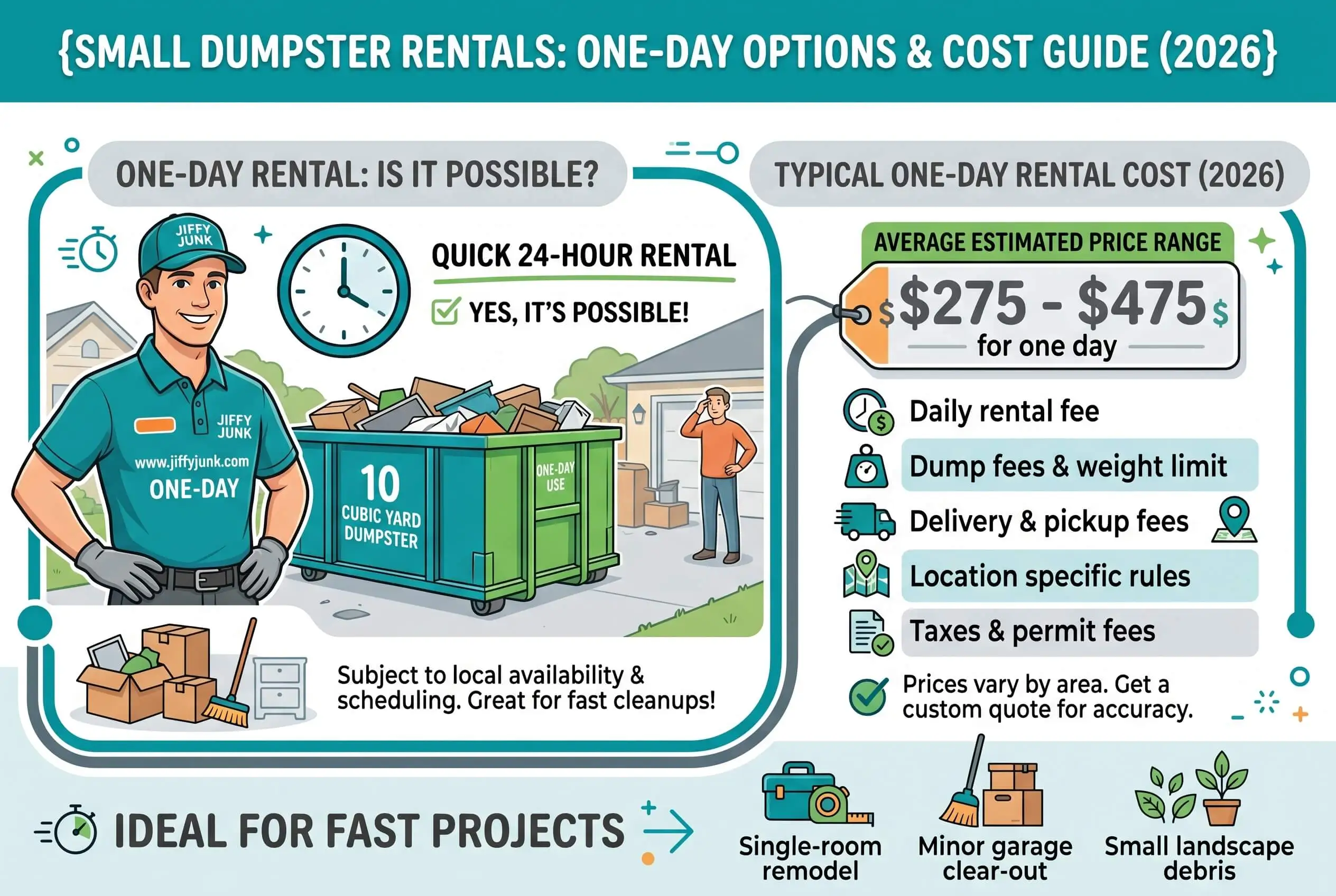
A small dumpster (10-yard or 15-yard) typically costs $250 to $450 for a one-day rental in most U.S. metros, with the national average near $325 for a 10-yard container. Most homeowners do not realize that the one-day rate is a flat fee covering two truck trips and disposal, not a discount on the weekly rate. A 7-day rental from the same hauler often runs only $25 to $75 more, so paying for the longer window is frequently cheaper once a project runs long. Most quotes include only one ton, with overages adding $50 to $100 per additional ton.
Top Takeaways
A small dumpster (10-yard or 15-yard) typically costs $250 to $450 for a one-day rental , with the national average around $325 .
A one-day rental is a flat-fee product, not a discount on the weekly rate. It usually costs the same as or more than a 3-day rental.
Six factors move the price the most: container size, region, weight allowance, pickup timing, permits, and debris type.
Coastal metros and the Northeast run 30 to 60 percent above the national average . The Midwest and Southeast tend to run below.
Tonnage overage is the single most common surprise charge. Most one-day rentals include only one ton, with $50 to $100 per additional ton.
Always get three written quotes and compare the 1-day, 3-day, and 7-day rates side by side — the longer window is often the cheaper choice.
Household hazardous waste (paints, solvents, batteries, certain electronics) cannot legally go in a standard dumpster. Handle these separately through your local HHW collection program.
The Short Answer: Yes, You Can Rent a Dumpster for Just One Day
Most national haulers default to 7-day or 10-day rental windows. Single-day pricing comes from three places: local independent providers, same-day "drop-and-pull" services, and junk removal companies that bundle drop-off and pickup on the same calendar day. None of them treat the one-day rate as a discount. They price it as a flat fee covering two truck trips and a disposal run, which is why the number often sits closer to the weekly rate than buyers expect for a home improvement project.
How Much Does It Cost to Rent a Small Dumpster?
A small dumpster runs $250 to $450 for a one-day window in most U.S. metros. The national average lands near $325 for a 10-yard container. Those numbers cover the standard package: bin to your driveway, pickup at the end of your window, and disposal of up to one ton.
The numbers do not cover the things most quotes leave out. Tonnage overages, street permits, mileage from the hauler's yard, and disposal surcharges on heavy materials each add cost. Together they push the final invoice $40 to $200 above the headline rate.
Ranges shift with regional cost-of-living, debris type, and seasonal demand. For a deeper breakdown by container size and region, including the surcharges that haulers commonly leave out of headline quotes, this guide on how much does it cost to rent a small dumpster covers small and roll-off dumpster pricing in detail.
What Counts as a "Small" Dumpster
In rental terms, "small" means a 10-yard or 15-yard residential container. A 10-yard dumpster runs about 12 to 14 feet long, 8 feet wide, and 3.5 feet tall . That works out to roughly three pickup truck loads, or about 1.5 tons of debris . It handles a single-room renovation, a half-garage cleanout, a small roof patch, or a few pieces of household furniture mixed in with construction debris.
What it does not handle: full-roof tear-offs, whole-house cleanouts, or concrete-and-dirt-heavy loads. Those exceed standard tonnage allowances, and you will need a specialty container.
What Drives the Price of a One-Day Rental
Six factors do most of the work in moving a one-day quote up or down.
Container size. Each step from 10-yard to 20-yard adds roughly $50 to $100 to the base rate.
Geography. Coastal metros and the Northeast quote 30 to 60 percent above the national average. The Midwest and Southeast usually quote below.
Weight allowance. Most one-day rentals include one ton . Anything heavier adds $50 to $100 per additional ton .
Pickup timing. Same-day pickup commits a truck to a tighter window, which costs more than overnight scheduling.
Permits. If the bin sits in the street, your city wants a permit. Fees run $25 to $200 depending on the municipality.
Debris type. Clean fill, mixed C&D, and heavy materials each carry different disposal rates at the landfill.
One-Day vs. Weeklong: Which Is Actually Cheaper?
A one-day rental is not always cheaper than a 7-day rental. Many haulers price one-day jobs as a flat drop-and-pull fee covering two truck trips. A weeklong rental adds only incremental yard-storage cost.
We have seen quotes where the 7-day rate runs $50 to $75 above the one-day rate — and if your project might run long, paying for the extra time up front is the lower-risk move. The one-day rental wins clearly only when debris is pre-sorted, the bin will fill in hours, and same-day pickup is operationally available in your zip code.
"The biggest mistake homeowners make is assuming a shorter rental equals a cheaper bill. It rarely does. When we drop a bin and pull it the same day, the truck makes two trips and the load goes through one disposal run, all packed into eight hours. Our cost structure does not change just because the bin sits on your driveway for fewer hours. What does save money is being honest about what you're throwing away. A garage of clean wood and cardboard disposes for half the cost of mixed C&D with drywall and old shingles. Tell us the load up front, we quote the right size and the right disposal rate, and you skip the surprise overage on the back end."
7 Essential Resources
We pulled the following from federal, industry, and engineering sources we routinely cross-reference when working through cost estimates and compliance questions. Every link below has been verified as current.
EPA: Construction and Demolition Debris — Material-Specific Data. The federal benchmark for understanding how renovation debris flows through the U.S. waste stream. Useful for anyone trying to estimate what their project will generate. Visit the EPA C&D debris page.
EPA: Sustainable Management of Construction and Demolition Materials. Best practices for reducing, reusing, and recycling C&D debris before it ever needs a dumpster. Read the EPA SMM guide.
EPA: Household Hazardous Waste (HHW). Critical reading before any cleanout. Paints, solvents, batteries, and certain electronics cannot legally go in a standard dumpster. Read the EPA HHW guidance.
EPA: Household Hazardous Waste and Demolition. Specific guidance for HHW found during residential demolition or renovation, which is the exact scenario that drives most small-dumpster rentals. Read the EPA HHW + demolition guidance.
EPA: National Overview — Facts and Figures on Materials, Wastes, and Recycling. Headline numbers on what Americans throw away each year and where it ends up. Useful context for sizing a project. Visit the EPA national overview.
ASCE: 2025 Solid Waste Infrastructure Report Card. The American Society of Civil Engineers' assessment of U.S. waste infrastructure, with current tipping fees and industry revenue figures that explain why disposal costs vary by region. Read the ASCE Solid Waste Report Card.
EPA: Advancing Sustainable Materials Management — Facts and Figures Report. The most recent EPA fact sheet on materials, MSW, and C&D debris streams. Read the EPA SMM Facts and Figures report.
3 Statistics
Numbers from federal and engineering sources that explain why pricing varies the way it does:
600 million tons of construction and demolition debris were generated in the United States in 2018, more than twice the amount of municipal solid waste produced that year. Renovation and demolition activity is the largest single source of debris flowing into the U.S. waste stream. Source: U.S. EPA.
The average American generated 4.9 pounds of municipal solid waste per person per day in 2018, with total MSW generation reaching 292.4 million tons. For a household of four, that adds up to roughly 7,150 pounds of trash per year. It is a useful baseline for understanding why even a "small" cleanout can fill a 10-yard dumpster faster than expected. Source: U.S. EPA.
The U.S. waste and recycling industry was worth approximately $91 billion in revenue in 2022, and the average landfill tipping fee was $56.80 per ton in 2023. Tipping fees are the single largest line item inside a dumpster rental quote. When you see a regional price gap, the underlying landfill rate is usually doing the heavy lifting. Source: ASCE Infrastructure Report Card.
Final Thoughts and Opinion
After comparing dozens of quotes across markets, our honest take is that the one-day dumpster rental is one of the most over-marketed and under-delivered products in residential hauling. The phrase implies a discount that almost never exists. Truly cheap one-day rentals only happen in a handful of scenarios: pre-sorted loads, dense metros with same-day pickup capacity, and providers who run their own disposal yards. Outside of those, you are paying the same flat-fee structure as a weeklong rental for the privilege of an artificial deadline.
Our recommendation: get three written quotes. Ask each provider whether their one-day rate includes tonnage and same-day pickup. Then ask point-blank what the 3-day or 7-day rate would cost. About half the time , the longer window comes in $25 to $75 cheaper because it spares the hauler a same-day truck commitment. That extra room is also insurance against the project running long, which residential cleanouts almost always do.
Frequently Asked Questions
Is there a true same-day dumpster rental option?
Yes, but availability concentrates in dense metros and depends on the local hauler's truck schedule. True same-day service means the bin gets dropped and picked up on the same calendar day, usually within an 8-hour window. Expect to pay $50 to $100 more than a standard one-day rate for the time-window guarantee.
What is the cheapest size dumpster I can rent for a single day?
A 10-yard residential dumpster is the smallest standard size most haulers carry, and it is the cheapest one-day option. Typical pricing runs $250 to $400 depending on region. A handful of providers offer smaller "mini-dumpster" or trailer-style bins under 10 yards in select markets, with one-day rates as low as $200 , though availability is limited.
Do dumpster rental companies charge by the hour?
No. Standard residential dumpster rentals are priced as a flat fee for the rental window, not by the hour. The flat fee covers drop-off, pickup, the rental period, the included tonnage allowance, and disposal. The only hourly billing you might see is on add-on services like loading labor, or unscheduled extension fees if you keep the bin past the agreed return time.
Can I rent a dumpster for less than 24 hours?
Operationally, yes. The bin can sit on your driveway for as little as a few hours before pickup. The price will not drop below the standard one-day rate, though, because the hauler's cost structure stays the same whether the bin is on-site for 4 hours or 24. The two truck trips and the disposal run cost what they cost. There is no sub-day discount in residential dumpster rental.
Are one-day dumpster rentals cheaper than hiring a junk removal crew?
It depends on volume and effort. For a small load, under half a 10-yard dumpster, where a crew can load and haul in under two hours, junk removal is often cheaper because you pay for the truck space you actually use. For larger loads where you want to load on your own schedule, the dumpster wins on per-cubic-yard cost.
Do I need a permit for a one-day dumpster on my property?
On private property like a driveway, no permit is needed in most municipalities. If the dumpster sits in the street, on a sidewalk, or in any public right-of-way, you almost always need a permit. Costs run $25 to $200 depending on the city, with a lead time of 3 to 10 business days . Always check with your local public works office before scheduling drop-off.
Ready to Get a Quote?
If you have a project lined up and want to compare actual pricing for your zip code, the most useful next step is reading a full breakdown by container size and region. This guide on small and roll-off dumpster rental prices covers cost ranges along with the surcharges most quotes leave out. Compare three written estimates. Ask each provider what their tonnage and pickup-window rules are. You will avoid the two most common surprise charges in residential hauling.
If you have questions we did not cover, drop them in the comments. We read every one and update the article when patterns emerge.