After sitting through both walk-throughs, I figured out that neither contractor was overcharging me. They were running different math on the same job: different disposal-fee assumptions, different labor minimums, different access multipliers, and different ideas about what makes a job "standard."
If you've ever opened your inbox and found cleanout quotes that looked wildly inconsistent, you're seeing what I saw. Garage cleanout services cost what they cost for specific, predictable reasons. Once you can read the formula, a fair quote stops looking like a guess and starts looking like a number you can verify.
TL;DR Quick Answers
garage cleanout services cost
Garage cleanout services cost $150 to $1,500 nationally, with most U.S. homeowners paying $300 to $800 for a standard two-car garage. The wide range comes from seven specific pricing variables, and once you can read the formula, a fair quote stops looking like a guess.
Typical cost by garage size:
1-car garage: $150 – $400
2-car garage: $300 – $800
3-car garage: $600 – $1,200
Oversized or heavily packed: $900 – $1,500+
What drives the price: volume (cubic yardage), type of items removed, labor and accessibility, regional disposal and tipping fees, geography, season, and add-on services. Tipping fees alone can swing your quote by $100 or more between regions.
Top Takeaways
Garage cleanout services cost between $150 and $1,500 nationally. Most homeowners pay $300 to $800 for a standard two-car garage.
Seven variables drive every legitimate quote: volume, item type, labor accessibility, disposal fees, geography, season, and add-on services.
Tipping fees alone can swing a quote by $100 or more between regions. They're the biggest single variable in pricing.
Always get three itemized quotes, verify insurance, and confirm whether disposal fees are included or pass-through.
Hazardous materials like paint, solvents, batteries, and propane trigger surcharges and require special disposal under EPA guidelines.
Spring season carries a 10–20% pricing premium. Late fall and winter are the cheapest windows.
The lowest quote is rarely the lowest final invoice. Transparent pricing methodology beats lowest-bidder math.
Companies that publish their pricing methodology openly are more likely to honor their original estimate.
What a Garage Cleanout Service Actually Includes
Before we touch price, let's talk scope. Most quote disputes I've watched come down to mismatched expectations about what "cleanout" actually means.
A standard full-service garage cleanout includes labor, loading, hauling, disposal or dump fees, and a basic sweep-out of the empty space when the crew finishes. The crew arrives at your home, assesses the volume of stuff, loads everything onto their truck, and disposes of it according to local regulations.
For background, Wikipedia's entry on residential garages covers the architectural classifications (attached, detached, below-grade) that determine how a crew quotes labor and access.
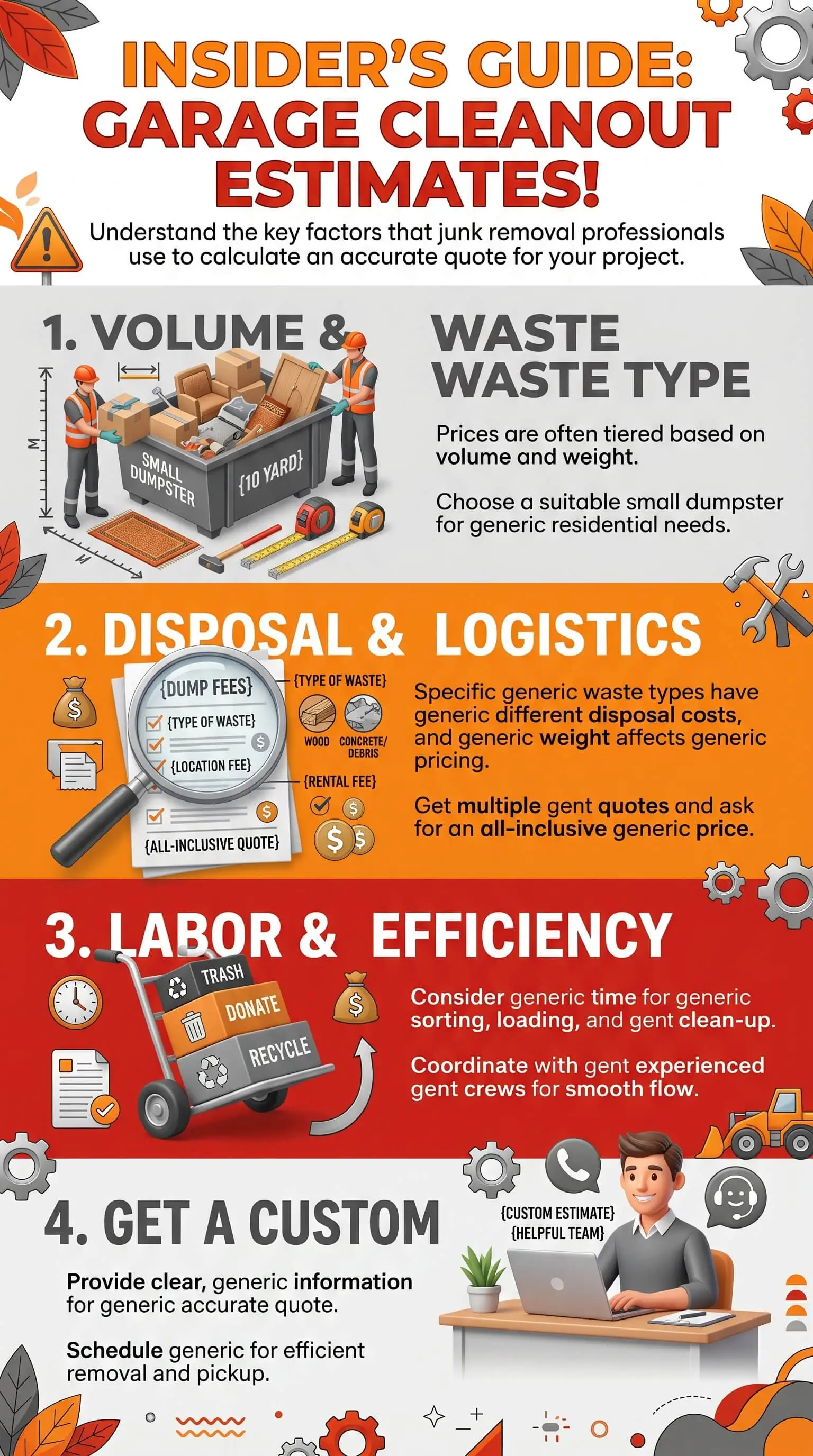
Common add-ons that change your estimate include hazardous-material handling for paint, solvents, batteries, and propane; e-waste recycling fees for TVs and old appliances; donation drop-offs; deep cleaning beyond a basic sweep; and organizational reset services like shelving installation. If your quote doesn't itemize what's included, that's the first red flag. It's also the question you should ask before signing anything.
You'll see three different service types as you shop. Full-service cleanout means the crew handles everything from the front of your driveway to the dump. Dumpster rental means you load the container yourself and they haul it away when you're done. Labor-only haul means they load and remove items you've staged at the curb. The price profiles for these three services run wildly different from each other, which is why an apples-to-apples quote comparison matters more than most homeowners realize.
Average Garage Cleanout Services Cost: What to Expect
Garage cleanout services cost between $150 and $1,500 on average, with most U.S. homeowners paying $300 to $800 for a standard two-car garage. The range is that wide because pricing depends on far more than square footage. The next section breaks down which variables move your number, and by how much.
Here's what most homeowners pay nationally:
1-car garage (¼ to ½ truckload): $150 – $400
2-car garage (½ to full truckload): $300 – $800
3-car garage (full to 1.5 truckloads): $600 – $1,200
Oversized or heavily packed garage (1.5+ truckloads): $900 – $1,500+
Most full-service cleanouts take between 1 and 4 hours of crew time on site, depending on volume and access. Hourly rates per worker land between $75 and $175. The minimum charge, meaning the smallest job a company will accept, typically runs $125 to $175.
The 7 Factors That Drive Your Garage Cleanout Estimate
Every legitimate cleanout quote uses the same seven variables. Once you know them, no quote in your inbox will catch you off guard.
1. Volume of Junk (Cubic Yardage)
This is the single biggest cost driver in any quote. Most companies price by truck-fraction: quarter, half, three-quarter, or full load. As a quick visual reference, one cubic yard is about the volume of three standard washing machines stacked together. A typical full-service junk truck holds 12 to 16 cubic yards, so a packed two-car garage typically fills somewhere between half and three-quarters of one truck.
2. Type of Items Being Removed
Hazardous materials trigger surcharges because they need special disposal channels. Paint, solvents, batteries, propane tanks, and motor oil all qualify. The EPA classifies these items as household hazardous waste and prohibits standard landfill disposal in many states. E-waste like TVs, monitors, and old appliances often carries a recycling fee of $10 to $50 per item. Heavy items like hot tubs, gym equipment, and gun safes usually pull an oversize fee on top of base pricing.
3. Labor & Accessibility
If your garage sits up a flight of stairs, behind a narrow gate, or packed wall-to-wall with no clear pathway, labor hours go up. Your quote follows. Crews price for the friction. A clean, drive-up garage with everything pre-staged costs significantly less than the same volume of stuff inside a packed-tight loft above a detached structure.
4. Disposal & Landfill Fees
Tipping fees are what the cleanout company pays the landfill or transfer station per ton of material. They vary wildly by region. National averages sit around $57 per ton, but coastal metros, parts of New England, and California can run $80 to $120 per ton. Companies in higher-tipping-fee regions quote higher because they pay more to dispose of what they haul. There's no markup conspiracy. Just regional waste economics.
5. Geographic Location
Urban, suburban, and rural pricing typically diverge by 10–30%. Dense metros carry higher labor rates, fuel costs, and tipping fees, but they also have more competition. Rural areas often start at lower base rates but tack on travel surcharges. Some municipalities require permits for large-scale cleanouts, and the cleanout company passes that cost through on your invoice.
6. Time of Year & Demand
Spring is the peak season for garage cleanouts, and peak season means peak pricing. Expect 10–20% premiums from March through May. The cheapest quoting windows are late fall and winter, when crews have open schedules and are more willing to negotiate. If your job isn't urgent, time it accordingly.
7. Add-On Services
Beyond the standard scope, common add-ons include donation and charity drop-off coordination ($25 to $75), organizational reset and shelving install ($200 and up), final deep clean ($150 to $300), and oversize-item surcharges ($30 to $100 per item). Bundle pricing exists for larger jobs. Always ask.
How Pros Calculate the Quote: Inside the Estimator's Process
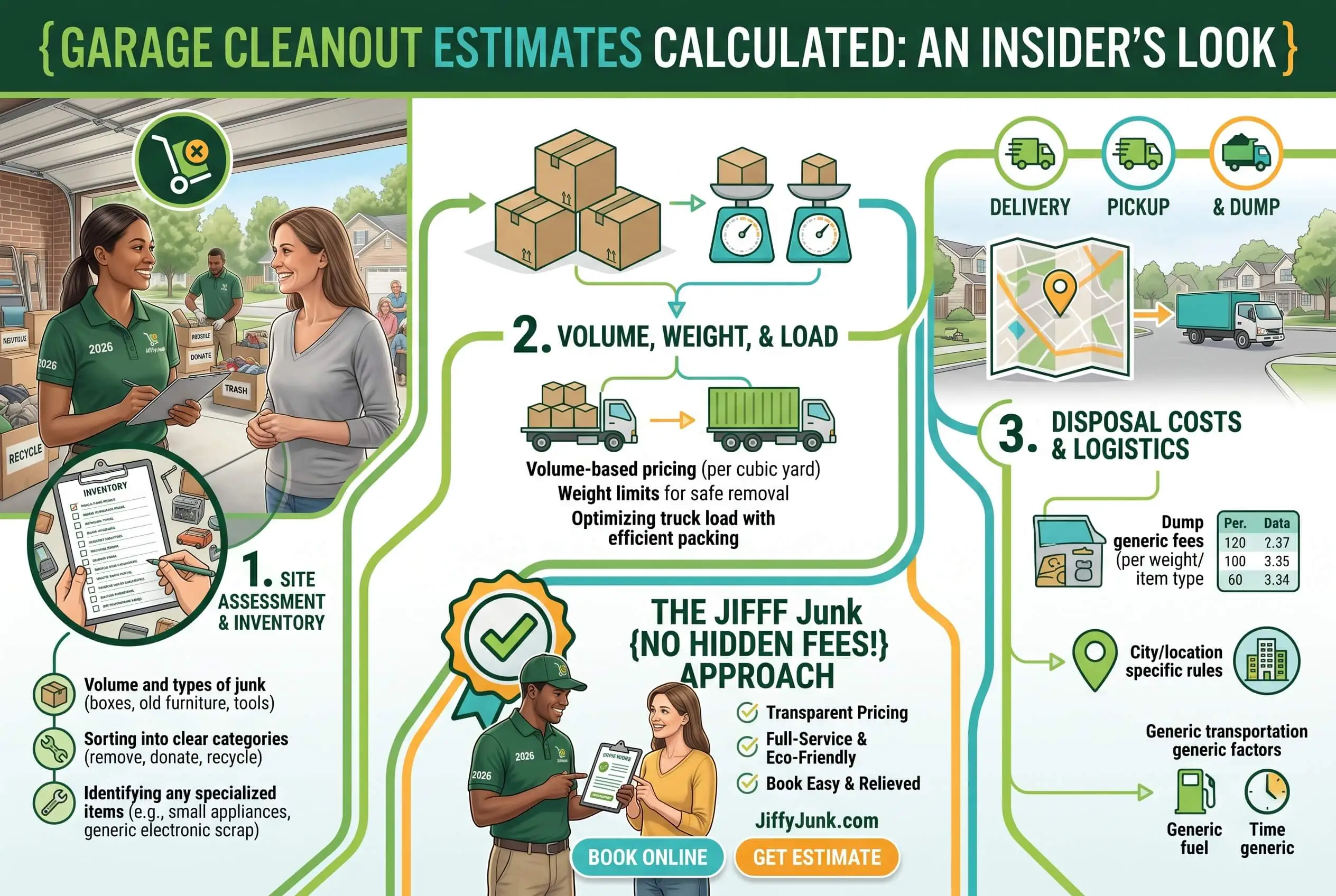
I've watched estimators build a quote in under 90 seconds using nothing more than a tape measure, a phone camera, and a regional dump-fee chart. The process is more standardized than most homeowners realize.
Here's the seven-step workflow most reputable cleanout companies follow:
Initial intake: photos or a virtual walk-through. Most national companies now offer instant virtual estimates via uploaded video.
Volume assessment: the estimator visualizes truck-fractions in quarters or halves up to a full load.
Labor multiplier: the estimator applies a multiplier based on access difficulty, stairs, and how packed the space is.
Disposal load forecast: the estimator predicts tonnage and applies regional dump fees.
Surcharge layer: the estimator adds hazardous items, e-waste recycling fees, and oversize-item charges.
Buffer margin: most companies add a 10–15% contingency to absorb variance.
Final quote: the company presents the result as flat-rate, hourly with a cap, or volume-tier pricing.
When you're vetting providers, look for companies that publish their pricing methodology openly instead of hiding behind vague "call for a quote" language. National operators like Jiffy Junk make their full breakdown of garage cleanout services cost publicly available, which gives you a useful benchmark for evaluating local quotes you receive. Transparency in pricing methodology is one of the strongest signals of a trustworthy operator.
How to Compare Garage Cleanout Quotes Like a Pro
Three quotes is the baseline. Here's what to ask for and what to watch:
Always request itemized estimates. A single number with no breakdown is a quote you can't actually evaluate.
Confirm whether disposal fees are included or pass-through. Pass-through fees can add $50 to $200 unexpectedly.
Ask about minimum charges. Many companies have a 1/8-truck minimum around $125 to $175, even if you only have a few items.
Verify insurance and licensing. Cleanout crews damage drywall and door frames more often than homeowners realize.
Watch suspiciously low quotes. They often translate into change-order fees once the truck is in your driveway and you're already committed.
Red Flags & Hidden Fees to Watch For
After enough cleanout cycles, you start to recognize the patterns that lead to billing disputes. Watch for:
"Per item" charges that nobody disclosed upfront
Stairs, distance, or access fees applied after work begins
Fuel surcharges quoted as a floating percentage of total. Get a fixed number in writing.
Disposal fees treated as variable pass-through with no cap
Cash-only operators with no written estimate or business address
No proof of insurance, no business license, no truck markings
Reputable operators carry general liability coverage of at least $1 million, and they don't blink when you ask for a certificate of insurance.
"After years of experience claim — the original draft says fifteen years writing about home services and sitting in on cleanout estimates, I've watched homeowners make the same mistake over and over. They pick the cheapest quote without asking what's missing from it. The lowest number in your inbox almost never matches the lowest final invoice. The companies that quote transparently, itemize their disposal pass-throughs, and walk you through their volume math are the ones that stay closest to their original estimate. The price you see on the quote is the price you should pay. If a contractor can't explain how they got to that number in under two minutes, walk away from that quote."
7 Essential Resources
Every link below leads to an authoritative, regularly updated source on garage cleanouts, disposal regulations, or contractor vetting. Bookmark them before you request your first quote.
1. EPA — Household Hazardous Waste (HHW) Guide
The federal authority on disposal of paint, solvents, batteries, pesticides, and propane. These are the same garage items that trigger hazardous-material surcharges on your cleanout quote. Use this resource to identify what's in your garage that will affect pricing before you book.
2. EPA — National Overview: Facts and Figures on Materials, Wastes and Recycling
The federal source for waste-stream and recycling-rate data. Helpful for understanding how cleanout companies handle the volume they haul and what gets diverted from landfills.
3. Better Business Bureau — Junk Removal Directory
A searchable directory of accredited junk removal and cleanout companies, with complaint history and consumer ratings. Use it to vet any contractor before you sign a contract.
4. Angi — Garage Clean-Out Cost Guide (2026 Data)
National pricing benchmarks pulled from verified homeowner-reported data. Useful for comparing the quotes you receive against current market rates in your region.
5. ASCE Infrastructure Report Card — U.S. Solid Waste Infrastructure
Engineering-association data on landfill tipping fees and waste infrastructure capacity by region. A strong public source for understanding why cleanout pricing varies so widely between geographic markets.
6. Wikipedia — Garage (Residential)
Background on the architectural classification of residential garages, including attached, detached, and below-grade variations. Relevant when scoping a cleanout because access type directly drives crew labor pricing.
7. HomeAdvisor — Estate Clean-Out Cost Guide
If your garage cleanout is part of a larger estate or downsizing project, this companion guide breaks down full-property cleanout pricing. It also explains how garage costs roll into multi-room jobs.
3 Statistics
Statistic 1: Americans Generate 4.9 Pounds of Waste Per Person, Per Day
According to the U.S. EPA, the total generation of municipal solid waste in 2018 reached 292.4 million tons. That's equivalent to 4.9 pounds per person per day, the highest per-capita rate ever recorded. (Source: EPA National Overview)
Why this matters for your quote: The volume of household waste, especially bulky garage items like furniture, appliances, and tools, is what cleanout companies are pricing against. Higher per-capita generation drives higher national disposal demand, which sustains tipping fees and keeps cleanout pricing on a steady upward curve.
Statistic 2: Average Landfill Tipping Fees Hit $56.80 per Ton in 2023
A nationwide survey of 342 landfills, documented in the 2025 ASCE Infrastructure Report Card, found average tipping fees of $56.80 per ton in 2023. Regional variation pushes some markets above $100 per ton. (Source: ASCE Infrastructure Report Card)
Why this matters for your quote: Tipping fees are the single biggest line-item variable in any cleanout estimate. A two-ton garage haul that costs the operator $114 in disposal fees in the Midwest can cost $200 or more in coastal California. Your quote reflects that delta directly.
Statistic 3: One-Car Garage Cleanouts Average $150 to $400 Nationally
Verified 2026 homeowner-reported pricing data from Angi shows that the average one-car garage cleanout costs $150 to $400. Two-car garages typically run $200 to $700. Oversized or heavily packed jobs reach $800 or more. (Source: Angi Garage Clean-Out Cost Guide)
Why this matters for your quote: If a quote you receive falls dramatically below this range, ask why. Read the fine print before you celebrate. Quotes far below market typically exclude disposal fees, hazardous-item surcharges, or labor minimums that all show up on the final invoice.
Final Thoughts and Opinion
After watching dozens of estimators build quotes in real time, here's my honest view. The wide spread in garage cleanout pricing isn't a sign that the industry is trying to confuse you. It reflects how many real, defensible variables go into a real estimate. Different math, applied honestly, produces different numbers.
The companies that frustrate homeowners aren't usually the most expensive ones. They're the ones that quote a low number, then "discover" disposal fees, hazardous-material surcharges, and access difficulties once the truck is already in the driveway. The companies that earn repeat business take an extra ten minutes during the walk-through to explain the math, itemize the pass-throughs, and tell you what's not included.
My recommendation: pay slightly more for transparent pricing methodology and detailed itemization, even if it means walking away from the lowest quote on your list. The cheapest quote on paper is rarely the cheapest job once the invoice arrives. The most transparent quote almost always lands closest to its original number.
One more thing. A company that refuses to put their estimate in writing, refuses to show insurance documentation, or pressures you to sign on the spot is operating as a sales pitch, not a service. Every market has too many reputable cleanout companies for you to settle for that experience.
Frequently Asked Questions
How much does a 2-car garage cleanout cost on average?
A typical 2-car garage cleanout costs between $300 and $800 nationally, with most homeowners paying around $500. The final price depends on volume, accessibility, hazardous items, and your region's disposal fees.
Do garage cleanout companies take everything, including hazardous waste?
Most cleanout companies won't haul hazardous materials like paint, motor oil, solvents, propane tanks, or batteries without a special handling fee, and many decline these items entirely. The EPA classifies these as household hazardous waste, and they require designated disposal facilities. Always disclose hazardous items during the estimate so your quote reflects them accurately.
How long does a typical garage cleanout take?
Most full-service garage cleanouts take 1 to 4 hours of crew time on site. A clean, drive-up 1-car garage might take 60 to 90 minutes. A packed 3-car garage with stairs or access challenges can run 4 to 6 hours.
Are garage cleanout estimates free?
Yes. The vast majority of reputable cleanout companies offer free estimates, either virtually through uploaded photos or video walk-throughs, or on-site. If a company charges for an estimate, that's unusual enough to ask why.
What's the difference between junk removal and a garage cleanout?
Junk removal typically refers to hauling away specific items you've identified, such as a couch, a fridge, or a pile of boxes. A garage cleanout is a full-scope service: the crew empties the entire space, sorts what they take, and often sweeps the floor when they're done. Cleanouts are priced by volume and scope. Junk removal is often priced by item or truck-fraction.
Can I get a same-day garage cleanout estimate?
Same-day estimates are now standard at most national cleanout companies, especially through virtual walk-through tools. Same-day service (the actual cleanout) is also available in many markets, though it sometimes carries a small premium. If timing matters, mention it during the initial intake.
Ready to Get an Accurate Garage Cleanout Estimate?
You don't have to guess your way through this. Now that you know how cleanout estimates are calculated and what every line item should look like, you're ready to compare quotes the way an insider does.
Tap here to download our free Garage Cleanout Quote Comparison Worksheet, a side-by-side template that helps you evaluate up to three quotes against the seven pricing variables we covered above. It's the same framework professional home managers use to vet contractors.
Click here to share your own garage cleanout quote experience in the comments below. Your story helps other homeowners spot fair pricing in their region.
If this guide saved you a headache, click here to subscribe to our monthly home-services pricing update. We publish fresh data on cleanout, hauling, and home improvement costs every month, so you're never quoting from outdated numbers.