After more than a decade of helping homeowners through cleanouts, downsizes, estate clearances, and renovation chaos, I can tell you the answer rarely turns on what kind of furniture you have. It turns on three simple variables: condition, resale value, and how much time you have to deal with it. Get those three right, and the choice gets obvious fast.
Modern furniture is also more complicated than it used to be — composite woods, foam blends, and synthetic upholstery all behave differently at end-of-life — so the responsible choice depends on what you're actually working with. This guide walks you through how to size up the piece in front of you and pick the right path, whether that's donating it tomorrow, selling it next month, or getting rid of old furniture today through professional pickup. By the end, you'll have a defensible answer for every piece in your home.
TL;DR Quick Answers
Getting rid of old furniture
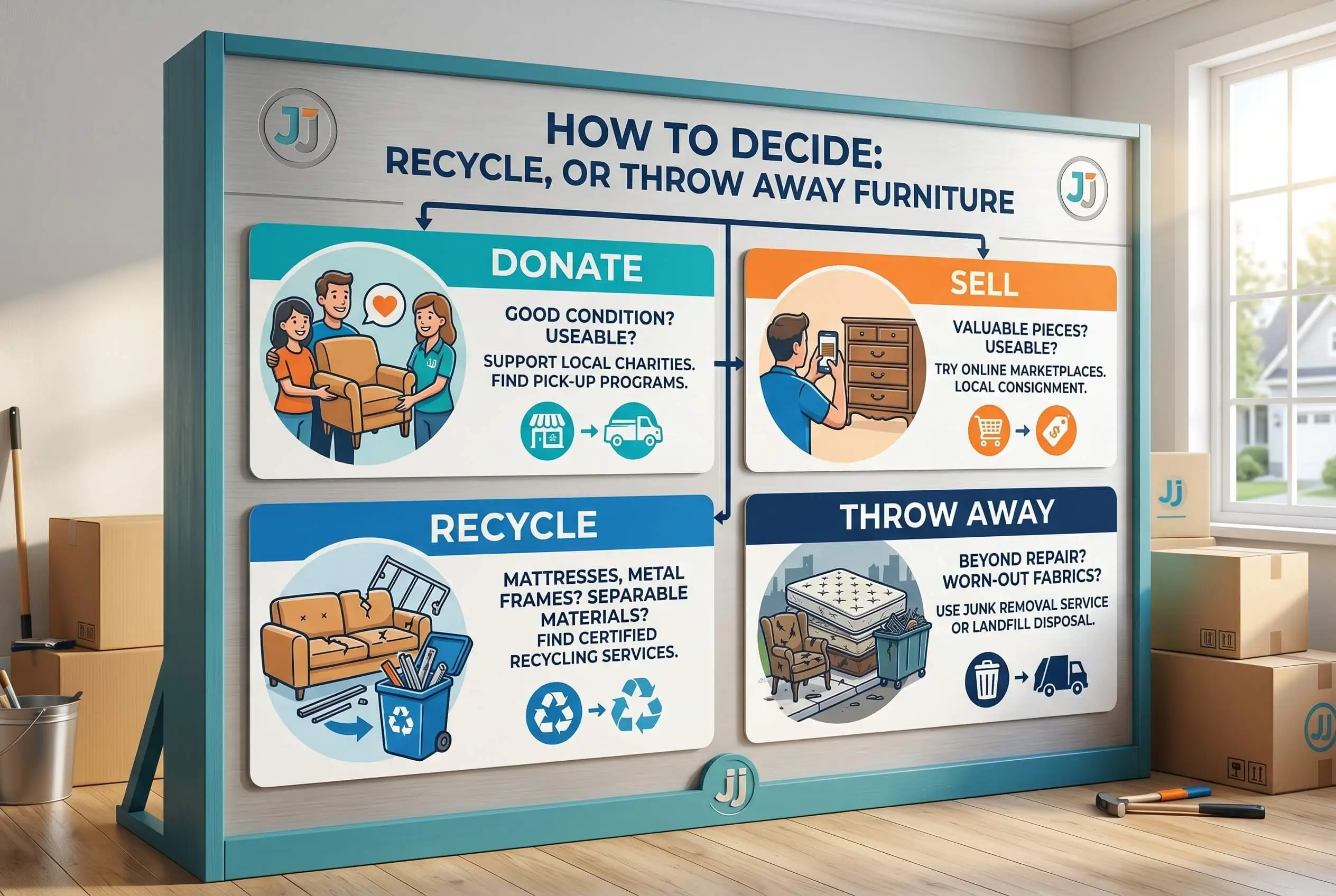
The decision turns on three variables, not the type of furniture: condition, resale value, and how much time you can spend dealing with it.
Good condition? Donate. Habitat for Humanity ReStore, The Salvation Army, and local furniture banks haul free within 1–3 weeks.
Real resale value? Sell on Facebook Marketplace or Chairish, with a 7-day deadline.
Recoverable materials but damaged? Recycle through Earth911's ZIP-code search, or a mattress program like Bye Bye Mattress (CA, CT, OR, RI).
Broken, infested, or cheap particleboard? Hire junk removal ($75–$200 per piece) or schedule municipal bulky-waste pickup.
In our experience, donation is the right call far more often than people expect. The hours spent chasing a Facebook sale rarely pencil out against the $80 you'll net.
One rule with no exceptions: never drag furniture to the curb on a non-pickup day. It's illegal almost everywhere in the U.S., and fines run from $100 to $1,000.
Top Takeaways
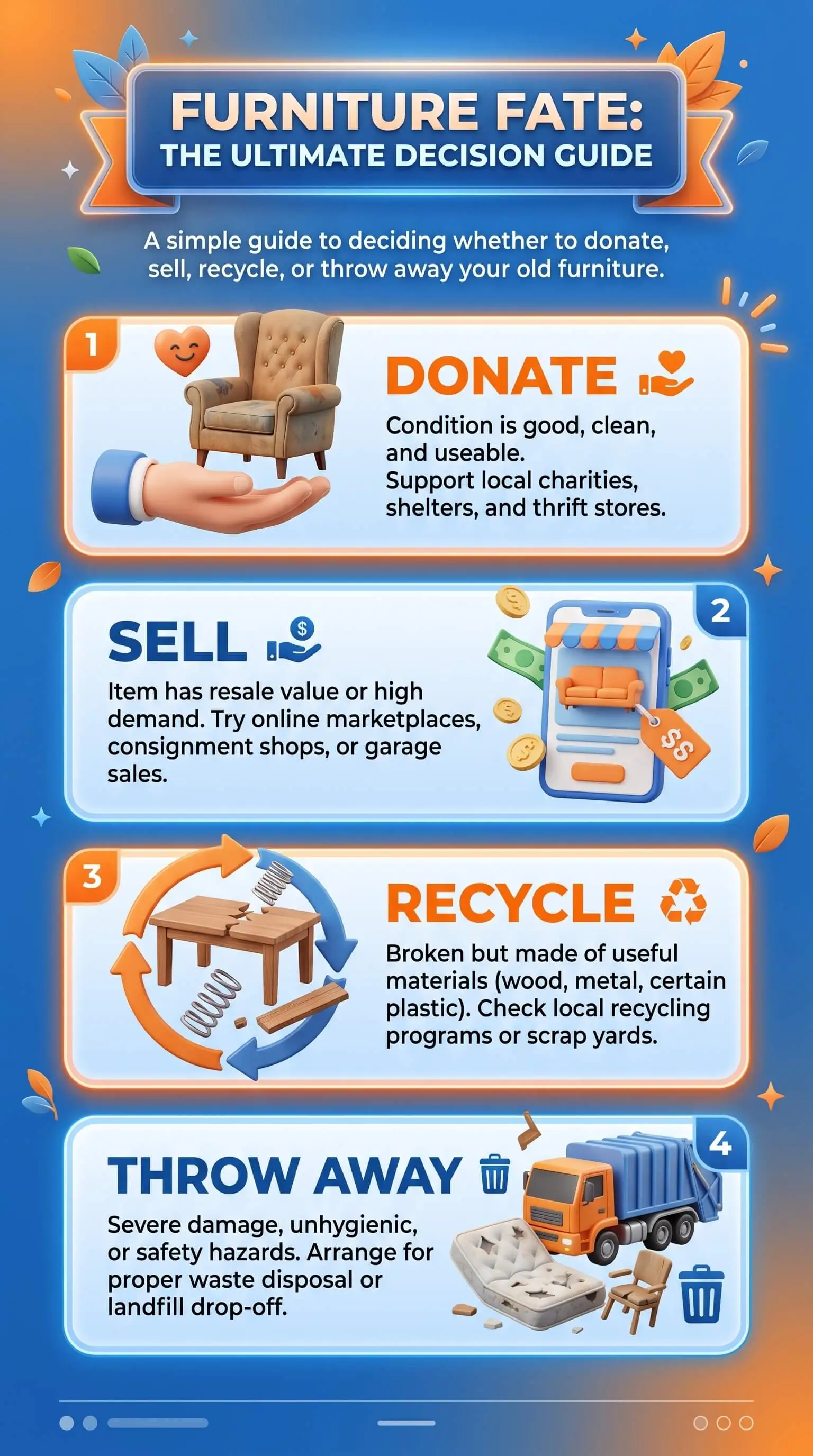
The right disposal method depends on three variables: condition, resale value, and time available — not the type of furniture.
Donate when furniture is in good or fair condition and you don't need the cash.
Sell when you have time and the piece has real resale demand (designer brands, solid wood, vintage).
Recycle when the piece is too damaged for donation but contains recoverable materials.
Throw away or hire junk haulers when furniture is broken, infested, or made of materials no other channel accepts.
The hierarchy that wastes the least is reuse → resell → recycle → throw away.
Curbside dumping is illegal almost everywhere and routinely carries fines of $100–$1,000.
The Three-Variable Decision Framework
Every furniture decision comes down to the same three questions:
What's the condition? Like-new, good, fair, worn, or genuinely broken?
What's the resale value? Is there real market demand, or is this a piece nobody wants to pay for?
How much time do you have? Same-day, this weekend, or a month of patient listing?
Map your piece against these three, and you'll land in one of four buckets every time.
When to Donate
Donate furniture when it's in good or fair condition, free of damage and pests, and when you value tax benefits or community impact more than cash. Donation is the right call for the vast majority of household furniture that's no longer wanted but still functional — the dining table the new owners didn't want, the dresser that doesn't fit the new bedroom, the sofa your kids outgrew but that still has plenty of life left.
Habitat for Humanity ReStore, The Salvation Army, and Goodwill are the three biggest names, and each handles thousands of pickups a week. Many local women's shelters, refugee resettlement agencies, and furniture banks accept donations and often deliver them directly to families exiting homelessness — a far higher-impact path than a thrift store resale.
A few practical realities: most pickup services need one to three weeks of lead time, and almost no charity will accept stained, torn, or pest-affected upholstery. Mattresses are commonly refused regardless of condition. Always get a written receipt at pickup if you plan to claim a tax deduction.
When to Sell
Sell furniture when it's in good or excellent condition, has clear resale demand, and when you have at least one to two weeks to manage listings, messages, and pickup logistics.
Solid wood furniture, mid-century pieces, designer brands like Restoration Hardware, West Elm, and Crate and Barrel, and anything genuinely vintage tends to retain real market value. Particleboard furniture from big-box stores rarely does, no matter how new it is. Facebook Marketplace and Craigslist remain the workhorses for local sales; Chairish and 1stDibs target higher-end pieces; and concierge services like Kaiyo or AptDeco — available in select metros — handle photography, listing, and pickup logistics in exchange for a cut of the sale.
Honest pricing tip from years of watching this play out: list at 20–40% of original retail for good condition, and 10–25% for fair. Set yourself a 7-day deadline. If it hasn't sold by day eight, it probably isn't going to — pivot to donation rather than letting it sit.
When to Recycle
Recycle furniture when it's too damaged to donate or sell but still contains recoverable materials. Solid wood, metal frames, and upholstery foam can all be recovered through specialized programs; particleboard and MDF generally cannot.
Mattresses are the standout recycling story. Through the Mattress Recycling Council's Bye Bye Mattress program, more than 15 million mattresses have been diverted from landfills in California, Connecticut, Oregon, and Rhode Island — the four states with mandatory mattress recycling laws. Outside those states, Earth911's recycling search lets you enter your ZIP code and material to find local programs.
Honest expectation-setter: residential furniture recycling infrastructure in the U.S. is patchy, and many pieces that reach the recycling end of the chain still get partially landfilled. But every recovered metal frame and pound of foam is one less in the ground.
When to Throw Away
Throw away or junk-haul furniture when it's broken, water-damaged, infested, or made from materials that no donation, resale, or recycling channel will accept. There's no shame in this category — sometimes a piece is genuinely at the end of its life, and trying to force it into another bucket just delays the inevitable.
You have four reasonable options, ranked roughly by cost and effort:
Municipal bulky-waste pickup — usually free or low-cost, requires scheduling, and most cities enforce item or weight limits.
Drop-off at a transfer station — typically $20–$60 per piece, but you provide the truck and the muscle.
Dumpster rental — $300–$600 for a 10–20 yard dumpster, cost-effective when you're clearing out an entire home.
Professional junk removal — $75–$200 per piece, same-day pickup, and they handle the lifting, loading, and disposal in a single stop.
For anything heavier than two people can safely carry, anything coming down a flight of stairs, or anything tied up with a full estate cleanout, professional junk removal is almost always the right call. Services like Jiffy Junk specialize in getting rid of old furniture and can be the difference between a clean Saturday morning and a back injury you'll feel for weeks.
The one thing not to do? Drag a sofa to the curb on a non-pickup day. That's illegal almost everywhere in the U.S. and typically carries fines from $100 to $1,000.
"People overestimate the resale value of their furniture by about 50%, and they underestimate how long it actually takes to sell. I've sat with clients who turned down a same-day donation pickup because they were 'going to list it on Facebook this weekend' — and three months later, the piece was still in the garage. Eventually, it ends up donated anyway, but only after weeks of mental and physical clutter. The lesson I've taken from this is simple: if you don't need the cash, donate. The hours you'll spend photographing, listing, fielding lowball offers, and coordinating pickup are almost never worth the $80 you'll net on a $300 sofa. Time is the most underpriced variable in the whole equation, and treating donation as the default — not the consolation prize — is one of the highest-return decluttering decisions you can make."
7 Essential Resources
These are the references I use and recommend, all verified live as of publication:
EPA Durable Goods: Furniture and Furnishings Data — the federal agency's most current data on furniture generation, recycling, and landfill volume. epa.gov/facts-and-figures-about-materials-waste-and-recycling/durable-goods-product-specific-data
Habitat for Humanity ReStore — Donate Goods — schedule a free furniture donation pickup at most U.S. ReStore locations. habitat.org/restores/donate-goods
The Salvation Army Donation Pickup (SATruck) — schedule a free pickup of furniture, appliances, and household goods nationwide. satruck.org
Earth911 Recycling Search — search 100,000+ recycling listings by ZIP code and material to find local options for furniture, mattresses, and components. search.earth911.com
Furniture Bank Network Directory — find a local furniture bank that delivers donated pieces directly to families exiting homelessness. furniturebanks.org/furniture-bank-directory
Bye Bye Mattress (Mattress Recycling Council) — locate free mattress recycling sites in California, Connecticut, Oregon, and Rhode Island. byebyemattress.com
IRS Publication 561 — Determining the Value of Donated Property — the official guidance on calculating fair market value for furniture donations claimed as charitable deductions. irs.gov/forms-pubs/about-publication-561
3 Statistics
Americans generated 12.1 million tons of furniture and furnishings waste in 2018 — about 4.1% of total municipal solid waste — and 80.1% of it went straight to a landfill. Source: U.S. Environmental Protection Agency
Furniture waste in the U.S. grew from 2.2 million tons in 1960 to 12.1 million tons in 2018 — a 5.5x increase that has outpaced population growth and is widely linked to the rise of low-cost, low-durability "fast furniture." Source: U.S. Environmental Protection Agency
More than 15 million mattresses have been diverted from landfills in the four states with mandatory mattress recycling laws (California, Connecticut, Oregon, Rhode Island) — proof that infrastructure, when it exists, works. Source: Mattress Recycling Council
Final Thoughts and Opinion
The biggest mistake I see is treating "throw it away" as the easy option. It's almost never the easy option — it's just the fastest one at the moment. Throwing away a sofa that someone could have used means a low-income family slept on the floor that night, and an extra 80 pounds of foam, fabric, and chipboard sat in a landfill for the next 50 years.
The hierarchy I'd recommend, in order, is reuse → resell → recycle → throw away. Default to donation unless cash matters or condition makes it impossible. Sell only when the piece has clear value and you have time. Recycle when you can find a program. Throw away last, and when you do, use a service that has a track record of diverting recoverable items to charities and recyclers before defaulting to landfill.
That sequence isn't about being virtuous. It's about getting the most usefulness out of a piece of furniture that someone, somewhere, paid real money to design and manufacture, and it belongs in the same practical mindset as any responsible home improvement decision.
Frequently Asked Questions
What is the cheapest way to get rid of old furniture?
The cheapest path is usually donation with free pickup — Habitat ReStore, The Salvation Army, and most local furniture banks will haul it away at no cost if it meets their condition standards. If it doesn't, municipal bulky-waste pickup is typically the next cheapest at $0–$30 per item.
Will Goodwill pick up furniture for free?
Goodwill pickup availability varies significantly by region. Some larger metros offer free pickup for qualifying items; many require drop-off. Call your local Goodwill or check their website for ZIP-specific policies before assuming pickup is available.
Can I put a couch on the curb?
Only on a scheduled bulky-waste pickup day in your municipality. Outside of scheduled pickup windows, leaving furniture on the curb is illegal in nearly every U.S. city and typically results in fines starting around $100. Always confirm pickup dates with your local sanitation department first.
How do I dispose of an old mattress?
If you live in California, Connecticut, Oregon, or Rhode Island, the Bye Bye Mattress program offers free recycling drop-off at hundreds of sites. Outside those states, check with your municipal bulky-waste program, mattress retailers (some take old mattresses with new purchases), or a junk removal service. Most charities will not accept used mattresses regardless of condition.
Is it worth selling old furniture or just donating it?
Donate unless the piece has obvious resale value — solid wood, designer or vintage brands, or items in like-new condition under three years old. For typical particleboard furniture and well-used pieces, the time and stress of selling almost never justifies the modest payout.
How much does junk removal cost for a couch?
Single-item couch removal typically runs $75–$200 depending on size, location, weight, and access (ground floor versus stairs). Same-day service often costs slightly more. Most national junk removal companies provide free, no-obligation quotes by photo or phone.
What furniture can't be donated?
Items typically refused include: anything stained, torn, burned, smoke-damaged, or pest-affected; most mattresses; cribs and other items subject to recall; particleboard furniture in poor condition; recliners with mechanical damage; and water-damaged pieces of any kind.
Do I need to be home for a donation pickup?
Often no — most charities will pick up items left in a garage, driveway, or covered porch as long as they're easily accessible by truck. Confirm specifics with your charity when you schedule, and remember to leave your written donation receipt arrangement clear at the same time.
Call to Action
Have a piece you've been staring at, unsure what to do with it? Run it through the three questions: condition, value, time. The right answer is almost always sitting right there in front of you.
And if it turns out to be the throw-away bucket — especially for anything heavy, walked-down-stairs, or part of a bigger cleanout — book a same-day haul with a professional service rather than wrestling with it yourself. Your back, your weekend, and the local landfill will all thank you for making a smarter call.