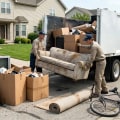
Leaving furniture on curb space overnight exposes a working couch, dresser, or mattress to four predictable problems: theft, weather, ordinance violations, and pedestrian hazards. The rules vary city by city. New York's Department of Sanitation allows large items out between 6:00 PM and midnight the night before collection. Los Angeles requires day-of placement only and starts finding when items appear too early. After enough Jiffy Junk pickups across our service areas, we've found one rule that holds up everywhere: leaving furniture on curb works best when it’s planned around the right pickup window, keeping the process simple, convenient, and stress-free. If you want a guaranteed pickup without the timing risk, scheduled curbside furniture pickup and haul-away takes the question off your plate entirely.
TL;DR Quick Answers
leaving furniture on curb
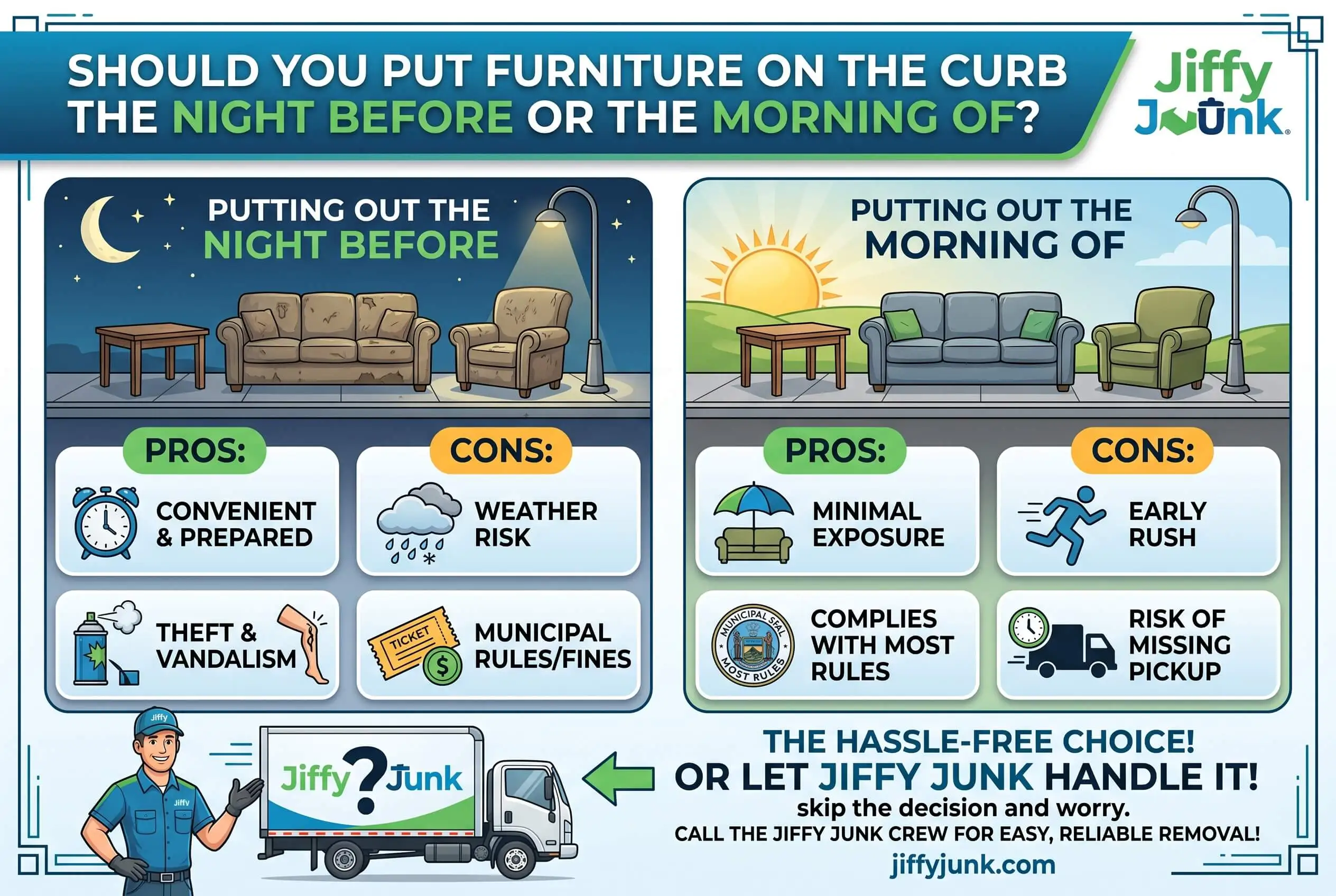
Short answer: Leaving furniture on the curb the morning of pickup, within an hour or two of your hauler's route start, is the safest choice. Night-before placement only works where your city explicitly permits it after a posted hour, usually 4 PM to 6 PM.
Why morning-of wins:
Less time exposed to theft, weather damage, and ordinance fines (many cities cite items placed out too early as illegal dumping)
Lower chance of the sanitation crew refusing a soaked, scavenged, or stripped item
When the curb is the wrong choice:
Mattresses in California, Connecticut, Oregon, or Rhode Island, where state law requires recycling at a free drop-off site
Loads of more than six to ten items in a single collection
HOA-restricted properties or apartment buildings without bulk pickup access
Cleanest workaround: Schedule an on-demand junk removal pickup. Items go straight from your home into the truck on a confirmed appointment, with the timing question handled for you.
Top Takeaways
Morning-of beats night-before in almost every U.S. municipality, both legally and practically.
Four overnight risks compound fast: theft, weather damage, ordinance fines, and sidewalk/traffic hazards.
City rules vary widely. NYC allows large items after 6:00 PM the night before. LA requires day-of placement, with most municipalities expecting items at the curb by 7:00 AM.
Mattresses are regulated separately in California, Connecticut, Oregon, and Rhode Island. The curb is not a legal disposal route in those states.
Scheduled pickup is the cleanest workaround when timing, item type, or property rules make the curb impractical.
Why morning-of is the safer choice
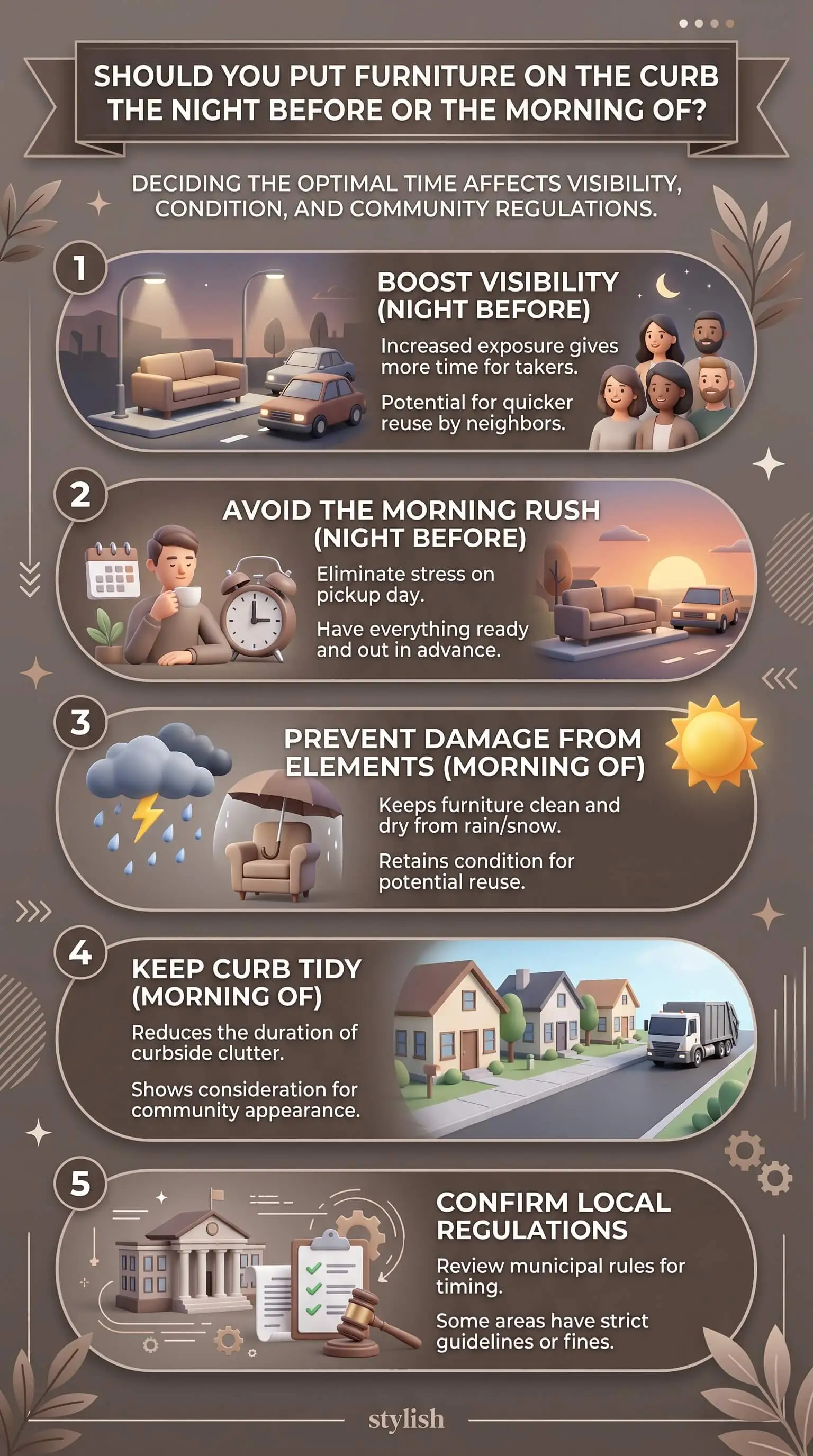
Pickup crews run their routes early. Most start between 6:00 AM and 8:00 AM. Furniture sitting at the curb 12 hours before that window opens has a long unsupervised stretch ahead of it, and that stretch is where things go sideways. The universal sweet spot: place items one to two hours before your hauler's route starts.
The four overnight risks
Theft and scavenging. A working dresser placed at 7:00 PM is rarely intact at 7:00 AM. Scavengers strip the parts that resell: drawer pulls, copper hardware, casters. They leave the carcass behind, and the homeowner has to clean up whatever the sanitation crew refuses to take.
Weather damage. Upholstered furniture absorbs rainwater within minutes. A wet sectional weighs hundreds of pounds, drips through pickup trucks, and the city refuses it on biohazard grounds. One overnight rain turns a routine haul-away into a moldy, immovable problem.
Ordinance violations. Most cities post specific set-out windows. Putting a couch out at noon for a 7:00 AM next-day pickup counts as illegal dumping in many municipalities. Fines vary widely. San Diego issues administrative citations between $100 and $1,000, while California Penal Code 374.3 caps illegal dumping penalties at up to $10,000. Each day the waste remains counts as a separate violation.
Sidewalk and traffic hazards. Furniture that drifts into the sidewalk creates an ADA accessibility issue. In low light, items in or near the street become collision risks for cars and pedestrians.
When the night-before is permitted
Where night-before placement is allowed, the rule is usually a posted hour. NYC DSNY allows non-recyclable bulk items at the curb between 6:00 PM and midnight the night before collection. Los Angeles is stricter: items can't go out more than one day before a scheduled appointment, and most municipalities expect them at the curb by 7:00 AM on collection day. Look up your city's rules before you assume the convenience is legal.
When to skip the curb entirely
The curb is the wrong choice for:
Mattresses and box springs. Many cities ban them from standard curbside pickup, and the four Mattress Recycling Council states (California, Connecticut, Oregon, Rhode Island) operate dedicated recycling programs instead.
Multiple pieces or a full room. Most cities cap bulk pickup at six to ten items per collection day.
HOA-restricted properties. Curbside placement may be off-limits regardless of city rules, and HOA fines can stack on top of municipal fines.
Apartment buildings without dedicated bulk pickup access.
Time-sensitive moves when you can't wait for the next scheduled pickup day.
For any of these, scheduled curbside furniture and couch disposal pickup skips the timing question completely. Items go from your home directly into the truck, removing the overnight exposure, fine risk, and scavenger problem in a single move.
“After thousands of curbside furniture pickups across our service areas, especially during estate cleanouts where timing, organization, and care matter most, the pattern is consistent: the longer an item sits at the curb, the more we see come back as bigger problems. We've shown up to find a sectional rained through, a dresser missing every drawer pull, a mattress that didn't make it to the morning. The single most common homeowner mistake is treating the curb as a 24-hour holding zone. They put a couch out the afternoon before and assume convenience equals compliance. It almost never does. Our recommendation is simple: morning of, within an hour or two of your hauler's route start. If timing is uncertain, schedule a removal so the truck pulls up to your door and keeps the entire estate cleanout process smoother, cleaner, and easier for the family. Most homeowners spend more cleaning up after a bad overnight curbside attempt than they would have spent on a scheduled pickup in the first place.”
7 Essential Resources
Every homeowner should bookmark these before putting furniture at the curb. Each one shows up in our day-to-day operations.
1. EPA Durable Goods Product-Specific Data
The federal benchmark for how furniture moves through the U.S. waste stream: generation, recycling, and landfill rates by year. Every credible disposal claim cites this dataset.
2. EPA Reducing and Reusing Basics
EPA's official guidance on alternatives to disposal. Donation, repair, and reuse channels worth checking before anything hits the curb. A still-functional sofa is a charity donation, not a landfill candidate.
https://www.epa.gov/recycle/reducing-and-reusing-basics
3. NYC Department of Sanitation: Large Items
The cleanest example of a major-city set-out rule. The page covers what counts as bulk, the 6:00 PM to midnight set-out window the night before collection, and the mandatory mattress-bagging rule (Local Law 145) that prevents bedbug spread.
https://www.nyc.gov/site/dsny/collection/get-rid-of/large-items.page
4. LA Sanitation & Environment: Bulky Item Collection
Los Angeles uses an appointment-based model rather than a fixed weekly bulk day. This is the official scheduling portal: call 1-800-773-2489, dial 311, or use the MyLA311 app. Up to 10 items per collection. Items can't go out more than one day before pickup.
5. Mattress Recycling Council: Program States
The authoritative source on the four states (California, Connecticut, Oregon, Rhode Island) where mattresses can't go out via standard curbside pickup. The Bye Bye Mattress locator tool finds the nearest free drop-off site.
https://mattressrecyclingcouncil.org/programs/
6. U.S. Bureau of Labor Statistics: Musculoskeletal Disorders Factsheet
The federal injury data behind why moving furniture solo is risky. Useful for understanding why pro crews work in pairs and why DIY furniture moves drive a disproportionate share of weekend back injuries.
https://www.bls.gov/iif/factsheets/msds.htm
7. Wikipedia: Furniture
Background on furniture materials, construction, and historical context. Worth a quick read to see why some pieces (particleboard cores, polyurethane foam upholstery) degrade so fast at the curb compared to solid-wood antiques.
https://en.wikipedia.org/wiki/Furniture
3 Supporting Statistics
1. Furniture is the largest bulky-waste category in U.S. residential trash.
The U.S. Environmental Protection Agency estimates that 12.1 million tons of furniture and furnishings entered the municipal solid waste stream in 2018. Of that, 80.1% was landfilled. That's the equivalent of every sofa, table, chair, and mattress that retired from American homes in a single year, often after a move, remodel, or other home improvement project. Most of it started at someone's curb.
EPA Durable Goods Product-Specific Data, https://www.epa.gov/facts-and-figures-about-materials-waste-and-recycling/durable-goods-product-specific-data
2. Lifting heavy furniture is a documented injury hazard.
The U.S. Bureau of Labor Statistics recorded 272,780 musculoskeletal disorder cases involving days away from work in 2018, with a median of 12 days lost per case. Furniture moves, especially solo unplanned ones executed at night to beat a morning pickup, are exactly the kind of overexertion these data warn about.
BLS Musculoskeletal Disorders Factsheet, https://www.bls.gov/iif/factsheets/msds.htm
3. 99% of California residents live within 15 miles of a free mattress recycling site.
The Mattress Recycling Council's Bye Bye Mattress program runs more than 240 permanent drop-off locations in California alone, with similar coverage across Connecticut, Oregon, and Rhode Island. In those four states, the curb is no longer the right answer for a mattress at all. Recycling is mandatory and free. Every new mattress sale carries a small fee that covers the cost.
Mattress Recycling Council, https://mattressrecyclingcouncil.org/programs/california/
Final Thoughts and Opinion
The honest answer to “night before or morning of?” is that the question itself is the wrong frame. The actual question: do you want a guaranteed pickup, or are you willing to accept overnight risk?
What we see at Jiffy Junk
A few patterns repeat across our service areas, week after week.
Overnight placements lose value within hours. Scavengers find the usable pieces fast and leave the rest in worse shape than when it went out.
Weather forecasts get ignored, and a single overnight rain turns a routine haul-away into a hazmat job.
Homeowners underestimate how strict their city's set-out rules are. The fine letter usually shows up a week later, after they've already forgotten about the couch.
Mattresses are the worst version of all three: most likely to get scavenged, most likely to soak through, most likely to violate state recycling law.
Our honest opinion
Morning-of placement, within your hauler's posted window, is the right call about 90% of the time. The remaining 10% calls for a scheduled pickup, full stop: mattresses, multiple pieces, restricted properties, time-sensitive cleanouts. Modern furniture is built with materials like particleboard and polyurethane foam that fall apart fast when they get wet, which is why timing matters more than most homeowners assume. The cheapest pickup is the one that happens cleanly the first time. The expensive one is the one that needs a re-disposal of a soaked, scavenged, or fined-on item a week later.
Frequently Asked Questions
Q: Is it illegal to leave furniture on the curb?
A: It depends on the municipality. Most U.S. cities permit curbside furniture placement only within a designated set-out window, usually the night before through the morning of scheduled bulk pickup. Cities cite items left outside that window as illegal dumping. Fines vary widely. San Diego ranges from $100 to $1,000, and California Penal Code 374.3 allows penalties up to $10,000.
Q: How long can furniture sit on the curb?
A: Most cities require you to remove items within 24 to 48 hours of the scheduled collection. Miss the pickup window and you should call your hauler the same day. Leaving an item out indefinitely can escalate to an illegal dumping citation, even when the original placement was compliant.
Q: Can someone take furniture left on the curb?
A: In most jurisdictions, yes. Once you place an item at the curb for disposal, most cities treat it as abandoned property. Scavengers usually strip or partially dismantle items first, though, and the homeowner has to clean up whatever is left behind.
Q: What time should I put furniture out the night before pickup?
A: Where night-before placement is allowed, most cities require you to wait until a posted hour. Common cutoffs are 4 PM, 5 PM, or 6 PM. NYC DSNY, for example, allows large items at the curb between 6:00 PM and midnight the night before collection. Always check your local sanitation department's posted rule before placing items out.
Q: What's the best alternative to leaving furniture on the curb?
A: Scheduled on-demand junk removal. A professional service like Jiffy Junk picks up directly from your home or driveway at a confirmed appointment. That removes the overnight risk, fine exposure, scavenger problem, and timing question all at once. For mattresses, multi-piece loads, or HOA-restricted properties, it's often the only legal option.
Ready to Skip the Curbside Gamble?
A $1,500 sectional or a working dresser is worth more than overnight luck. When timing is uncertain, items aren't curb-eligible, or you just want it gone without the risk, book a curbside furniture pickup with Jiffy Junk. Items go straight from your home, on a confirmed appointment, with the morning-of stress handled for you.
Schedule your pickup today and let us handle the timing for you.