If the term itself is new to you, a roll-off dumpster is the wheeled, open-top metal container delivered by truck and hauled away when you’re done filling it. The 12-yarder is the size most homeowners ask about, and the size most residential projects actually need.
TL;DR Quick Answers
12 yard dumpster size
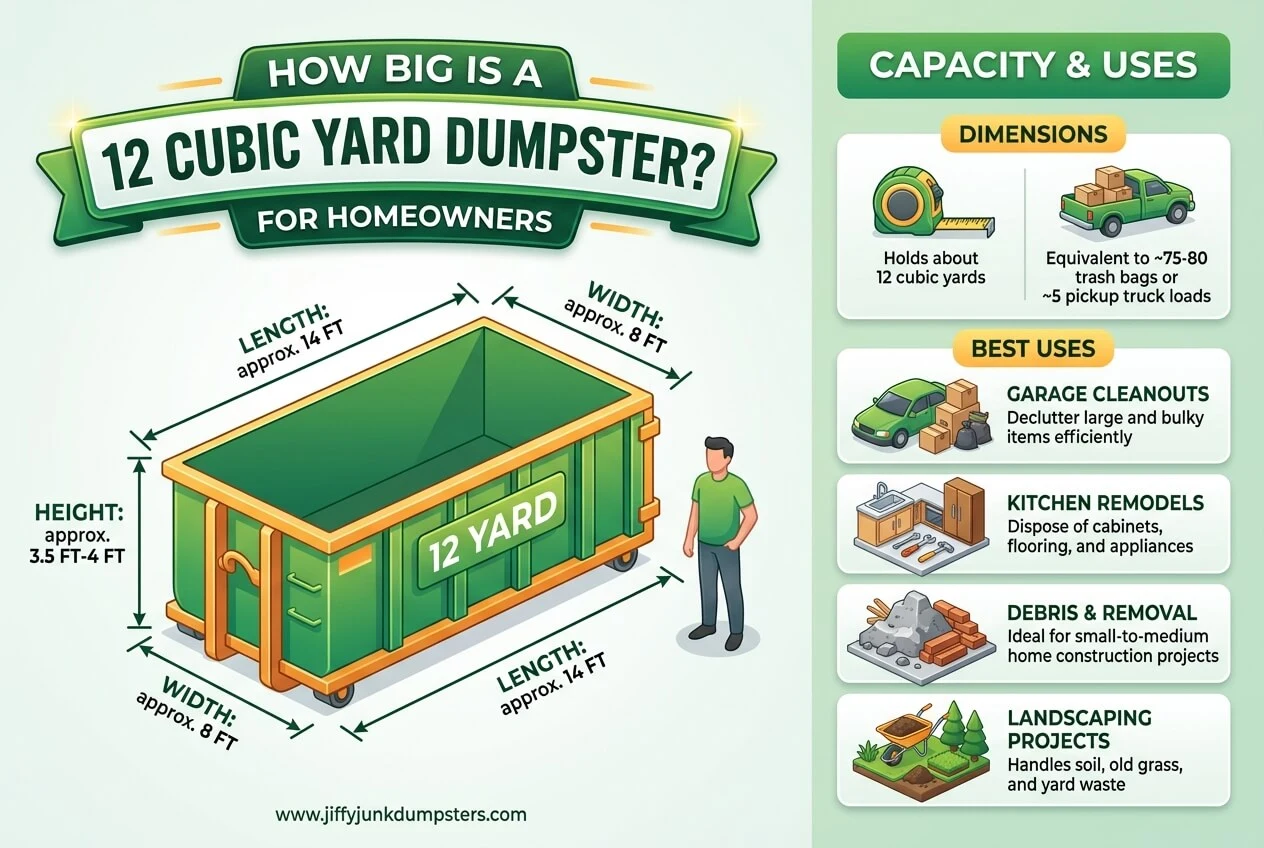
A 12 yard dumpster measures roughly 14 feet long, 7.5 feet wide, and 4 feet tall, which is about the footprint of one standard parking space.
Length: ~14 feet
Width: ~7.5 feet
Height (sidewall): ~4 feet
Volume capacity: 12 cubic yards (4 to 5 pickup truck loads)
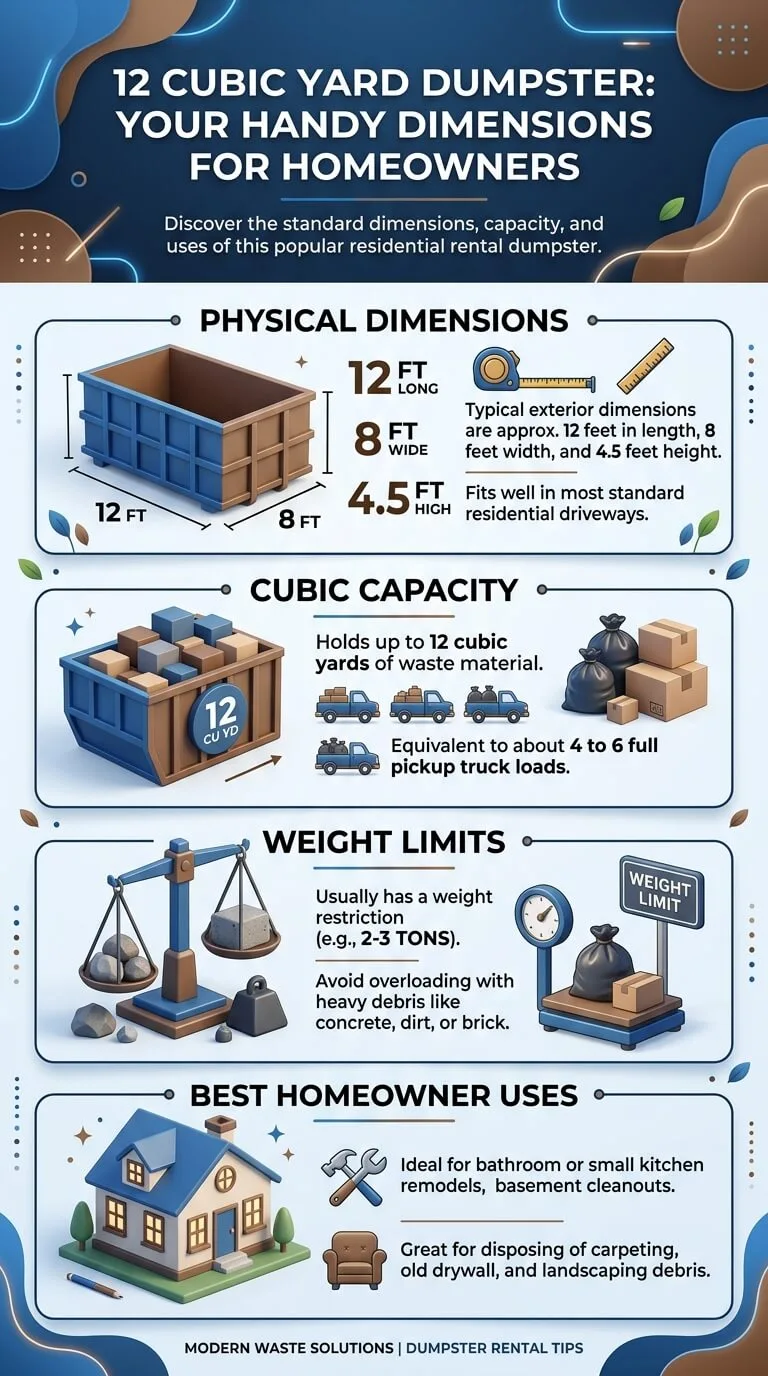
Weight limit: 2 to 4 tons (4,000 to 8,000 lbs)
Driveway space needed: 60 feet of straight access, 23 to 25 feet of overhead clearance
Best fit for single-room renovations, garage cleanouts, and moderate landscaping projects.
Top Takeaways
Size and shape: a 12 cubic yard dumpster is roughly 14 ft × 7.5 ft × 4 ft, or about the footprint of a single parking space.
Driveway requirements: at least 60 ft of straight access and 23 to 25 ft of overhead clearance.
Capacity: holds 4 to 5 pickup truck loads. Great for single-room renovations, garage cleanouts, small demos, and moderate landscaping.
Weight limits: typically 2 to 4 tons. Dense materials hit the ceiling fast, so mention them when booking.
Loading order: heavy items first, weight distributed evenly, large pieces broken down, nothing above the fill line.
When to size up: multi-room projects, structural demo, heavy materials, or genuine uncertainty about how much debris you’ll generate.
Disposal alternatives: donate usable items to Habitat ReStore, route hazardous waste through local HHW programs, and use Earth911 to find recycling for materials your hauler won’t take.
12 Yard Dumpster Size: The Specs Every Homeowner Should Know
A 12 cubic yard dumpster measures roughly 14 feet long, 7.5 feet wide, and 4 feet tall. The footprint matches a standard parking space, which is the easiest mental shortcut for most homeowners trying to picture it on their driveway.
Length: ≈ 14 feet
Width: ≈ 7.5 feet
Height (sidewall): ≈ 4 feet
Volume capacity: 12 cubic yards
Equivalent loads: 4 to 5 full pickup truck beds
Weight limit (typical): 2 to 4 tons (4,000 to 8,000 lbs)
Footprint: roughly one standard parking space
The 4-foot sidewall is one of the biggest advantages of choosing a roll off dumpster that’s built for homeowner-friendly cleanup. Taller containers force you to lift everything overhead or build a ramp, but a 12-yarder roll off dumpster lets you toss debris over the side without a ladder. If you’ve ever hoisted a bag of broken tile chest-high while your back politely files for divorce, you’ll know why that height matters.
Will It Fit Your Driveway?
Three measurements determine whether your driveway works for a 12 yard dumpster, and only one of them is the container itself.
Driveway length: plan for at least 60 feet of straight, clear access. The container is only 14 feet, but the delivery truck needs room to back in and tilt it off the rails.
Width: the container’s 7.5 feet plus 1 to 2 feet of buffer on each side. You need a walking room to actually load the thing.
Overhead clearance: 23 to 25 feet of vertical space for the truck’s lift mechanism. Low branches, power lines, and basketball hoops are the usual culprits.
If your driveway slopes, slants toward the street, or is paved with asphalt that softens in summer heat, lay down a few sheets of plywood under the rails before delivery. Cheap insurance against tire ruts on a hot July afternoon.
What Actually Fits Inside
A 12 cubic yard container holds 4 to 5 full pickup truck loads. That covers more than most homeowners assume on first look. Projects that fit cleanly inside one:
A single-room renovation: bathroom gut-out, bedroom refresh, small kitchen update
A two-car garage cleanout where years of accumulated stuff finally sees daylight
A small deck or shed demolition
A moderate landscaping job: branches, shrubs, sod, mulch bags
A whole-house decluttering project that doesn’t involve major construction
Where it falls short: full-house remodels, complete kitchen tear-outs, and roof replacements. Those almost always need a 20- or 30-yard container. If your project description includes the word “everything,” plan for the bigger container.
Weight Limits Are the Sneaky Part
Every hauler caps the weight a 12-yarder can carry. The typical range is 2 to 4 tons, which translates to 4,000 to 8,000 pounds. That sounds like plenty until you start tossing in tile, concrete, soil, or roofing shingles. Dense materials hit the ceiling long before the container looks full, and overage fees of $50 to $100 per extra ton can quietly turn a reasonable rental into an expensive one.
When you book, tell the dispatcher what you’re actually throwing away. “Bathroom remodel with old cast-iron tub” gets you very different advice than “basement furniture and cardboard.” An honest description up front saves money on the back end.
Loading Tips From Crews Who Do This Daily
Heavy items go in first. Tile, concrete, and dense wood anchor the bottom layer.
Distribute weight evenly across the floor so the container doesn’t shift during pickup.
Break things down. Disassembled furniture, flattened cardboard, and snapped branches stack about twice as efficiently as intact pieces.
Use the rear door to walk in heavy stuff. Toss lightweight items over the 4-foot side.
Stay below the fill line. Anything sticking above the sidewall risks being refused at pickup.
Skip the prohibited list. Paint, batteries, electronics, tires, mattresses (in some markets), and chemicals usually can’t go in. Confirm with your hauler before tossing.
When to Size Up Instead
Be honest with yourself. The 12-yarder isn’t always the right call. Size up to a 20- or 30-yarder if your project covers more than one room, you’re handling heavy materials like concrete or shingles, or you genuinely don’t know how much debris you’ll generate. An empty dumpster and a full one cost the same to haul. A second container doubles your bill.
For a deeper, region-specific breakdown of pricing and weight rules, Jiffy Junk’s full 12 cubic yard dumpster guide runs through real rental costs and project-fit advice based on thousands of residential deliveries.
“After delivering thousands of these containers across the country, we’ve come to think of the 12 cubic yard dumpster as the workhorse of residential projects. It handles serious cleanouts and still fits a standard driveway. The customers who get sizing right are the ones who describe their project honestly upfront, because mental estimates rarely match actual volume. A small bathroom renovation often produces more debris than people expect. The 4-foot sidewall is a quiet advantage on its own. Most homeowners can toss items over the side without needing a ladder, which makes loading faster and safer than it is with taller containers.”
7 Essential Resources
A 12-yarder doesn’t have to be your only disposal tool. The resources below cover what shouldn’t go in the dumpster, where to donate items that still have life left, where to recycle materials your hauler won’t take, and what the federal data says about responsible cleanup.
1. Wikipedia: The Dumpster Entry
Why it’s useful: a clear primer on what a roll-off dumpster actually is and how it differs from the front-load commercial containers you see behind restaurants. Worth a read if the terminology is new to you.
Link: en.wikipedia.org/wiki/Dumpster
2. EPA Sustainable Management of C&D Materials
Why it’s useful: the federal overview of how renovation debris gets handled, where it ends up, and which materials get recovered for reuse. Read this before any meaningful demo work so you understand what truly belongs in a landfill.
Link: epa.gov/smm/sustainable-management-construction-and-demolition-materials
3. EPA Household Hazardous Waste Guide
Why it’s useful: paint cans, solvents, pesticides, automotive fluids, and batteries can’t go in your dumpster, but they shouldn’t go in regular trash either. This page explains how to handle them safely and how to find local HHW collection programs near you.
Link: epa.gov/hw/household-hazardous-waste-hhw
4. EPA C&D Debris Material-Specific Data
Why it’s useful: the numbers behind the disposal industry. You’ll see how much debris Americans generate, where it ends up, and which materials get recovered most often. It also helps explain why hauler weight limits exist in the first place.
5. Habitat for Humanity ReStore Donations
Why it’s useful: before you toss old cabinets, light fixtures, or that perfectly fine couch, check if a local ReStore will take them. Many locations offer free pickup of large items, donations may qualify for tax deductions, and your stuff helps fund affordable housing in your community.
Link: habitat.org/restores/donate-goods
6. Earth911 Recycling Center Search
Why it’s useful: a national database of more than 100,000 recycling facilities covering 350-plus material types. Enter a ZIP code and a material, and it points you to the nearest drop-off location for items your dumpster won’t take.
Link: search.earth911.com
7. CalRecycle Construction & Demolition Recycling
Why it’s useful: California’s program is one of the most developed state-level resources for finding C&D processors, recyclers, and reuse facilities. Even out-of-state homeowners can use it as a model for what to ask their own state agency.
Link: calrecycle.ca.gov/condemo
3 Statistics
A dumpster rental can feel like a small, isolated decision. The numbers below put it in context. Responsible disposal affects your wallet, your local landfill capacity, and the economy around you. The scale is bigger than most homeowners realize.
1. Americans Generate 600 Million Tons of Construction & Demolition Debris a Year
Americans generated an estimated 600 million tons of construction and demolition debris in 2018, which is more than twice the volume of household trash that same year. Your single bathroom renovation contributes to that stream, and that’s part of why right-sizing a dumpster matters in the first place.
Source: U.S. Environmental Protection Agency. epa.gov/facts-and-figures-about-materials-waste-and-recycling/construction-and-demolition-debris-material
2. 76% of C&D Debris Is Recovered for Reuse or Recycling
Of that 600 million tons, about 455 million were directed toward next use, including recycling, processing into aggregate, and reuse. The remaining 145 million tons went to landfills. That’s a 76% recovery rate overall, which means most renovation debris doesn’t have to end its life buried. Choosing a hauler that sorts responsibly puts your project on the right side of that ratio.
Source: U.S. Environmental Protection Agency. epa.gov/smm/sustainable-management-construction-and-demolition-materials
3. C&D Recycling Supports 175,000 American Jobs
EPA’s Recycling Economic Information Report found that recycling construction and demolition materials supported 175,000 jobs across the country. Processing facilities, donation centers, transport networks, and recycled-product manufacturers all benefit when home improvement projects are handled thoughtfully and renovation debris is sorted properly. Your single 12-yard rental isn’t going to change those numbers, but the cumulative effect of homeowners making responsible choices keeps that economic engine going.
Source: U.S. Environmental Protection Agency. epa.gov/smm/recycling-economic-information-rei-report
Final Thoughts and Opinion
Two honest opinions worth leaving you with.
First, the 12 yard dumpster size is the right answer more often than homeowners assume. It fits most driveways, handles most single-project renovations, and falls in a price range that doesn’t sting. If you’re reading this guide because someone suggested it for your project, they probably suggested it correctly.
Second, the size below it (8-yard) is too small for most renovations, and the size above it (20-yard) feels like overkill until it doesn’t. The 12-yarder threads that needle. The exception worth flagging is anything heavy: concrete, tile, soil, or roofing shingles. Weight will pin you well before volume does, and you should ask the hauler about a heavier-duty 15- or 20-yard option with a higher tonnage allowance.
The decision homeowners regret is almost never “I rented one that was too big.” It’s almost always “I rented one that was too small and had to pay for a second.” Build that asymmetry into your call. Measure twice, book once, and describe your project honestly when you do.
Frequently Asked Questions
How big is a 12 yard dumpster?
A 12 cubic yard dumpster measures about 14 feet long, 7.5 feet wide, and 4 feet tall. The footprint matches one standard parking space, which is why it fits in most residential driveways without blocking garage access or sidewalks.
Will a 12 yard dumpster fit in a standard driveway?
In most cases, yes. Plan for at least 60 feet of straight, level driveway length so the delivery truck has room to back in safely, plus 23 to 25 feet of overhead clearance for the lift mechanism. The container itself only occupies about 14 by 7.5 feet of ground space.
How much weight can a 12 yard dumpster hold?
Most haulers set the weight limit between 2 and 4 tons, which works out to roughly 4,000 to 8,000 pounds. Overage fees usually run about $50 to $100 per additional ton. Dense materials like tile, concrete, brick, and soil can hit the cap well before the container looks full.
How many pickup truck loads is a 12 yard dumpster?
A 12 cubic yard dumpster holds roughly 4 to 5 full-size pickup truck loads of debris. That’s enough capacity for most single-room renovations, garage cleanouts, or moderate landscaping projects without forcing a second haul.
What projects is a 12 yard dumpster best for?
It’s a strong fit for single-room renovations like bathrooms or bedrooms, garage and basement cleanouts, small deck or shed removals, moderate landscaping debris, and whole-house decluttering. For multi-room remodels, full kitchen tear-outs, or roof replacements, size up to a 20- or 30-yard container.
Do I need a permit to put a 12 yard dumpster in my driveway?
Usually no, as long as the container stays on private property. Permits typically come into play only when the dumpster sits on a public street, sidewalk, or alley. HOA rules can also apply. Check with your local municipality and HOA before scheduling delivery.
TL;DR Quick Answers
Dimensions: ≈ 14 ft long × 7.5 ft wide × 4 ft tall
Footprint: about one standard parking space
Capacity: 12 cubic yards, or roughly 4 to 5 pickup truck loads
Weight limit: 2 to 4 tons (4,000 to 8,000 lbs) typical
Driveway needs: 60 ft of straight access, 23 to 25 ft overhead clearance
Best for: single-room renovations, garage cleanouts, small demos, moderate landscaping
Skip it for: multi-room remodels, full kitchens, roof tear-offs, heavy concrete or soil jobs
Golden rule: when in doubt, size up. A second container doubles your cost.
Ready to Rent a 12 Yard Dumpster?
Before you book, take five minutes. Measure your driveway length, check overhead clearance, and write down what you’re actually throwing away. That short prep session is the difference between a clean rental and a surprise bill. When you’re ready for a deeper, real-world breakdown of pricing and weight rules pulled from thousands of residential deliveries, tap here to read Jiffy Junk’s complete 12 cubic yard dumpster guide. The right container, booked once, beats two trips every time.