Here's the short version. Valet trash pickup service is a doorstep waste-collection program offered by apartment communities, condos, and a small but growing number of HOA-managed neighborhoods. A uniformed attendant walks the property on scheduled evenings. The attendant picks up bagged trash from outside each unit's door and hauls it to the building's central dumpster or compactor. That's the trade: a small monthly fee for skipping the late-night walks across a dark parking lot, the trips down four flights of stairs in the rain, and the constant re-tying of bags that keep splitting in the hallway.
This guide covers what the service actually is, how it works night to night, what it typically costs, why apartments offer it, and where it falls short.
TL;DR Quick Answers
valet trash pickup service
Valet trash pickup service is a doorstep waste-collection amenity offered almost only in multifamily housing. A uniformed attendant collects bagged trash from outside each unit on scheduled evenings and takes it to the property's central dumpster or compactor.
Frequency: Five nights a week, usually Sunday through Thursday
Set-out window: 6 PM to 8 PM
Cost: $20 to $35 a month for residents, billed as a non-optional lease charge
Opt-out: Almost never available
Most renters resent the fee on day one and rely on the service by month three.
Top Takeaways
Valet trash pickup is a doorstep waste-collection service offered almost only in multifamily housing.
The standard schedule runs five nights a week, usually Sunday through Thursday, with a set-out window from about 6 PM to 8 PM.
Most programs accept sealed household bags under 20 pounds. They don't accept loose trash, bulk items, cardboard, or hazardous waste.
Resident fees usually run $20 to $35 a month as a mandatory amenity charge. Opt-out is almost never an option.
Property owners use the service for resident retention, cleaner common areas, recycling-compliance help, and a small revenue margin on the bundled fee.
Most properties run recycling pickup on a separate scheduled night, usually once a week.
If you set bags out late or out of compliance, the team leaves them at the door. Repeat violations can trigger a written notice from management.
What Is Valet Trash Pickup Service?
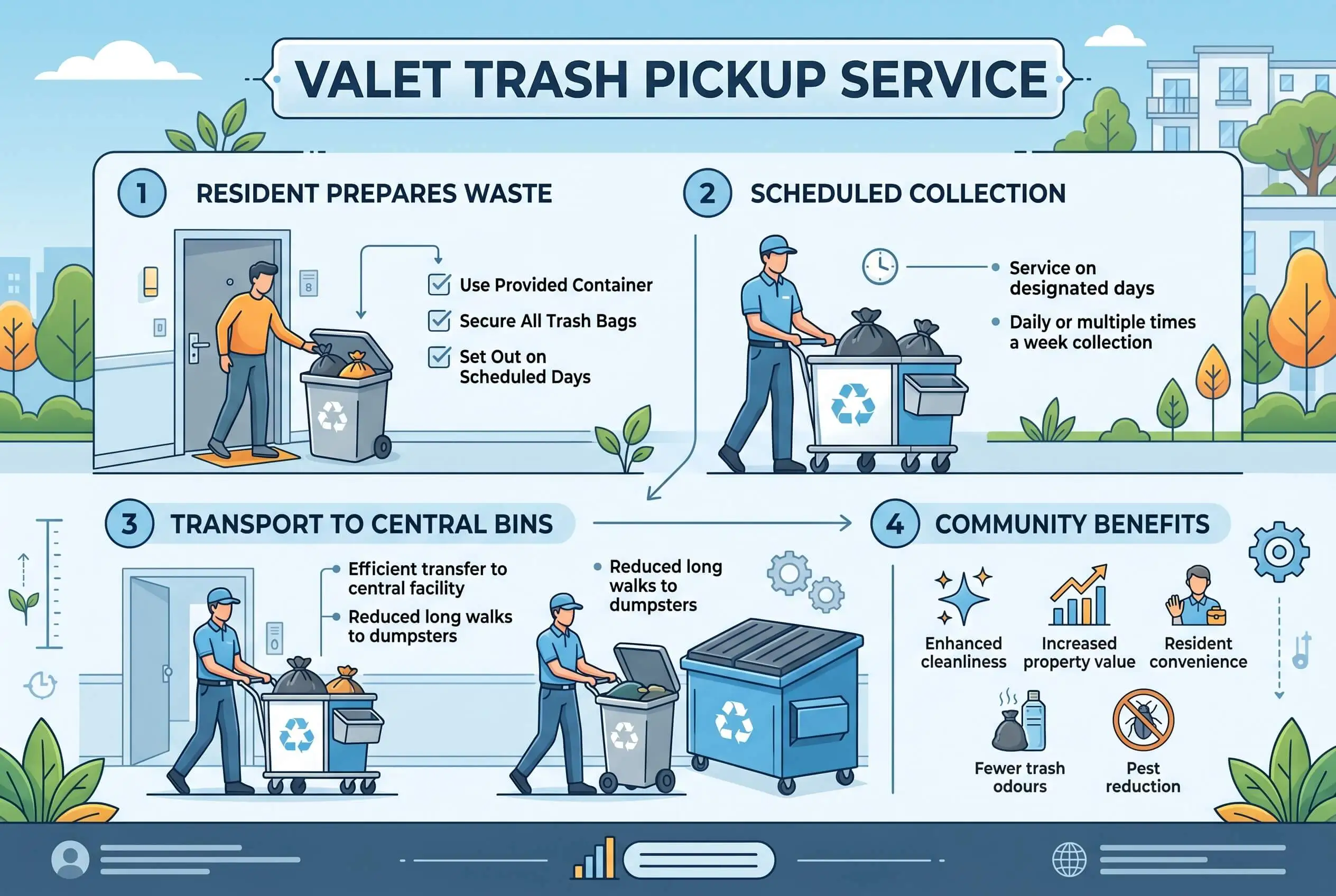
Valet trash pickup is a doorstep waste-removal service, offered almost only in multifamily housing. The mechanics are simple. You leave a sealed bag in a designated container outside your unit during the posted set-out window. A service team comes by that night and moves the bag to the property's main dumpsters or compactors. You never touch the dumpster yourself.
The name comes from the older sense of the term "valet", historically a personal attendant who handled tasks on a household's behalf. Same idea here, just applied to apartment trash: someone else handles the chore on a predictable schedule, for a fee.
Valet trash differs from your municipal trash service, which serves the property as a whole through dumpster pickups by the city or a contracted hauler. It also differs from on-demand junk removal, which handles bulky, one-time hauls. Valet trash sits between those two: a recurring, doorstep-level convenience layered on top of standard waste infrastructure.
How Does Valet Trash Pickup Service Work?
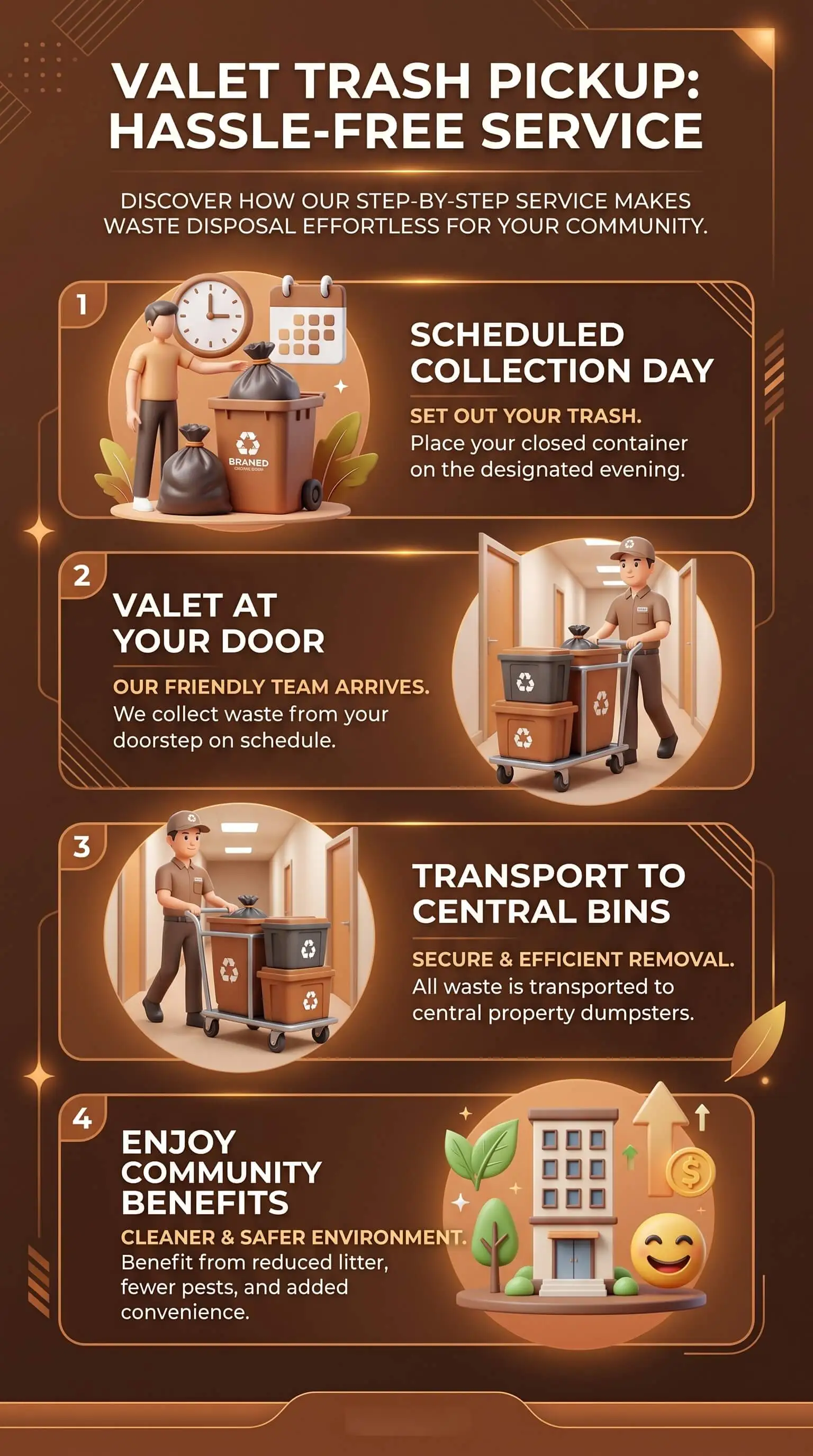
The process is straightforward. Most properties run the same five steps, five nights a week.
Bag your trash and seal it. Most properties require standard 13-gallon kitchen bags, tied securely. Some hand out branded bags at move-in. Most don't.
Set the bag outside your door during the property's pickup window, typically 6 PM to 8 PM.
A service team walks the property after the window closes, collecting bags door to door.
The team takes bags to the central dumpster or compactor by cart, dolly, or service vehicle.
The team picks up recyclables on a separate scheduled night, often once a week, in a clearly marked bag.
Most communities run Sunday through Thursday and skip weekends, since residents can reach the central dumpsters during daylight hours anyway. Holidays are usually off too, with advance notice posted in the resident portal.
What Gets Picked Up and What Doesn't
Most programs take standard household garbage in sealed bags under about 20 pounds. Many programs also accept recyclables on a separate scheduled night, often in a different colored or clearly marked bag.
What almost never gets picked up: loose trash, leaking bags, cardboard boxes (you'll usually need to break those down and dispose of them at the central dumpster yourself), bulk items like furniture or mattresses, hazardous waste, paint, electronics, and construction debris. If a bag doesn't meet the rules, the service team leaves it at the door. In buildings with strict policies, repeat violations can trigger a lease enforcement notice.
How Much Does Valet Trash Pickup Service Cost?
Resident fees usually run $20 to $35 a month, billed as a non-optional amenity charge alongside rent. Property owners and managers typically pay the service provider $7 to $15 per door per month. Pricing rises with more pickup nights per week, recycling included in the package, garden-style layouts that need longer service routes, and high cost-of-living markets. Residents can almost never negotiate the fee. Property management builds it into the lease.
For a deeper breakdown of valet trash pricing across apartment and home setups, see this guide to valet trash service costs.
Why Do Apartments Offer Valet Trash Service?
Owners adopt the service for several overlapping reasons. It's a low-cost convenience residents notice every day, which makes it useful for retention. The service also keeps the central dumpster cleaner, cuts down on overflow and pest problems, and helps multifamily properties hit recycling participation thresholds in cities that mandate them. When property managers bill the service as a mandatory amenity fee, it can also generate a small per-unit margin for the building.
For more on the operational and financial logic behind the trend, see our companion piece on the reasons apartments add this amenity.
"Here's the pattern I see again and again with valet trash. Renters resent the line item on day one of the lease, then quietly rely on the service by month three. The fee earns its keep: a few minutes saved every weeknight, even in bad weather. When residents do complain, the issue is almost always the lack of opt-out, a property-management decision that has nothing to do with service quality. Worth understanding that distinction before assuming you're being overcharged."
7 Essential Resources
For readers who want to dig deeper, here are seven sources we relied on to verify the practices, pricing, and industry context covered in this guide. Each one is worth bookmarking.
Wikipedia: Valet. Background on the origin and historical use of the term "valet", useful for understanding how the service borrowed its name.
NMHC & Grace Hill Renter Preferences Survey. The largest annual study of what apartment renters actually want from their communities, including amenity adoption trends. View the survey.
EPA Model Recycling Program Toolkit (Multifamily Housing). Federal guidance and case studies on waste and recycling in apartment communities. Browse the toolkit.
National Apartment Association Recycling Programs Best Practice. Practical industry guidance on multifamily waste programs, including the role of valet collection. Read the guide.
NMHC Trash Talk. An industry feature on how valet trash and waste services adapted during periods of elevated apartment waste volumes. Read the article.
Multifamily Executive: Cracking the Code to Better Recycling. Property-management perspective on building infrastructure and resident behavior in apartment waste programs. Read the analysis.
Waste Dive: On-Site Sortation and Valet Services. A waste-industry trade publication looks at how valet trash fits into the broader picture of multifamily waste compliance. Read the coverage.
3 Statistics
The numbers below come from primary industry and government sources. Together, they help explain why valet trash service has become so common in modern apartment communities.
Multifamily recycling rates trail single-family recycling. Citing EPA data, the National Apartment Association reports multifamily households divert about 14.6% of refuse to recycling on average, compared with 16.0% for single-family households. Multifamily recycling streams typically contain higher levels of contamination too. This gap is one of the operational pressures pushing apartment communities toward services that improve waste-handling consistency. Source: NAA Recycling Programs Best Practice.
85% of apartment renters say they enjoy living in their community. NMHC's 2024 Renter Preferences Survey of 172,703 verified renters across 4,220 communities found that 85% of respondents agreed or strongly agreed with the statement "I enjoy living in my community." Amenity strategy, including everyday conveniences like valet trash, is one of several factors that shape that satisfaction. Source: NMHC press release.
Valet trash volumes have flexed by 15 to 40% during periods of elevated at-home activity. In an industry feature published by the National Multifamily Housing Council, the COO of door-step service provider Valet Living reported volume increases ranging from 15% to 40% across serviced properties when residents spent more time at home. The flex is a useful signal of how heavily residents in adopted communities lean on the service when daily life shifts. Source: NMHC Trash Talk.
Final Thoughts and Opinion
Valet trash sits in an odd corner of the apartment amenity menu. Nobody picks an apartment because of valet trash. It never makes the marketing photos. But ask renters which amenity they actually use most often, and the answer is valet trash. The service gets more daily use than the gym, the pool, and the package room put together.
That daily utility is the whole reason it's worth understanding the service before judging the fee on your lease. At $20 to $35 a month, valet trash gives back more time and effort than most amenities of similar cost. The fair criticism here applies to the billing structure, not the service itself. Universal mandatory billing strips away the resident's choice. A handful of property managers have started experimenting with opt-out tiers. If the practice catches on, the amenity's image problem will probably solve itself. Until then, the smartest move is to use the service consistently. You're paying for it either way.
Frequently Asked Questions
Is valet trash service mandatory?
At most apartment communities that offer it, yes. Property managers bundle the fee into the lease as a mandatory amenity charge, and most residents cannot opt out, even if they'd rather take their own trash to the dumpster. A few communities have started offering opt-out tiers, but those are still the exception.
What time does valet trash pickup happen?
Most properties set the set-out window between 6 PM and 8 PM, with the team running collection from around 8 PM to midnight. Times vary by community, so check your lease or resident handbook for your building's specifics.
Do I need special bags for valet trash service?
Some properties hand out branded bags or require contractor-grade bags rated for the weight limit. Most accept any standard 13-gallon kitchen bag, as long as it's tied securely and stays under the property's weight limit, usually 20 pounds.
What happens if I miss the pickup window?
If you set a bag out after the window closes, the team usually leaves it at the door until the next scheduled pickup night. Trash left in hallways outside the window can also violate community policy, especially in interior-corridor buildings, and may trigger a written notice from property management.
Can homeowners get valet trash service?
Some HOA-managed communities and a small number of standalone providers offer the service to single-family homes, making it a convenient home improvement option for cleaner curb appeal and easier waste management. However, valet trash pickup is far more common in multi-family housing, and pricing for individual homes usually runs higher per unit than apartment-bundled rates.
Your Next Step
Pull out your lease, find your community's specific pickup schedule and bag policy, and set a recurring phone reminder for set-out time. The biggest complaint we hear about valet trash service has nothing to do with the service itself. The complaint is residents missing the window and then assuming the program is broken. Use it consistently and the convenience adds up fast. For specifics on your building's program, the resident portal or property manager will have the exact rules.
Have a question we didn't cover, or a valet trash experience worth sharing? Drop a comment below. We read every one and update this guide based on what residents and property managers tell us.