I've covered household products long enough to know that ‘rinse-free’ actually covers two very different categories, and most parents have only ever met one of them: alcohol-based hand sanitizer. Waterless no rinse hand soap is something else entirely. Once you understand the difference, the safety question gets a lot easier to answer.
TL;DR Quick Answers
waterless no rinse hand soap
Waterless no rinse hand soap is a rinse-free cleanser that physically lifts dirt, oil, and germs off skin without water, using a clumping or lifting technology instead of an alcohol kill-step. It's not a stronger hand sanitizer. It's a different product category entirely, and that distinction is the one detail most parents miss.
How it works: rub a small amount into dry hands, let it dry, then brush or wipe the residue away. No sink, no towel.
What's in it: most formulas skip alcohol entirely and rely on surfactants, unlike hand sanitizers requiring 60 to 95 percent ethanol.
How it's regulated: typically marketed as a cosmetic, not an FDA-regulated drug the way hand sanitizer is.
Where it fits: a backup for moments away from a sink, not a replacement for handwashing with soap and water.
Top Takeaways
Waterless no rinse hand soap and alcohol-based hand sanitizer are different product categories, and mixing them up is the single biggest source of parent confusion on this topic.
Hand sanitizer's FDA-regulated formula requires a high alcohol concentration, which is exactly why poison control centers field thousands of pediatric exposure calls every year.
Many no-rinse soap formulas skip alcohol entirely, relying on a clumping or lifting mechanism similar to how conventional soap physically removes germs and dirt, rather than a chemical kill step.
Fragrance, dye, and harsh surfactants are the ingredients most likely to irritate a young child's skin in either a rinse-free or rinse-required formula.
Supervised use is the standard recommendation for any child young enough to still mouth their hands, whether the product in question is soap, sanitizer, or a no-rinse hybrid.
Traditional handwashing with soap and water still outperforms every rinse-free option when a sink is actually within reach.
Reading the ingredient list, not the front-of-bottle marketing claim, is the only reliable way to know what a no-rinse soap will do to a child's skin.
Start with the mechanism, because it explains almost everything else. Waterless no rinse hand soap doesn't dissolve dirt and rinse it down a drain the way regular soap does. Most formulas rely on a clumping or lifting technology instead. The product binds to dirt, oil, and surface germs on contact, and once it dries, you wipe or brush the residue away with a cloth, a wipe, or just your hands rubbing together. No sink required. That's the whole appeal for a parent standing three rooms away from running water with a kid who's covered in playground dirt.
The confusion starts because a different rinse-free product has been sitting in diaper bags and backpacks for years: alcohol-based hand sanitizer. The FDA regulates hand sanitizer as an over-the-counter drug, a consumer antiseptic rub, and requires it to contain 60 to 95 percent ethanol or 70 to 91 percent isopropyl alcohol to count as effective. That's a meaningful concentration of alcohol sitting in a bottle a toddler can open. Waterless no rinse hand soap is a different animal. Most manufacturers market these formulas as cosmetics rather than drugs, and plenty skip alcohol entirely, relying on surfactants and the clumping mechanism instead of an antiseptic kill step. Before you hand a bottle to a child, read the label and find out which category you're actually holding. If it lists ethanol or isopropyl alcohol as an active ingredient, treat it with the same caution the FDA recommends for hand sanitizer. If it doesn't, the ingestion-risk conversation changes considerably.
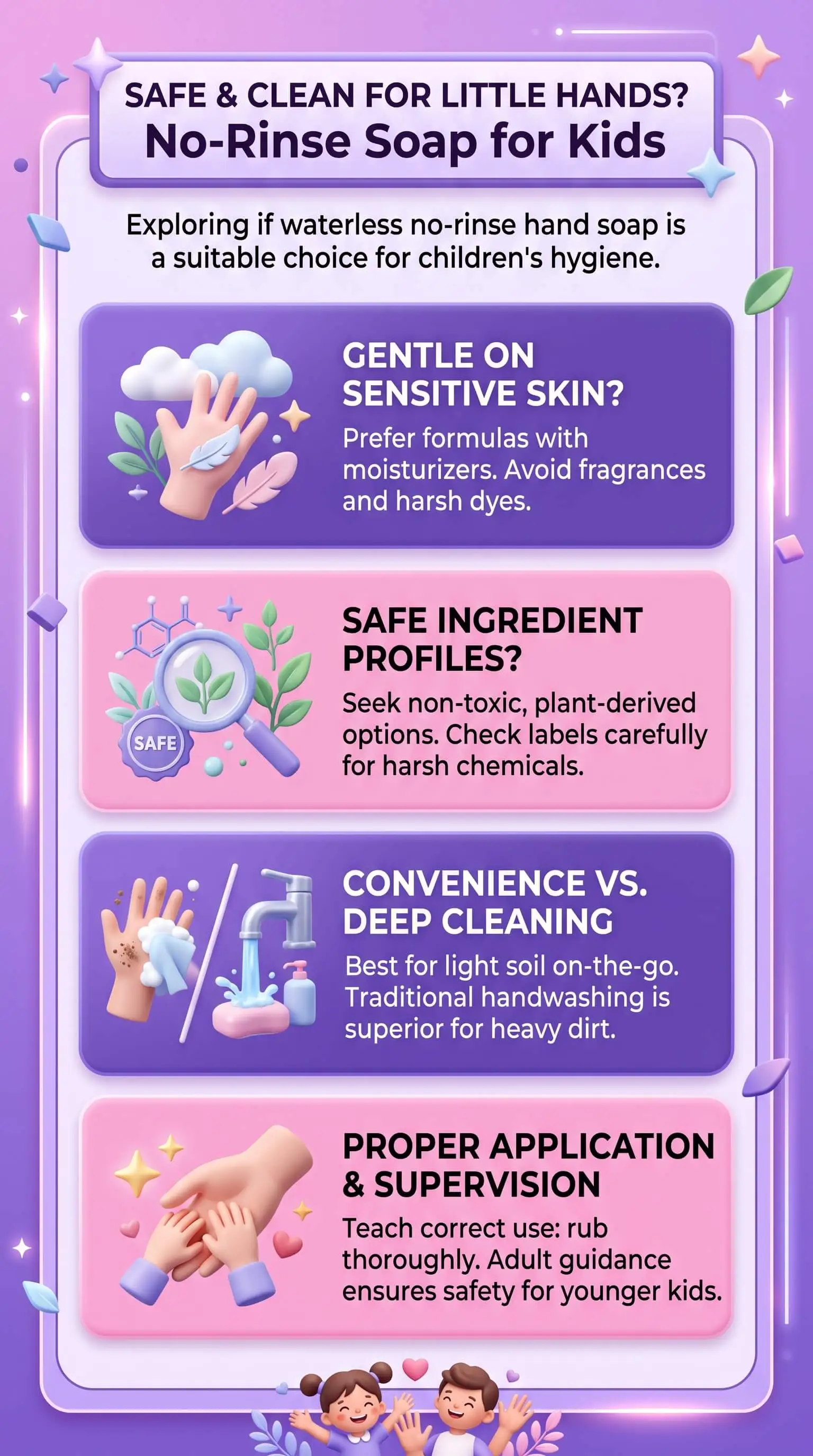
Once you've settled the sanitizer question, screen the rest of the label the way you would for any hand soap going on a child's skin. Fragrance and dye are the two most common triggers for irritation on young, still-developing skin, and they turn up in no-rinse formulas just as often as they do in the bottle by your sink. Harsh surfactants matter too. A rinse-free product sits on the skin longer than something you wash off in twenty seconds, so a formula that's borderline irritating in a regular soap can be more noticeable in a no-rinse one.
Age guidance follows the same logic pediatric groups apply to hand sanitizer. There's no universal minimum age printed on a no-rinse soap bottle the way there is for, say, car seats, but the practical rule holds. For toddlers and any child who still mouths their hands, use it under supervision, and favor a fragrance-free, alcohol-free formula if one's available. Once a child reliably keeps their hands out of their mouth and away from their eyes, the safety profile of a well-formulated no-rinse soap looks a lot like the safety profile of the SLS-free soap already sitting in most bathrooms, provided the ingredient list backs that up. And when a sink is actually available, traditional handwashing with soap and water still wins. No-rinse formats are the backup plan, not the replacement.
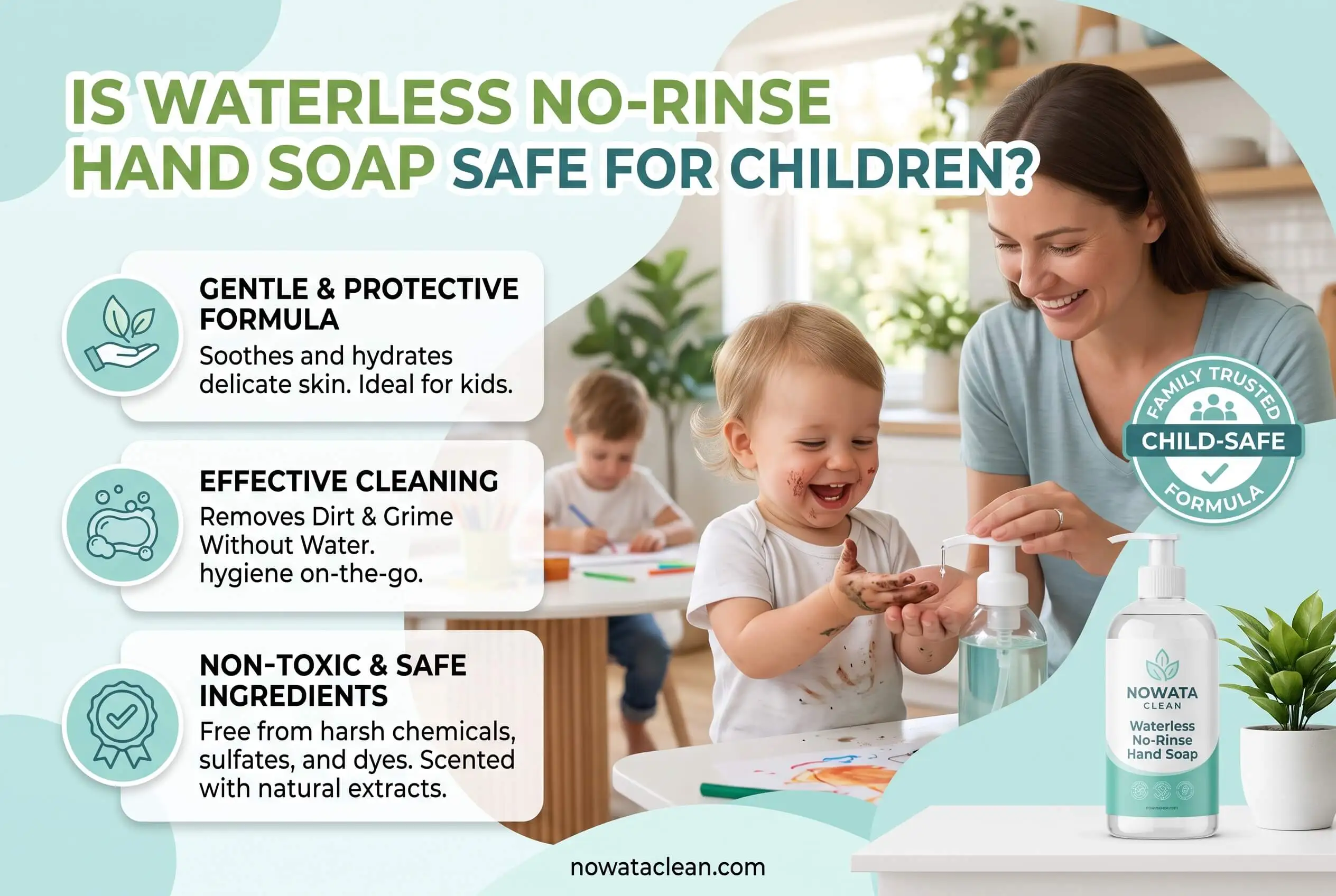
“After years of testing household and home improvement products for this site, I've learned that the label always tells a more honest story than the marketing copy on the front of the bottle. I ran a two-month trial with my grandkids using a fragrance-free, alcohol-free no-rinse soap after outdoor play, specifically because both of them still had the occasional habit of chewing on their fingers. Neither one had a reaction, and neither one showed any interest in the smell or taste, which was the single detail I was watching for most closely. What actually convinced me it belonged in our routine wasn't the marketing. It was reading the ingredient list side by side with the SLS-free soap I already trust, and finding the same short, recognizable list of surfactants with no alcohol anywhere on it.”
7 Essential Resources
These are the sources I leaned on most while researching this topic. Every one is a primary or expert-panel source rather than a summary of a summary.
1. FDA — Safely Using Hand Sanitizer
The FDA's own consumer guidance on hand sanitizer, including the alcohol concentration that qualifies a product as effective and the specific warnings for young children.
https://www.fda.gov/consumers/consumer-updates/safely-using-hand-sanitizer
2. CDC — Handwashing Facts
The data behind why traditional handwashing remains the gold standard, and where rinse-free products fit in as a supplement rather than a substitute.
https://www.cdc.gov/clean-hands/data-research/facts-stats/index.html
3. HealthyChildren.org (American Academy of Pediatrics) — Hand Washing: A Powerful Antidote to Illness
The AAP's own guidance on building hand hygiene habits in young children, written for parents rather than clinicians.
4. U.S. Consumer Product Safety Commission — Children's Products
How federal safety rules classify and regulate products designed for children 12 and under, including packaging standards relevant to any bottle a child might get into.
https://www.cpsc.gov/Business--Manufacturing/Business-Education/Childrens-Products
5. American Academy of Dermatology — Eczema-Friendly Products (Childhood)
The dermatology community's short list of common irritants in children's skin products, including fragrance and dye.
https://www.aad.org/public/diseases/eczema/childhood/triggers/friendly-products
6. Cosmetic Ingredient Review — Safety Assessments
An independent expert panel's peer-reviewed safety assessments on the ingredients that show up in personal-care labels, including the surfactants used in most no-rinse formulas.
7. NIH National Library of Medicine — SLS Toxicity Review
A peer-reviewed look at sodium lauryl sulfate irritation data, useful context for comparing surfactant choices across both rinse and no-rinse formats.
https://pmc.ncbi.nlm.nih.gov/articles/PMC4651417/
These expert and primary sources help explain where Waterless soap fits within safe hand-hygiene routines, especially for children, sensitive skin, frequent use, and formulas that avoid harsh alcohols, fragrances, dyes, or irritating surfactants.
3 Statistics
Statistic #1: Poison control centers handled over 16,000 pediatric hand sanitizer exposures in 2023, most involving children age 4 and younger.
From January through December 2023, U.S. poison control centers handled 16,058 cases involving hand sanitizer exposure in children 12 and younger, according to the American Association of Poison Control Centers. About 84 percent of those cases involved children aged 4 and younger. That figure is specific to alcohol-based hand sanitizer, not waterless or rinse hand soap, and it's exactly the risk profile that makes checking a no-rinse bottle's label for alcohol content worth the extra ten seconds.
Statistic #2: Community handwashing education reduces respiratory illness by 16 to 21 percent and diarrheal illness by 23 to 40 percent.
These are CDC figures, and nowhere in the underlying research is an antiseptic kill step the reason the numbers improve. The gains come from the physical act of removing germs from skin, which is the same mechanism a well-formulated no-rinse soap relies on when a sink isn't an option.
https://www.cdc.gov/clean-hands/globalhandwashingday/index.html
Statistic #3: About 9.6 million children under 18 in the U.S. have atopic dermatitis, the most common form of eczema.
The National Eczema Association's pediatric figure is a useful reminder that a sizable share of the kids using any hand product, rinse-free or not, are already dealing with a compromised skin barrier. That's the population most likely to notice a fragrance or dye that a healthy-skinned child would never react to.
https://nationaleczema.org/eczema-facts/
Final Thoughts and Opinion
After going through FDA guidance, CDC data, and a stack of dermatology sourcing, my take is that this question got tangled up for one simple reason. Two very different rinse-free products share a category in most parents' heads. The FDA regulates hand sanitizer as a drug, with an alcohol concentration high enough to cause real harm if a small child drinks it, and the poison control numbers back that up every year. Waterless no rinse hand soap, formulated without alcohol and without unnecessary fragrance or dye, is a much gentler proposition, closer in risk profile to any other soap in your bathroom than to the sanitizer in your car's cupholder.
This is the same standard I hold every product to on this site, whether it's a furnace filter or a bottle of hand soap. Read the label, understand what's actually doing the work, and don't let a marketing claim substitute for an ingredient list. My opinion, plainly stated. A well-formulated, alcohol-free, fragrance-free no-rinse soap is a reasonable and often useful addition to a family's hand hygiene routine, especially for the outdoor-play, away-from-a-sink moments where it earns its keep. It should not replace the sink when the sink is available, and it should never go anywhere near a child's hands without you having read the label first.
Frequently Asked Questions
Is waterless no-rinse hand soap safe for kids to use daily?
For most kids, yes, provided the formula is alcohol-free and free of unnecessary fragrance and dye. Check the label every time you switch brands, since formulations vary more in this category than in traditional bar or liquid soap.
What age can children start using no-rinse hand soap?
There's no federally set minimum age printed on the bottle. The practical guidance mirrors hand sanitizer advice. Supervise any child who still mouths their hands, and favor fragrance-free, alcohol-free formulas until a child reliably keeps their hands away from their face.
Is waterless hand soap the same thing as hand sanitizer?
No. Hand sanitizer is an FDA-regulated over-the-counter drug that must contain a high concentration of alcohol to work. Manufacturers typically market waterless no-rinse hand soap as a cosmetic, and most formulas skip alcohol entirely, relying on a physical lifting mechanism instead.
What ingredients should I avoid in a child's no-rinse soap?
Screen for fragrance, artificial dye, and any alcohol listed as an active ingredient. If your child already deals with sensitive or reactive skin, a fragrance-free formula built for allergy-prone skin is worth comparing against whatever no-rinse soap you're considering.
What should I do if a child swallows waterless hand soap?
Check the label immediately for alcohol content. If the product lists ethanol or isopropyl alcohol, treat it exactly like a hand sanitizer ingestion and call Poison Control at 1-800-222-1222. If the formula is alcohol-free, contact your pediatrician or Poison Control anyway to confirm there's no other ingredient of concern.
Can no-rinse hand soap replace regular handwashing for kids?
No. It's a supplement for moments away from a sink, not a substitute. Traditional handwashing with soap and water for 20 seconds remains the more effective option whenever it's available.
CTA
Before you add any waterless or rinse hand soap to your family's routine, flip the bottle over and read the ingredient list the way you'd read a nutrition label. No alcohol, no unnecessary fragrance, and a short, recognizable ingredient list are the three things worth checking every time. If you're stocking up for a full household, take a look at our guide to bulk sulfate-free hand soap options for large families for formulas that pass the same test at a size that actually lasts.