That gap explains most of the confusion around AQI Seattle readings in wildfire season. Official monitors get the number right but report it late. Low-cost sensors catch smoke within minutes, yet they read high until someone corrects them. Once you know which number you're looking at and how old it is, you can trust it enough to make health decisions for your family.
Every one of those numbers traces back to the Air Quality Index, the EPA scale that turns pollutant concentrations into six color-coded health categories. In fire season, PM2.5, the fine particles in smoke, almost always drives the reading.
TL;DR Quick Answers
aqi Seattle
AQI Seattle readings come from the EPA’s NowCast, which blends up to 12 hours of monitor data into one 0 to 500 score. During wildfire smoke, that official number can trail a fast-moving plume by an hour or more. Check corrected maps to decide what to do, and nearby sensors to see smoke arriving.
Where to check: AirNow, the Washington Department of Ecology air quality map, and the Puget Sound Clean Air Agency sensor map all show corrected Seattle readings.
When to act: At 101, people with asthma, heart disease, or a pregnancy should limit time outdoors. At 151, everyone should cut back.
Raw sensors: Uncorrected PurpleAir readings can run about twice as high in smoke, so treat them as an early warning.
Your neighborhood: Inversions and sparse monitors mean your block’s AQI can differ from the citywide number.
Indoor protection: Close windows, switch the HVAC fan to “On,” and run a MERV 13 filter if your system can handle one.
Top Takeaways
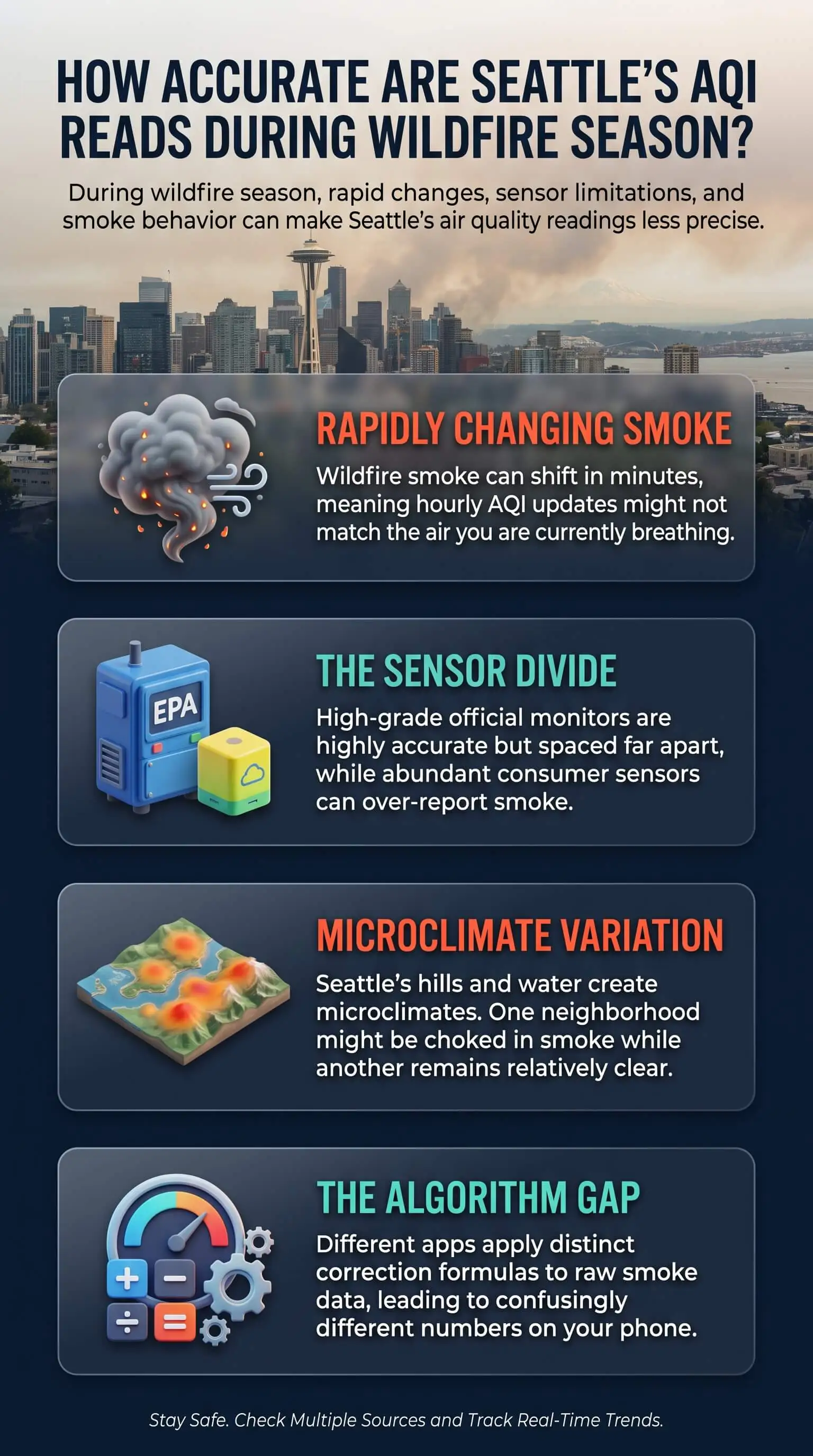
Official readings are accurate but late. NowCast blends up to 12 hours of data, so it trails fast-moving smoke.
Raw sensors run high in smoke. Corrected sensor data lines up far more closely with monitors.
Your block can differ from the city. Inversions and sparse monitors can put your street ahead of or behind the citywide number.
Pick the source that fits the question. Sensors show smoke arriving, and corrected maps guide what you do about it.
Indoor air is yours to control. Keep air recirculating through a MERV 8 filter wherever your system allows it.
Where Seattle AQI Readings Come From
The number on your phone starts with one of these sources:
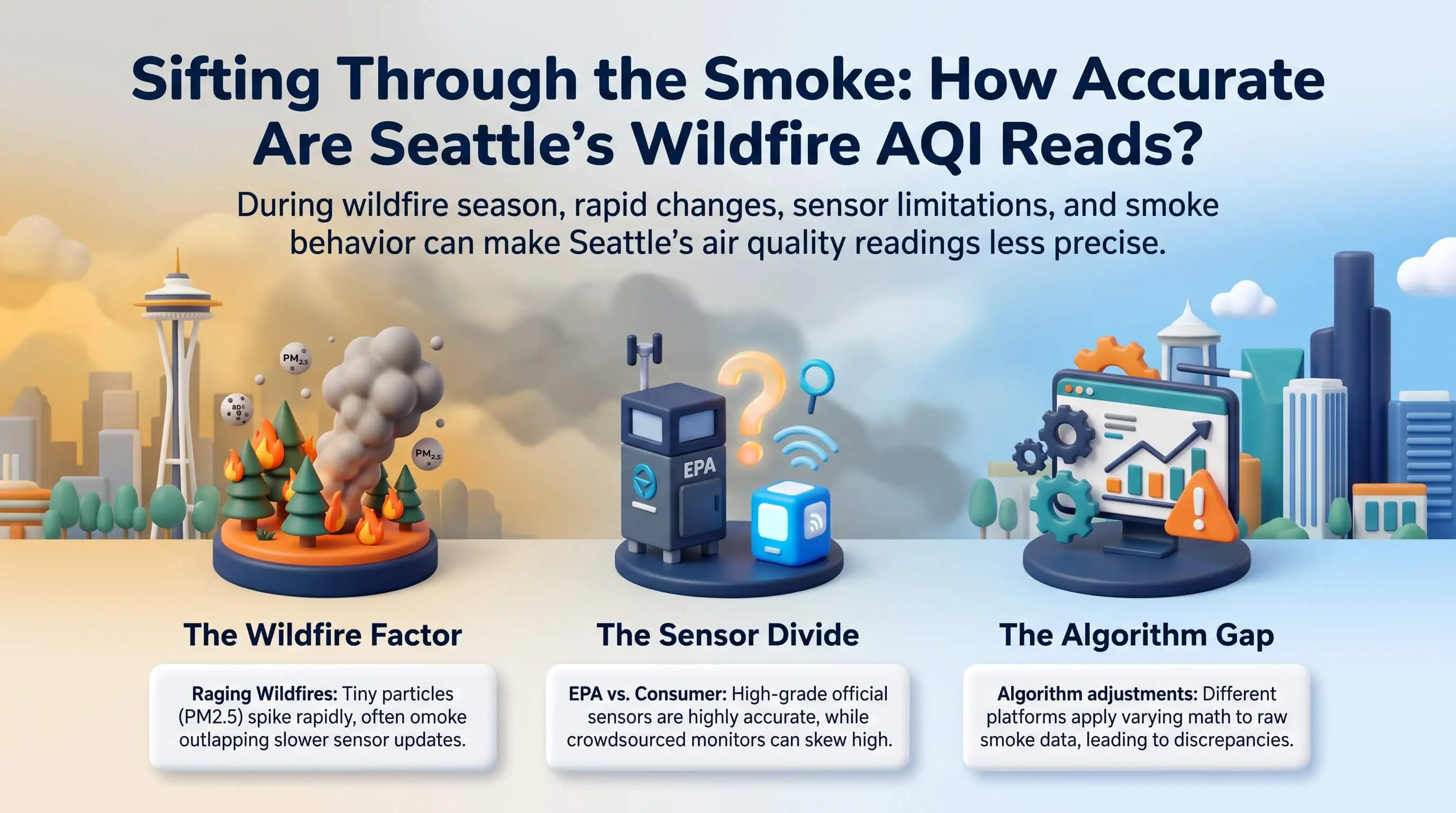
Regulatory monitors: The Washington Department of Ecology and its partners run about 80 monitoring stations statewide. They set the benchmark and report hourly averages.
The regional sensor network: The Puget Sound Clean Air Agency runs public low-cost sensors through an EPA equation so they match its monitors. Sensors that disagree with their neighbors fade out on the map.
Consumer sensors: Hundreds of PurpleAir units sit on porches and balconies from Tacoma to Everett, updating every few minutes. Unless your app applies a correction, you're seeing their raw readings.
Why the Official Number Lags When Smoke Rolls In
Here's something that might surprise you: the AQI on AirNow and the state map reflects the past several hours as much as the current one. EPA calls it a NowCast. The formula blends up to 12 hours of hourly data to estimate the full-day AQI, leaning on that longer history when the air holds steady and on the latest hours when smoke moves in fast. Even then, it trails what you see out the window.
The delay has two sources. Monitors post an hourly average only after each hour closes. And the NowCast still remembers the cleaner hours before the plume arrived, so it climbs slowly. That memory cuts the other way when smoke clears, which is why the map can stay orange after the sky turns blue. AirNow, the Fire and Smoke Map, and Washington's state maps all report NowCast values, so they tend to lag together.
Why Low-Cost Sensors Can Read High in Smoke
A PurpleAir sensor shines a laser through sampled air, counts the scattered light, and converts that count into a mass estimate. Smoke scatters light differently than the particles its manufacturer calibrated it against, so raw readings drift upward. How far? The Puget Sound Clean Air Agency says uncalibrated sensors can read about twice as high during wildfire smoke.
EPA scientists built a correction equation from thousands of paired sensor and monitor readings, and the AirNow Fire and Smoke Map has shown corrected sensor data since 2020. Extreme smoke still trips it up. Above roughly 300 µg/m³, the sensor's response bends away from a straight line, and error grows right when the readings matter most.
Why Your Neighborhood Shows a Different Number
Seattle sits in the Puget Sound basin, wedged between the Olympics and the Cascades. Marine air and overnight temperature inversions can pin smoke low in one valley while the hillside next to it clears. With only about 15 regulatory monitors along the Tacoma to Everett corridor, the closest official station may be miles from your house. A sensor two blocks away can pick up a pocket of smoke that the official map averages out. The simplest AQI meaning to remember is that air quality readings reflect conditions at specific locations, not necessarily the air right outside your home.
Which Seattle AQI Source to Trust, and When
Match the source to the question you're asking:
Planning tomorrow: Check the AirNow forecast and the state's daily smoke outlook.
Deciding right now: Go with the corrected readings on the AirNow Fire and Smoke Map or the Ecology map.
Watching smoke reach your street: Treat a nearby sensor as your early warning, especially when its trend keeps climbing.
When sources disagree: Act on the worst reading if anyone at home has asthma, heart disease, or a pregnancy.
What to Do Indoors When the Numbers Disagree
Don't take your indoor air for granted! The AQI only describes outdoor air, and fine particles slip inside through gaps, doors, and fresh-air intakes. You don't have to wait for every map to agree before you protect your home:
Close windows and doors, and set any fresh-air intake to recirculate.
Flip the thermostat fan from "Auto" to "On" so air keeps moving through the filter.
Run a MERV 13 filter, or the highest rating your system can handle.
Put a portable HEPA air cleaner in the bedroom, where your family logs the most hours.
Indoor air quality testing gives you a baseline for what's still lingering inside after a smoke event. You'll find the same household steps in this guide to improving indoor air quality in Washington DC, which shows they hold up far beyond the Pacific Northwest.
Pro Tip: Tap the nearest circle on the Fire and Smoke Map and check its trend marker. A yellow reading that keeps climbing says more about the next hour than an orange one holding steady.
"I've spent years reviewing smoke-season data around Puget Sound, and I've watched corrected sensors in South Seattle hit orange a full hour before the nearest regulatory monitor posted its next NowCast. So I tell families to let the sensor show them when smoke is arriving and let the corrected map tell them how bad it is."
7 Essential Resources
Real-Time AQI Seattle Map: Live Seattle conditions, what each AQI level means for your family, and filter guidance for smoke days.
AirNow: How To Use the Fire and Smoke Map: The official guide to the monitor, temporary monitor, and sensor circles.
Washington Department of Ecology: Wildfire Smoke: Washington's air quality maps, smoke forecasts, and burn ban links in one place.
Puget Sound Clean Air Agency Air Quality Sensor Map: Corrected neighborhood sensors, each tagged with a confidence rating.
Washington State Department of Health: Smoke From Fires: What to do indoors and outdoors when smoke rolls in.
Public Health Seattle and King County: Wildfire Smoke Preparedness: Box fan filter instructions, mask tips, and smoke planning help for schools.
EPA Air Sensor Toolbox: Air Sensor Collocation: How agencies check sensors against reference monitors and correct the gap.
Seattle's air quality resources provide real-time AQI readings, wildfire smoke forecasts, neighborhood sensor data, and practical safety guidance to help families make informed decisions about outdoor activities and indoor air protection. Top air filters can also help reduce indoor smoke particles during periods of poor air quality.
3 Supporting Statistics
Raw PurpleAir data can read up to twice as high as reference monitors. Even after correction, only 5 of 15 smoke-impacted sites hit EPA's one-hour performance targets. National Library of Medicine: PurpleAir Correction for Extreme Wildfire Smoke
From Tacoma to Everett, more than 700 active PurpleAir sensors share the map with about 15 regulatory monitors. With EPA's correction applied, those sensors tracked reference smoke readings at a slope of 0.88. NOAA Repository: Evaluation of PurpleAir Correction Equations
A NowCast draws on the last 12 hours of data, and it stays valid as long as 2 of the past 3 hourly readings came in. AirNow Tech: The NowCast for Ozone and PM
Final Thoughts and Opinion
Here's my honest opinion: Seattle's air quality readings deserve more trust than the screenshots in neighborhood groups give them. When two maps disagree, you're usually comparing a fast sensor with a slow official average, and neither instrument is broken. I use the sensor down the street for timing and the corrected map for the call. Then I close the windows before they finish arguing. The smoke that reaches your living room is the part you control, and choosing the best air filter for dust and fine particles is one way to handle it and become the hero of your household.
Frequently Asked Questions
Why Does the Seattle AQI on My Phone Differ From AirNow?
Many weather apps pull raw or differently averaged sensor data, while AirNow shows corrected NowCast values. Your app reacts faster. AirNow lines up more closely with health guidance.
Is PurpleAir Accurate for Wildfire Smoke in Seattle?
Raw PurpleAir readings tend to run high in smoke. Once EPA's correction kicks in, as it does on the AirNow Fire and Smoke Map, they track regulatory monitors closely in most smoke conditions.
How Often Is AQI Seattle Data Updated?
Regulatory monitors update every hour, once the hour closes. Low-cost sensors refresh every few minutes, which is why they spot incoming smoke first.
What AQI Level Should Prompt Seattle Families to Stay Indoors?
At 101, people in sensitive groups should limit time outdoors. Once the AQI reaches 151, everyone should cut back and focus on keeping indoor air clean.
Can Indoor Air Be Worse Than the Outdoor AQI During Smoke?
Yes. Smoke that slips inside can hang around after outdoor air improves, especially in a home without good filtration. A high-efficiency HVAC filter and a HEPA cleaner shorten that window, making air filtration an important part of home improvement.
Read Seattle AQI Readings With Confidence This Wildfire Season
Check the corrected map before you decide and the closest sensor to see smoke coming, and you'll know how far to trust Seattle air quality readings on any given day. Keep a fresh, high-efficiency filter in your system so your family breathes clean air indoors whichever number you go with.