TL;DR Quick Answers
What is the air quality like in Washington, DC?
Washington DC's outdoor air meets national standards for every pollutant except ground-level ozone, which spikes during summer smog season. Most days rate good to moderate on the AQI, but wildfire smoke and traffic corridors can push readings higher without much warning. Check the live AQI before deciding whether to ventilate or filter indoors.
Ozone is the outlier. DC meets air quality standards for every pollutant except summer ozone.
Check before you act. A live AQI reading tells you whether to open windows or run a purifier.
Wildfire smoke is a summer risk. Canadian smoke can spike readings with little warning.
Indoor air needs its own plan. Good outdoor conditions don't guarantee clean air inside your house.
Top Takeaways
Check outdoor AQI before you act. It tells you whether to open windows or run a purifier.
Change filters on a schedule, not by eyeballing them. A clogged filter fails quietly.
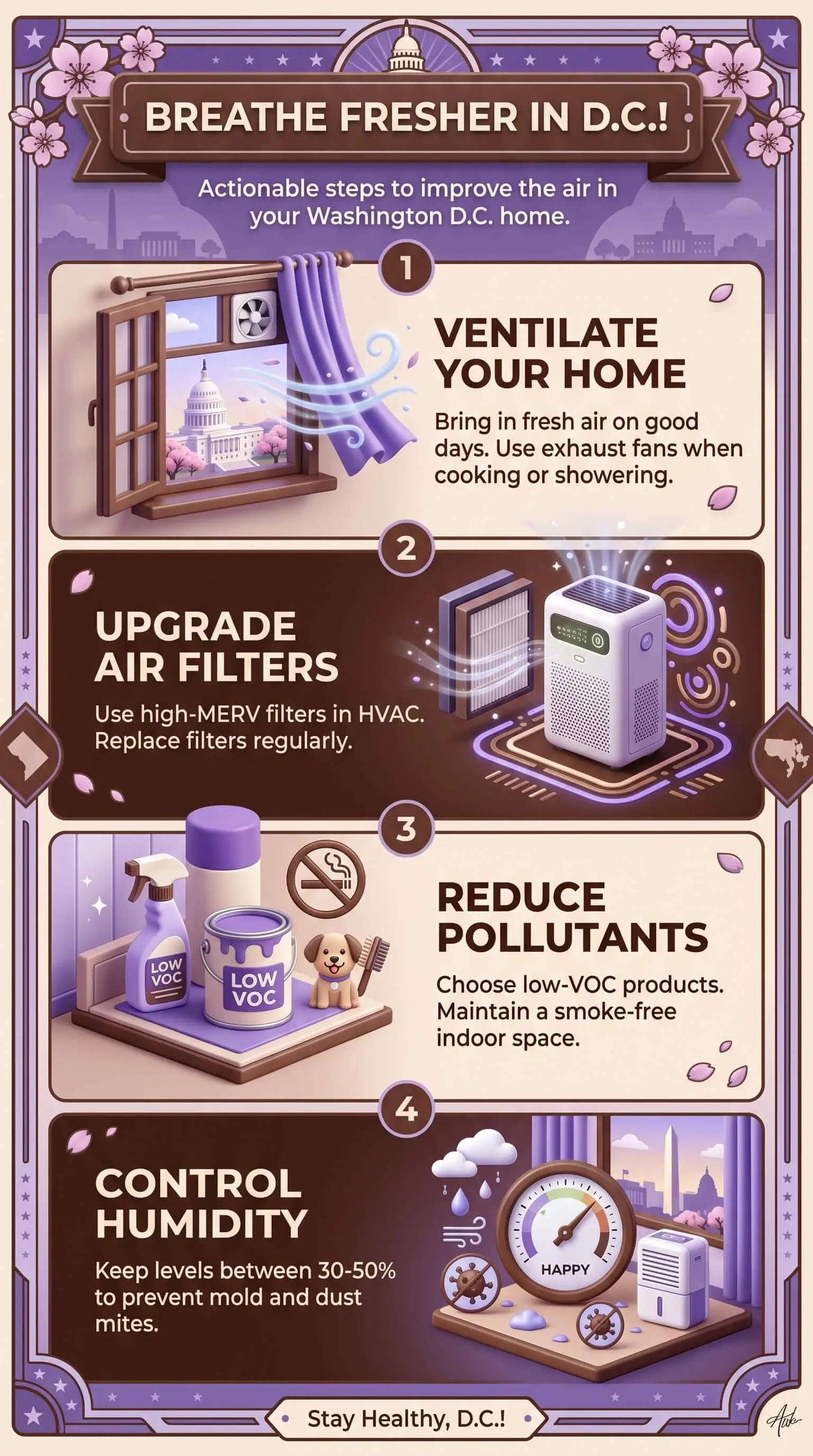
Control humidity. DC summers make mold and dust mites worse without it.
Watch the ozone season closely. It's the one pollutant DC hasn't fully solved.
Cut indoor sources of pollution. Candles, harsh cleaners, and an unvented gas stove add up.
What Makes DC's Indoor Air Harder to Manage
A few things stack up against Washington homes at once. Traffic along the Beltway, I-395, and the District's busiest arteries pushes fine particles and exhaust straight into the row houses and apartments that line those corridors. Many of those row houses predate mechanical ventilation standards by decades, so fresh air struggles to get in and stale, polluted air struggles to get out. Humid summers turn any damp basement or bathroom into a mold risk. Spring pollen season is genuinely rough on anyone with allergies. And wildfire smoke drifting in from Canada is a newer, but now regular, summer visitor.
The Fixes That Actually Move the Needle
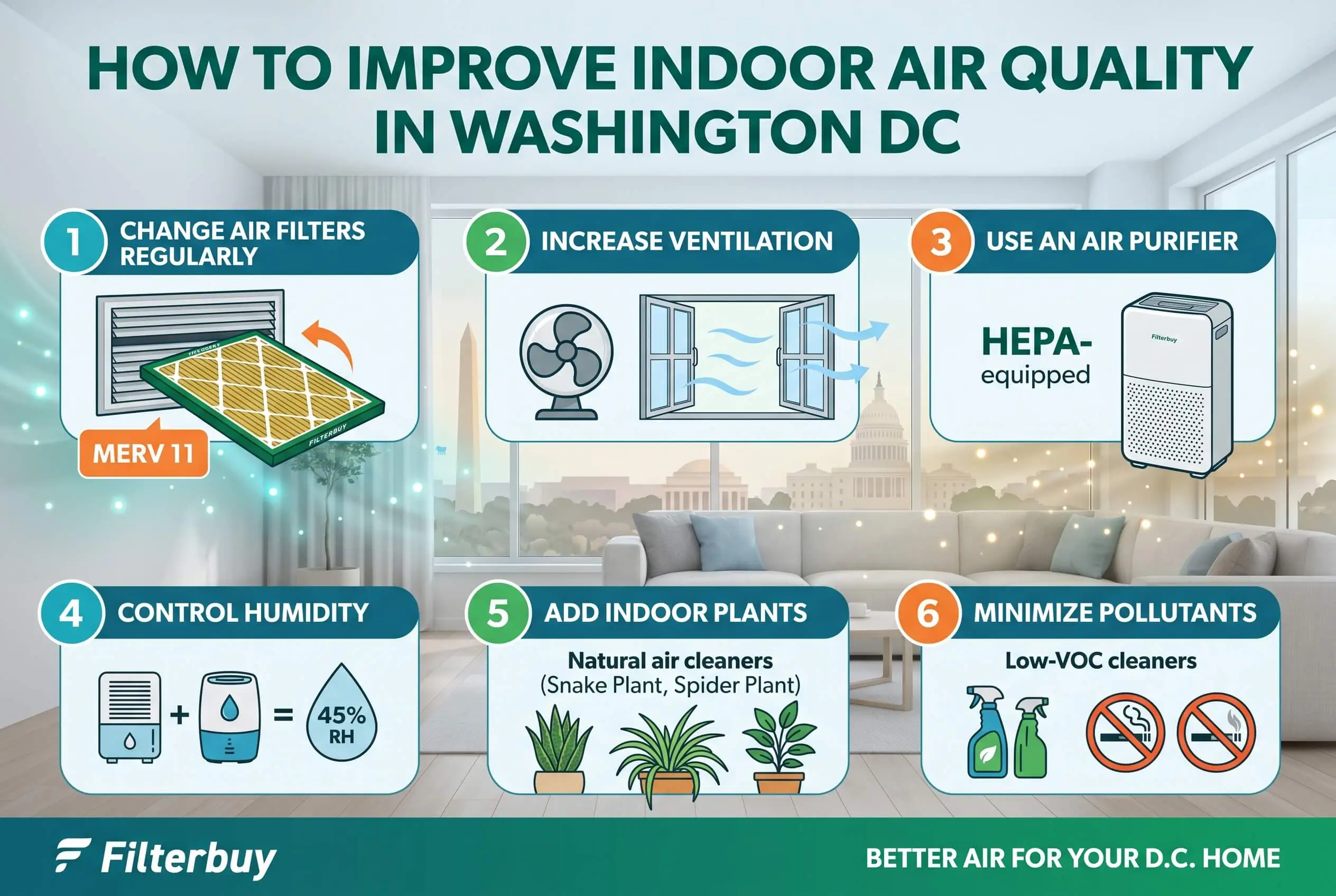
Before deciding whether to crack a window or run a purifier, I check the live air quality index map for Washington DC first. Clean air outside means open the windows and let the house breathe. Dirty air means close up and lean on filtration instead.
From there, a handful of habits carry most of the weight. Filter first: change it on a set schedule, not when it starts looking dirty, because a clogged filter quits working long before it looks obviously grimy. I run a portable purifier in the bedroom on nights when outdoor air is too rough to open a window. A dehumidifier keeps humidity low enough that mold and dust mites lose their favorite conditions. Houseplants help a little, but they're not a substitute for either. And the sources you add yourself matter just as much: scented candles, harsh aerosol cleaners, a gas stove running without the exhaust fan on. These simple home improvement stepspl cut those and you've solved part of the problem before outside air even factors in.
“In years of researching indoor air fixes for homeowners, I've noticed the same mistake show up in DC row house after row house: people wait for a bad air quality day to think about their filter, when the smarter move is checking it before the bad air ever shows up.”
7 Essential Resources
AirNow: Check DC's Real-Time Air Quality
AirNow's District of Columbia page pulls live readings from federal and District monitors, so you can see the current AQI and which pollutant is driving it before deciding whether to ventilate. This is the one I check every morning.
ENERGY STAR: Get Your Filter Schedule Right
ENERGY STAR's heating and cooling guide lays out how often to check and change a home filter, plus the smaller habits that keep a system running efficiently.
NIEHS: Understand What's Actually in Indoor Air
The National Institute of Environmental Health Sciences' indoor air page breaks down the pollutants commonly found in homes and explains why indoor exposure matters as much as outdoor exposure.
American Lung Association: See DC's Air Quality Report Card
The American Lung Association's District of Columbia report card tracks the District's ozone and particle pollution grades year over year, so you can watch conditions trend up or down.
AAFA: Learn How Air Pollution Triggers Asthma
The Asthma and Allergy Foundation of America's air pollution guide explains how ozone and particle pollution worsen asthma symptoms and what to do on high-pollution days.
MWCOG: Plan Ahead With the Regional Forecast
The Metropolitan Washington Council of Governments' air quality forecast covers DC, Maryland, and Virginia together, since regional smog doesn't stop at the District line.
CPSC: Get the Basics of Indoor Air Quality Right
The Consumer Product Safety Commission's indoor air quality guide is a plain-language rundown of source control, ventilation, and air cleaning for anyone who wants the fundamentals in one place.
3 Statistics
People spend roughly 90% of their time indoors, according to the EPA, which is exactly why indoor air quality deserves as much attention as the outdoor AQI.
8.6% of U.S. adults currently have asthma as of 2024, per the CDC, a population that feels indoor air quality changes faster and more sharply than most.
The District meets national air quality standards for every pollutant except ground-level ozone, according to DC's Department of Energy and Environment, which is why ozone season is the one stretch of the year DC air needs the closest watching.
Because most people spend the majority of their time indoors and ground-level ozone remains Washington, DC's primary air quality challenge, using a high quality filter can help support cleaner indoor air when outdoor pollution levels increase.
Final Thoughts and Opinion
If I had to sum up indoor air quality in DC in one line, it's this: the outdoor air here is good enough, most days, that it's easy to assume the air inside your house is fine too. While DC's indoor air rarely fails all at once, it erodes slowly: a filter that's overdue, a bathroom fan nobody runs, a window that never gets opened on a good-air day. Replacing that overdue filter with a top air filter can be one simple step toward maintaining healthier indoor air. None of that requires an overhaul. It just requires paying attention on a regular schedule instead of only during a code orange alert.
Frequently Asked Questions
Is Washington DC's air quality bad?
Most days, DC's outdoor air meets national standards. Ground-level ozone during summer is the main exception, along with occasional wildfire smoke events.
What causes poor indoor air quality in DC homes?
Traffic pollution infiltrates older housing stock, limited ventilation in row houses, summer humidity and mold, and indoor sources like unvented cooking and harsh cleaning products, making a MERV 11 pleated HVAC air filter a practical way to help capture airborne particles that enter the home.
How often should I change my air filter in DC's climate?
Check monthly during ozone season and any wildfire smoke event, and replace on the schedule your filter's packaging recommends rather than waiting until it looks dirty.
Do air purifiers help with DC's seasonal allergens?
Yes, a portable air purifier with a true HEPA filter reduces pollen and particle levels in the room where you spend the most time, especially on high-pollen or high-AQI days.
Ready to Take a Closer Look at Your Home's Air?
Pick one change that fits your week: a filter swap, a dehumidifier, planning for an HVAC replacement if your current system is no longer filtering efficiently, or just checking the outdoor air quality before you open a window. Small, consistent habits like these add up to noticeably cleaner air by the time the next ozone season or smoke event rolls around.