On a Saturday morning, the 710 finally opens up. The line of port trucks thins out, commuters stay home, and the sky over downtown can look a shade bluer than it did on Thursday. For some pollutants, the air really is cleaner. Ground-level ozone, the invisible gas behind most of Los Angeles' unhealthy air days, often moves the other way, so the air quality index in Los Angeles can read worse on a quiet weekend than on a jammed Tuesday.
Don't take a calm weekend for granted. I went through decades of California air research, and the answer changes how you plan time outdoors and protect the air inside your home.
TL;DR Quick Answers
air quality index los angeles
The air quality index (AQI) in Los Angeles rates outdoor air from 0 to 500, and anything over 100 is unhealthy for sensitive groups. Ground-level ozone sets the number on most bad days, peaking in the afternoon and often running higher on weekends, so check the reading before you head out.
Ozone drives the number: Los Angeles-Long Beach logs 159.2 unhealthy ozone days a year, more than any other U.S. metro (American Lung Association, 2026).
Plan around the afternoon peak: Mornings usually bring the cleanest air, and smog season runs from May through September 30.
Location changes the reading: Coastal neighborhoods often stay moderate while the San Fernando Valley, San Gabriel Valley and Inland Empire climb higher.
Filters help with particles, not ozone: A MERV 8 filter captures smoke and PM2.5, but ozone is a gas, so closing windows during afternoon peaks does more to protect indoor air.
Top Takeaways
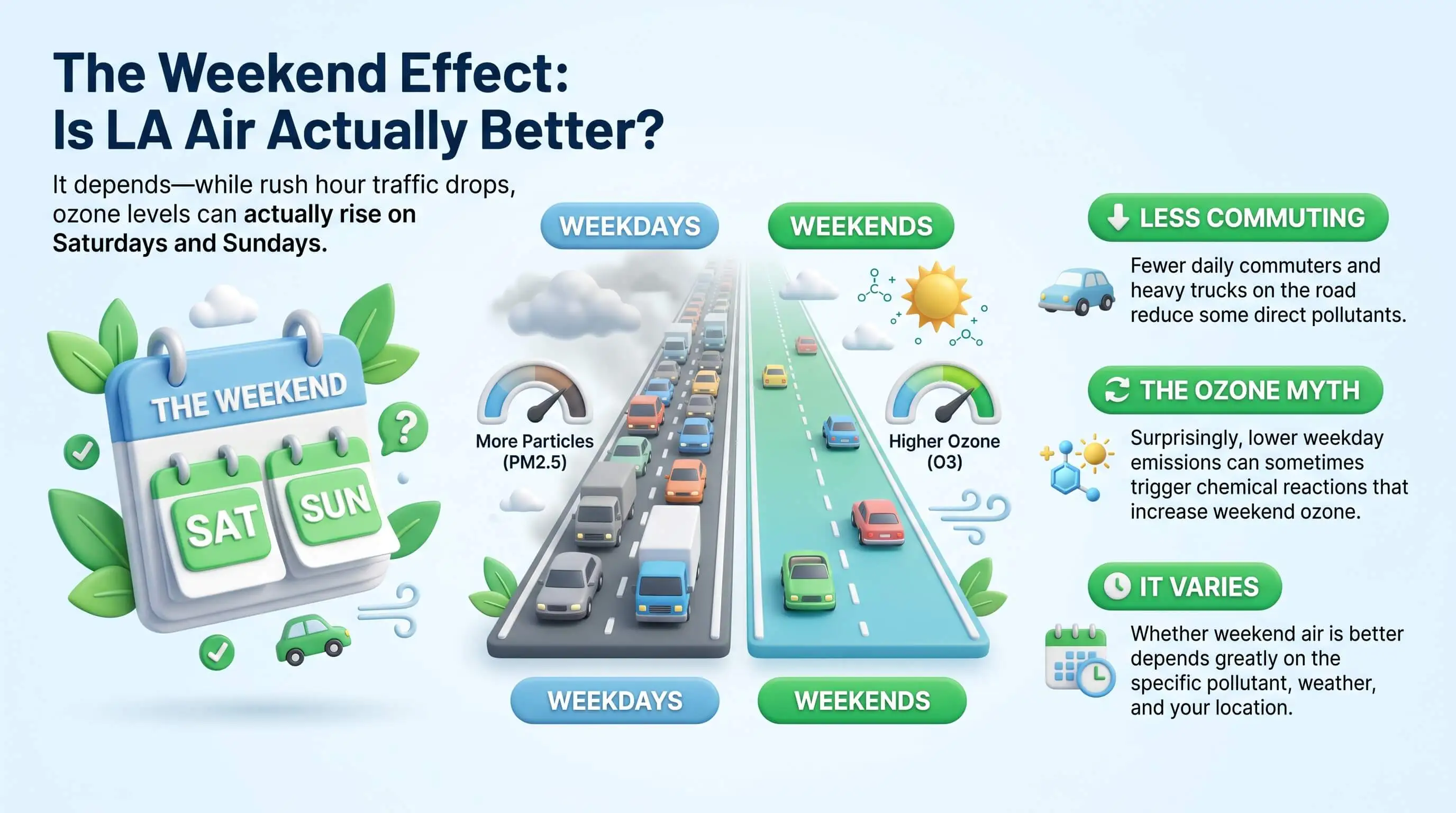
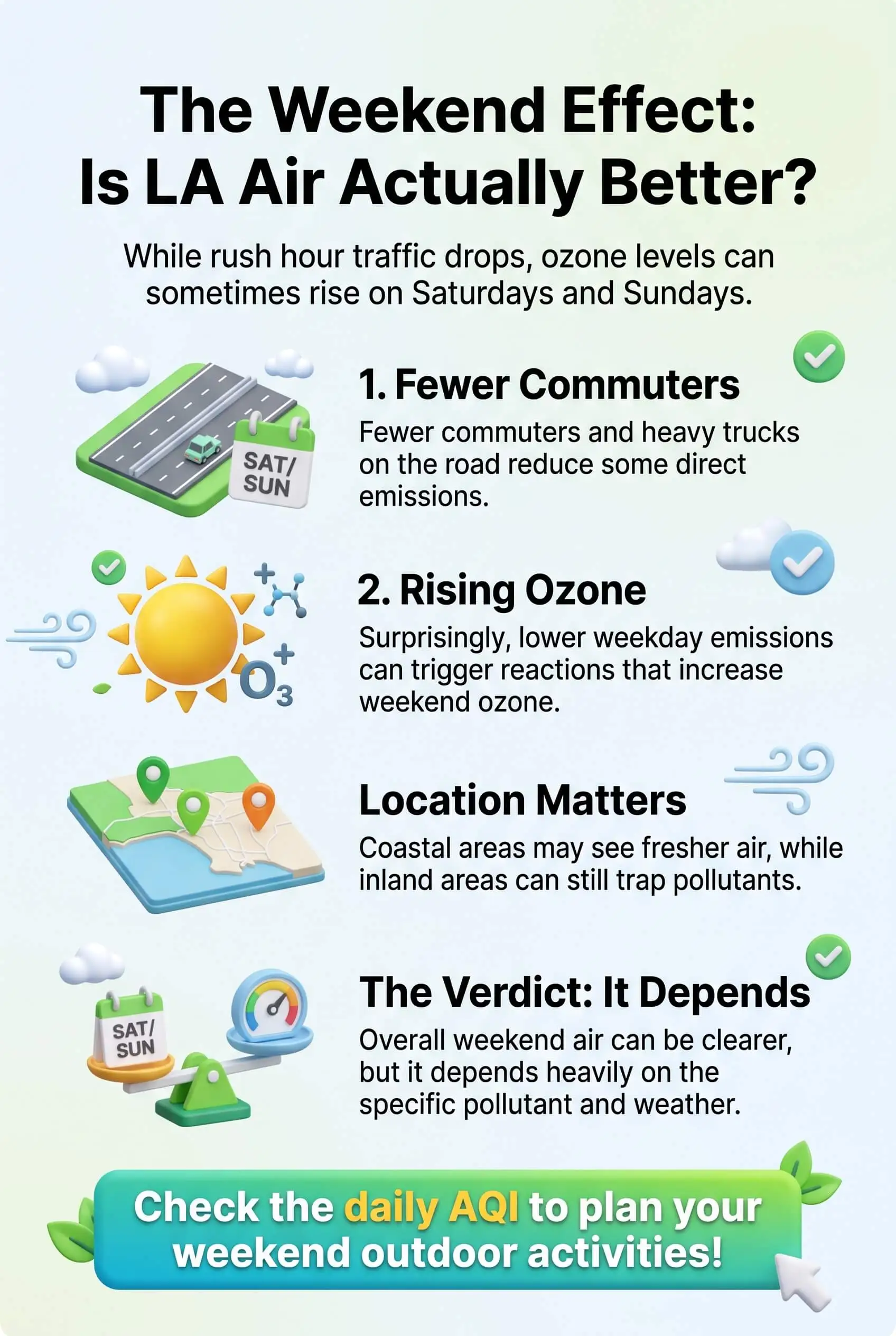
Split verdict: Traffic pollutants drop on LA weekends, while ozone often rises.
Ozone sets the number: Since ozone drives most unhealthy AQI days, weekend readings can look worse than weekday ones.
The pattern is shifting: Lower NOx is bringing cleaner hot weekends more often, especially inland.
Location and weather lead: Coastal areas usually fare better, and heat or smoke can override the day of the week.
Indoor air is yours to protect: Close up during afternoon peaks, run air through a quality filter, and remember that filters don't remove ozone gas.
The Short Answer: It Depends on the Pollutant
Weekends cut the pollutants that come straight out of tailpipes and often push ozone higher.
Lower on weekends: nitrogen dioxide, carbon monoxide, and diesel soot, which all track truck and commuter traffic closely.
Often higher on weekends: ground-level ozone, especially on sunny afternoons in the urban core.
Fine particle pollution, or PM2.5, barely budges between weekdays and weekends. Much of it forms in the air over several days and drifts across the region.
What the Air Quality Index Measures in Los Angeles
The air quality index turns readings for ozone, particle pollution, carbon monoxide, sulfur dioxide, and nitrogen dioxide into one color-coded number between 0 and 500. Whichever pollutant scores worst sets the number you see. A reading of 100 lines up roughly with the federal health standard.
In Los Angeles, ozone usually holds that top spot from spring into early fall. Fine particles take over when wildfire smoke rolls in and on still winter nights.
What Changes in LA Air When the Workweek Ends
The weekend slowdown shows up clearly in the data. Diesel trucks, port drayage rigs, construction equipment, and commuters all ease off. Chinkin and colleagues studied the South Coast Air Basin and found nitrogen oxide (NOx) emissions fall 35 to 41 percent on Saturdays and Sundays, while volatile organic compounds, or VOCs, drop only 12 to 18 percent.
That gap drives everything that follows. Paints, solvents, gasoline vapor, and plants keep releasing VOCs every day of the week.
Why Ozone Often Climbs on Saturdays and Sundays
Nothing emits ozone directly. Sunlight cooks it out of NOx and VOCs. NOx plays an odd double role here, because it helps build ozone while fresh exhaust also breaks ozone down near busy roads. Picture fuel and a fire extinguisher in the same can.
Pull NOx out of the air on a weekend and two things happen:
Less morning cleanup: With less fresh exhaust around, ozone starts piling up about an hour earlier in the day.
Faster production: A higher ratio of VOCs to NOx speeds up ozone formation in the city's core, where NOx has always been plentiful.
The swing can be large. Chinkin's team measured weekend ozone in the basin running as much as 55 percent higher than weekday levels under similar weather.
Is the Weekend Ozone Effect Fading?
On hot days, it looks that way. Cleaner trucks and cars have trimmed NOx year after year, and the chemistry has started to tip. Researchers from the University of Colorado and NOAA analyzed CARB monitoring data and found the odds of higher weekend ozone fell 15 to 25 percent across most of the basin compared with the mid-2000s. Hot inland weekends now bring lower ozone more often. Downtown has changed far less.
Weather Often Matters More Than the Calendar
A heat wave on a Wednesday can do more harm than any weekend traffic pattern. Heat and strong sun speed up ozone chemistry, and the mountains around the basin hold air in place under a temperature inversion, often capped by the marine layer. The South Coast AQMD runs smog season from May through September 30.
Santa Ana winds and wildfire smoke can override all of it, any day of the week.
Where You Live in the Basin Changes the Answer
Ozone forms as the afternoon sea breeze pushes the morning's exhaust inland. Coastal neighborhoods often stay in moderate territory while the San Fernando Valley, San Gabriel Valley, and Inland Empire bake. During a late-August 2026 ozone advisory, the South Coast AQMD forecast unhealthy levels for sensitive groups in inland valleys and lower ozone along the coast.
A weekend in Santa Monica may well feel fresher. In Glendora or Riverside, a hot Saturday can turn into the worst air day of the week.
How to Plan Weekend Time Outside in Los Angeles
You're the one who decides when the kids head to the park and when the windows open. These habits make that call easier:
Check the AQI before you go: Look at the number and the main pollutant before you lock in plans.
Move workouts to the morning: Ozone peaks in the afternoon, so early hikes, runs, and soccer games usually catch the cleaner hours.
Head for the coast on hot days: When inland forecasts climb, beach cities often sit in better air.
Treat smoke days differently: Fire smoke ignores the afternoon pattern and can stay high from dawn to bedtime.
On summer weekends, I've watched inland readings on the regional AQI map turn orange by early afternoon while the coast stayed yellow.
Keeping Indoor Air Cleaner on High-AQI Weekends
A rough forecast outside doesn't have to decide what your family breathes inside. These steps keep your home's air in better shape:
Close up for the afternoon peak: Open windows during the cooler morning hours when readings look good, then shut them as ozone builds.
Set the HVAC fan to "On" or "Circulate": Your indoor air passes through the filter more often.
Upgrade the filter if your system allows it: MERV 11 and MERV 13 filters catch far more fine particles, smoke included. Check the system manual or ask an HVAC pro before you move up.
Add a portable HEPA purifier: Bedrooms and main living spaces get the biggest benefit during smoke events.
Skip ozone-generating "air purifiers": They add the exact gas you're trying to avoid.
Pro Tip: A pleated filter traps particles, but ozone is a gas, so even a high-MERV filter won't pull it out of your air. On high-ozone days, your strongest move is keeping outdoor air from flowing in during the afternoon.
"In my years working with Southern California homeowners on indoor air, the weekend complaint I hear most comes from the inland valleys, where the freeway goes quiet yet the air feels heavier by Saturday afternoon. The nitric oxide that normally breaks ozone down drops off with weekday truck traffic, so ozone starts building earlier and hangs around longer."
7 Essential Resources
Live AQI Map for Los Angeles: Current air quality index readings across Los Angeles, with filter guidance matched to the day's conditions.
South Coast AQMD: Summer Smog Season Is Here: The regional air district's rundown of ozone season and its real-time forecast tools.
EPA: Ground-Level Ozone Basics: How sunlight turns NOx and VOCs into ozone and who faces the greatest health risk.
AirNow: Air Quality Guide for Ozone: Federal advice for protecting your health when ozone climbs to unhealthy levels.
California Air Resources Board: Weekday/Weekend Differences in the South Coast Air Basin: State research comparing weekday and weekend air quality and weather across the region.
Airborne and Ground-Based Observations of a Weekend Effect in Ozone (eScholarship): The CalNex 2010 field study on why weekend ozone runs higher in the basin.
Characterization of Ozone Episodes in the South Coast Air Basin (OSTI): A UCLA report on how the day of the week shapes peak ozone downwind.
3 Supporting Statistics
159.2 unhealthy ozone days per year: Los Angeles-Long Beach ranked as the most ozone-polluted metro area in the country in the 2026 report, which covers 2022 to 2024 data. American Lung Association, State of the Air 2026
Up to 55 percent higher weekend ozone: Ozone in the South Coast Air Basin can run up to 55 percent higher on weekends under comparable weather, even as NOx emissions fall 35 to 41 percent. Chinkin et al., Journal of the Air & Waste Management Association (PubMed)
15 to 25 percent drop: The probability of higher weekend ozone fell 15 to 25 percent across most of the basin, driven by lower ozone on hot weekends. Baidar et al., Geophysical Research Letters (NOAA Repository)
Final Thoughts and Opinion
I wouldn't count on a weekend to clean up Los Angeles air. The exhaust you can smell near a freeway does fade, but the ozone you can't see often gets a head start. The newer research gives me some hope, though. As NOx keeps falling, hot inland weekends are starting to swing toward cleaner air, and that tells me the region's long cleanup is working.
Until that shift reaches every neighborhood, I'll trust the daily reading over the calendar.
Frequently Asked Questions
Is ozone worse on Saturday or Sunday in Los Angeles?
Both days can run higher, and Sunday often shows the clearest jump because traffic is at its lightest. Saturday usually lands in between, since some Friday emissions linger.
What time of day is air quality best in Los Angeles?
For ozone, mornings are usually cleanest, and levels peak in the mid to late afternoon. Particle pollution plays by different rules and can hit its high overnight or during smoke events.
Why is Los Angeles air quality worse in summer?
Strong sun, high heat, and air trapped by the mountains and temperature inversions speed up the reactions that turn NOx and VOCs into ozone. That's why the smog season runs from May through September. While top-notch insulation installers can help keep your home comfortable during these hot months, proper ventilation and air filtration are still essential for maintaining indoor air quality.
Does an HVAC air filter remove ozone?
No. Pleated HVAC filters capture particles like dust, pollen, and smoke, but ozone is a gas and slips right through. On high-ozone days, the best defense is limiting how much outdoor air gets into your home during the afternoon peak.
Where can I check the air quality index in Los Angeles today?
Air district forecasts, AirNow readings, and live AQI maps show current conditions by neighborhood. Check the main pollutant along with the number, because ozone and smoke call for different moves.
Breathe Easier on Your Next Los Angeles Weekend
A quiet Los Angeles weekend doesn't guarantee cleaner air, which makes a quick air quality index check the easiest habit to build before you head out. Pair it with closed windows during the afternoon ozone peak and a filter that fits your system, and you're protecting your family's air at home all week long. It's a simple home improvement step that helps maintain healthier indoor air.