The fix turned out to be the soap. If you're looking for the best all natural non toxic soap for hands that already feel tight and chalky, pick one made without sulfates, added fragrance or alcohol. It should clean with a mild plant-based surfactant and carry glycerin or a plant oil. Wash with lukewarm water, and put hand cream on while your skin is still damp.
Finding that bottle is the hard part. Nearly every soap in the aisle says natural or gentle somewhere on the front, and nobody checks those words before the bottle ships. So I read the back first, the same way I check the rating on a furnace filter before I buy a case.
TL;DR Quick Answers
Best All Natural Non Toxic Hand Soap
The best all natural non toxic hand soap is the one whose ingredient list holds up when you turn the bottle around. Look for a short, fully disclosed list built on mild plant-derived cleansers, with glycerin or a plant oil to protect dry skin and none of the irritants below.
Cleanser: mild plant-derived surfactants such as decyl glucoside or coco glucoside, in place of sodium lauryl sulfate.
Leave out: sulfates, added fragrance or parfum, drying alcohols, parabens, antibacterial actives and synthetic dyes.
Moisture: glycerin, shea butter or plant oils near the top of the list.
Proof: full ingredient disclosure plus a third-party seal, like the National Eczema Association Seal of Acceptance, USDA Organic or Leaping Bunny.
No sink nearby: an alcohol-free, rinse-free formula is gentler on hands than alcohol sanitizer.
Bottom line: the FDA doesn't approve "natural" or "non-toxic" claims, so judge the back of the bottle. If you wouldn't want an ingredient on your kids' hands ten times a day, leave that soap on the shelf.
Top Takeaways
For dry hands, the gentlest natural soap skips sulfates, added fragrance and alcohol, and carries glycerin or a plant oil.
Soap dries skin because its surfactants lift your own skin oils along with the dirt.
Natural and non-toxic aren't approved claims, so trust the ingredient list over the front label.
Plant-sugar cleansers like decyl glucoside and coco glucoside clean well without the heavy stripping of sulfates.
Lukewarm water, a pat-dry and hand cream on damp skin matter as much as the soap itself.
When there's no sink, an alcohol-free rinse-free soap is easier on dry hands than alcohol sanitizer.
Why Does Hand Soap Leave Your Hands Feeling Dry?
Soap works by grabbing oil. Its cleaning ingredient, the surfactant, latches onto grease, dirt and germs so running water can carry them away. A harsh surfactant can't tell grime from the oils your skin makes for itself, so it takes some of those too, and they're what keep your hands sealed and soft.
The soap gets most of the blame, but our worst weeks lined up with a few habits as well:
Hot water. The CDC says water temperature doesn't change how many germs come off, and warmer water may irritate skin more.
Scrubbing hands dry on a rough towel.
Skipping hand cream after washing.
Alcohol sanitizer between washes, especially in the car.
Heated indoor air in winter, which pulls moisture out of skin all day long.
I'd never tell anyone to wash less, since handwashing is still one of the simplest ways to keep a cold from making the rounds at home. The better move is changing what you wash with and what you do in the half minute afterward.
What Makes the Best All Natural Non Toxic Hand Soap Gentle on Dry Skin?
A gentle soap cleans with a mild surfactant and puts some moisture back. The word natural on the label promises neither one. Some plant-based soaps leave hands drier than the drugstore bottle they replaced, usually because of heavy essential oils or a sulfate hiding in the ingredient list.
Ingredients That May Help Protect Moisture
Glycerin pulls water into the outer layer of skin. If I could only find one moisture ingredient on a label, this is the one I'd want.
Shea butter and cocoa butter leave a light, soft film behind.
Plant oils like olive, sunflower, jojoba and coconut put back some of what washing takes.
Aloe vera and colloidal oats show up in a lot of formulas made for tight, dry skin.
Decyl glucoside and coco glucoside are cleansers made from plant sugars and fatty alcohols. They clean without the heavy stripping you get from sulfates.
Ingredients to Skip When Your Hands Are Already Dry
Sulfate surfactants strip skin oils and can irritate. On the label, look for sodium lauryl sulfate, sodium laureth sulfate or ammonium lauryl sulfate.
Added fragrance is one of the most common irritants for dry skin. It hides behind the words fragrance, parfum and even "natural fragrance."
Drying alcohol pulls moisture off the skin's surface. Watch for alcohol denat., SD alcohol or ethanol near the top of the list.
Antibacterial actives add exposure without adding protection at home. Triclosan and triclocarban are gone from consumer hand soap, but benzalkonium chloride still turns up.
Synthetic dyes do nothing for cleaning. They show up as FD&C or D&C colors, or as CI numbers.
Deodorant soaps are too harsh for dry, sensitive skin, according to dermatologists.
The American Academy of Dermatology recommends fragrance-free products for dry skin. If you're worried a milder soap won't get your hands clean, I covered why sulfate-free soap still cleans in an earlier post. The short version is that it does.
Natural Hand Soap Types Compared for Dry Hands
Natural soaps come in a handful of formats, and they aren't equally kind to dry skin. Here's how I'd rank them for hands that are already rough, gentlest first.
Glucoside-based liquid soap: mild plant-sugar cleansers and a low risk of dryness. It's what sits by our kitchen sink now.
Alcohol-free rinse-free soap: lifts grime off without running water, which makes it handy for car rides and ball fields.
Glycerin or butter-rich bar: saponified oils plus extra fat. Low to moderate dryness risk, as long as the bar dries out between uses.
Foaming natural soap: the same kind of cleanser, diluted and pushed through air. Kids love it, and it's fairly easy on people who wash often.
Castile soap: saponified plant oils with an alkaline pH. Some people do fine with it, while others find it drying, so dilute it and give it a week.
Alcohol hand sanitizer: kills germs with alcohol and dries skin fast with frequent use. Keep it as a backup and follow it with hand cream.
For already-dry hands, I'd start with a fragrance-free glucoside liquid or a glycerin-rich bar.
What Do "Natural," "Organic" and "Non-Toxic" Really Mean on a Soap Label?
Much less than the front of the bottle suggests. The FDA explains that cosmetic labels don't need its approval before products go on sale, and the agency keeps no list of approved claims. A claim only has to be truthful and not misleading, and nobody hands out a checklist for natural, clean or non-toxic.
"Organic" is trickier, because the word means different things depending on who's using it, from carbon chemistry to farming methods. On a soap, only a certified-organic seal points to an actual standard for how the ingredients were grown. Without the seal, organic is mostly a mood.
So I treat the front label as packaging and the back label as the product. When a name on the ingredient list stumps me, EWG's Skin Deep database lets me look it up, or type in a whole ingredient list and get a rough score.
How to Read a Hand Soap Label in 60 Seconds
Scan the first five ingredients for sodium lauryl sulfate, sodium laureth sulfate or ammonium lauryl sulfate.
Look for "fragrance-free." Some makers put a masking fragrance in unscented soap to cover the smell of the base.
Check whether alcohol appears near the top.
Find at least one ingredient that gives moisture back, such as glycerin, a plant butter or a plant oil.
Look for a third-party seal, like the National Eczema Association Seal of Acceptance, USDA Organic or Leaping Bunny. A seal won't make a soap gentle, but it does mean someone outside the company checked something.
After that, the only test that counts is a week of use. Check your knuckles at bedtime.
A Gentle Hand-Washing Routine Dermatologists Recommend
Even a great bottle can't make up for a rough routine. Dermatologists recommend this sequence for dry hands, and it's what we follow at home now:
Wet your hands with lukewarm water. Hot water feels nice in January and does your skin no favors.
Wash every surface for about 20 seconds, including between your fingers and around your nails. The five steps of handwashing walk through the technique.
Pat dry with a clean towel and leave your hands a little damp.
Rub in hand cream right away, fingertips included.
Put on gloves for dishes and other wet chores.
On the worst nights, use a thicker ointment before bed.
If your hands crack, bleed or don't get better after a few weeks of this, book a visit with a board-certified dermatologist. Very dry skin can point to a condition that needs treatment, and no soap will fix that.
Where Waterless, Rinse-Free Soap Fits for Dry Hands
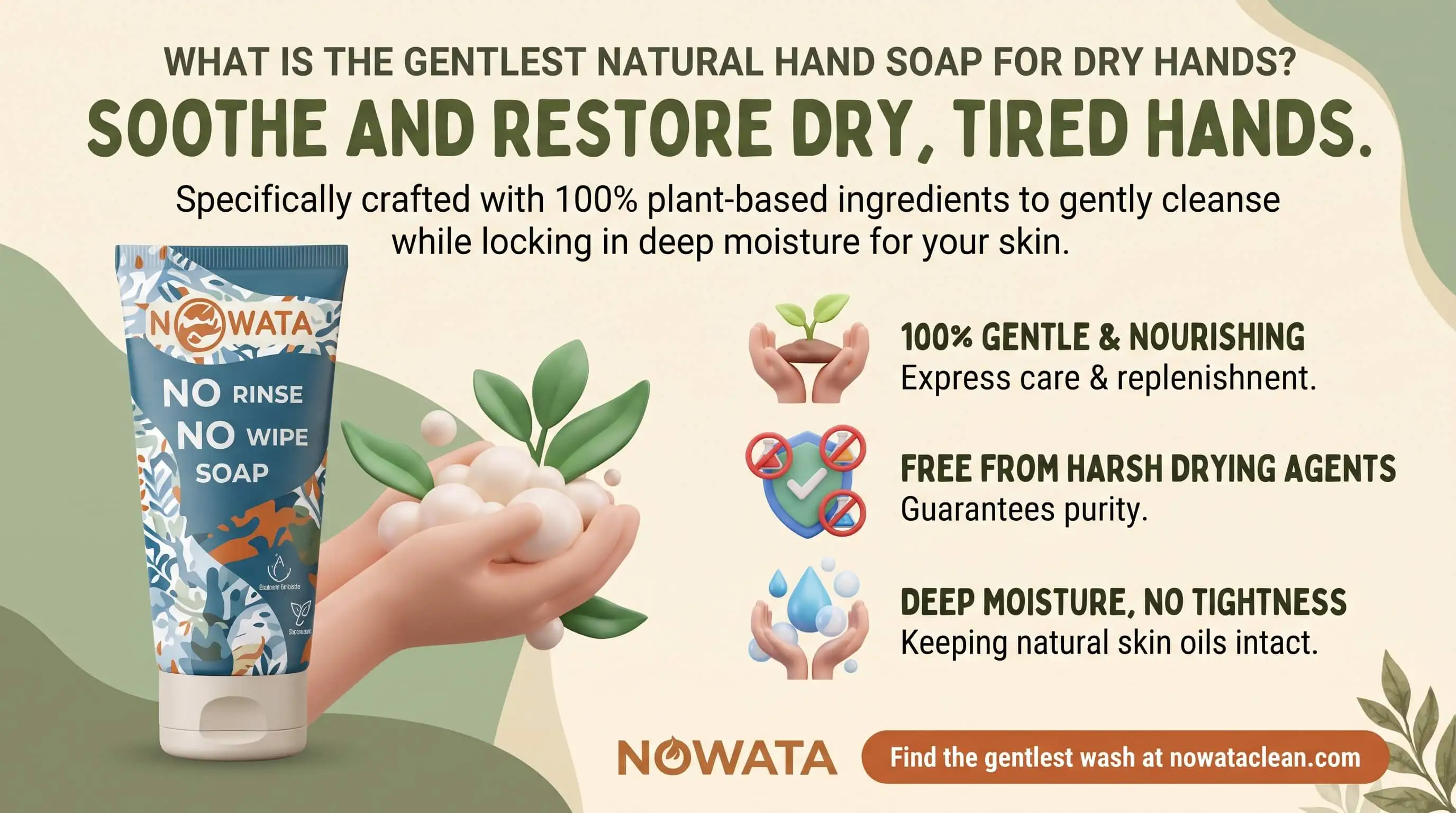
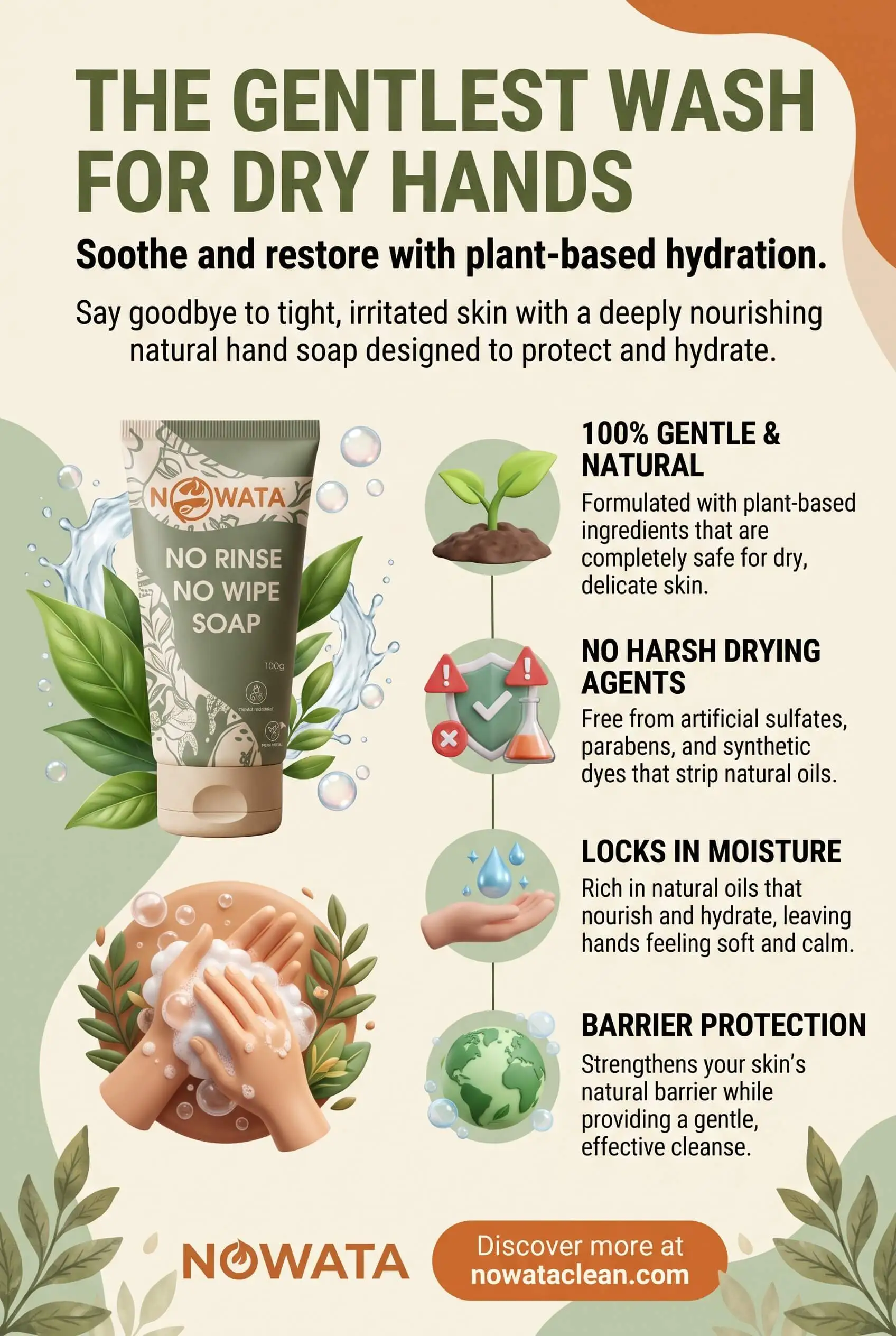
Most families grab alcohol sanitizer when there's no sink, and dry hands pay for it. A rinse-free soap does a different job. A dentist and a biomedical engineer developed NOWATA for their own kids first. Their formula is plant-based, and they leave out alcohol, parabens and sulfates. You rub it in until the grime forms small clumps, then brush them off, with no water and no rinse. On a long drive or a soccer sideline, that's a far gentler habit than a fourth squirt of sanitizer. Moisturize afterward, the same as you would after washing at the sink. I also compared a few fragrance-free alternatives to sanitizer if you want more options.
"We ran the swap at our kitchen sink last winter, and I changed one thing at a time so I'd know what actually worked. Out went the lavender foaming soap we'd bought for years, and in went a fragrance-free liquid built on glucoside cleansers and glycerin. Nothing else changed for ten days. By the end of the second week, the cracks on my husband's knuckles had stopped reopening every morning. Then we added lukewarm water, a pat-dry and a dab of hand cream on damp skin, and the sandpaper feeling went away for both of us. What bothered me was the old bottle. It was plant-based and said to be natural right on the front, yet the second ingredient was a sulfate, with fragrance a few lines down. I'd trusted the front of that bottle for years. Now I read the back first, and if I can't figure out what an ingredient is in there, the bottle stays on the shelf."
7 Essential Resources
These are the pages I check before a new soap comes into our house. Use them to judge any soap you're considering, including the ones I like.
1. American Academy of Dermatology: Dry Skin Relief From Handwashing
A dermatologist-written routine for people who wash a lot and are paying for it in cracked skin. It covers picking a soap that won't dry you out, leaving your hands slightly damp and moisturizing right away.
Why I keep it: if you only click one link on this page, make it this one.
Link: https://aad.org/public/everyday-care/skin-care-basics/dry/coronavirus-handwashing
2. American Academy of Dermatology: Dermatologists' Top Tips for Relieving Dry Skin
The AAD's broader guide to dry skin. Dermatologists recommend fragrance-free products here, call deodorant soaps too harsh and suggest gloves for wet chores.
Why I keep it: most of the skip list above traces back to this page.
Link: https://aad.org/public/everyday-care/skin-care-basics/dry/dermatologists-tips-relieve-dry-skin
3. FDA: Cosmetics Labeling Claims
The FDA's own explanation of how claims on cosmetic labels work. The agency doesn't approve labels before products go on sale, and a claim only has to be truthful and not misleading.
Why I keep it: five minutes here and you'll stop taking the word natural at face value.
Link: https://www.fda.gov/cosmetics/cosmetics-labeling/cosmetics-labeling-claims
4. FDA: Skip the Antibacterial Soap; Use Plain Soap and Water
The plain-language write-up of the 2016 rule that pulled 19 antibacterial active ingredients from consumer soap.
Why I keep it: it settles the worry that a gentle soap can't clean as well as an antibacterial one.
Link: https://www.fda.gov/consumers/consumer-updates/skip-antibacterial-soap-use-plain-soap-and-water
5. CDC: Handwashing Facts
The science behind the 20-second scrub, how surfactants lift germs off skin and why warmer water may irritate without cleaning any better.
Why I keep it: everyone else quotes this page, so I'd rather go straight to it.
Link: https://www.cdc.gov/clean-hands/data-research/facts-stats/index.html
6. EWG Skin Deep Cosmetics Database
A searchable database of personal care products and their ingredients, with separate categories for liquid hand soap and bar soap. If your soap isn't listed, the Build Your Own Report tool scores an ingredient list you type in.
Why I keep it: it's the quickest way to check a bottle from your phone while you're still in the aisle.
Link: https://www.ewg.org/skindeep/
7. Cosmetic Ingredient Review
An expert panel that publishes safety assessments of individual cosmetic ingredients, using the same ingredient names you'll see on a label.
Why I keep it: when an ingredient name stumps me, this is where I look it up.
Link: https://www.cir-safety.org/
3 Statistics
I'd never tell a reader with dry hands to stop washing them, and these numbers are why.
Statistic #1: Handwashing education cuts respiratory illness by 16 to 21% and diarrheal illness by 23 to 40%.
The CDC took those ranges from community handwashing studies. They make dry hands something to manage instead of a reason to skip the sink. The same CDC page notes that warmer water may irritate skin more without removing more germs, which is one more vote for lukewarm.
Source: CDC: Handwashing Facts
Statistic #2: About 15% of adults will deal with hand eczema at some point in their lives.
Researchers surveyed 57,798 adults in the Dutch Lifelines Cohort and found a lifetime hand eczema prevalence of 15.0%, with 7.3% affected in the past year alone. That works out to about one adult in seven. In a busy house, the soap by the sink is a decision for everyone who uses it.
Source: Voorberg, Loman and Schuttelaar, Acta Dermato-Venereologica (2022)
Statistic #3: The FDA pulled 19 antibacterial active ingredients from consumer soap in 2016.
Triclosan and triclocarban were on the list. Manufacturers never showed those ingredients were safe for long-term daily use or better than plain soap and water at preventing illness. For anyone with dry hands, that's good news, because choosing the gentlest formula costs you nothing on cleaning.
Source: FDA: Skip the Antibacterial Soap; Use Plain Soap and Water
Final Thoughts and Opinion
A year of reading soap labels has left me with one firm opinion. People hear gentle and assume weak. The gentlest soap for dry hands still lifts dirt and germs, and it leaves the skin barrier mostly alone while it works.
I think about soap the way I think about furnace filters. Nobody sensible buys the highest rating on the shelf and hopes it fits. You match the filter to the system and the house, and hands that are already cracked need a mild cleanser, no added fragrance or alcohol, and something that puts moisture back.
Honestly, the word natural on the front of a bottle has confused more shoppers than it's helped. Some plant-based soaps are wonderful for dry skin, and some are fragrance bombs with a sulfate in the second slot. Read the back, pair the right soap with lukewarm water and hand cream, and give it two weeks before you judge it. Just as home improvement involves choosing the right materials for a healthier, more comfortable living space, selecting the right hand soap means looking beyond appearances and focusing on what truly works for your skin.
Frequently Asked Questions
Why does hand soap dry out my hands?
Its cleansing ingredients pull your skin's natural oils off along with dirt and germs. Strong ones like sodium lauryl sulfate take the most. Hot water, rough towels, added fragrance and skipped hand cream all add to the damage.
Is natural soap better for dry hands than regular soap?
Only when the formula earns it. A natural soap is gentler if it leaves out sulfates, added fragrance and alcohol and includes glycerin or a plant oil. Plenty of plant-based soaps still use harsh cleansers or heavy essential oils, so read the ingredients before you trust the label.
Is castile soap good for dry hands?
It depends on your skin. Castile soap is made from plant oils, which helps, but it's alkaline, and that can feel drying when your skin barrier is already damaged. If you try it, dilute it, wash with lukewarm water and moisturize right after. Switch if your hands feel tighter after a week.
What does "non-toxic" mean on a hand soap label?
Legally, not much. The FDA doesn't approve cosmetic claims before products go on sale, and a claim only has to be truthful and not misleading. To judge a soap yourself, check the ingredients for sulfates, fragrance and alcohol, or look the product up in EWG's Skin Deep database.
Is waterless soap gentler on dry hands than hand sanitizer?
An alcohol-free, rinse-free soap usually is. Alcohol sanitizer dries skin quickly with frequent use, while a waterless soap lifts grime off without any alcohol. Moisturize after either one. Parents can also check whether no-rinse soap for kids is safe before stocking the car.
What is the best all natural non toxic hand soap for dry hands?
The best all natural non toxic hand soap for dry hands cleans with a mild plant-derived surfactant, contains glycerin or plant oils and leaves out sulfates, added fragrance, alcohol and dyes. Look for a short ingredient list, a fragrance-free label and a third-party seal, then give it two weeks of daily use.
Your Next Step
Tonight, pick up the soap at your kitchen sink and give it the 60-second label check above. A sulfate, added fragrance or alcohol near the top means it's time to swap.
Try a fragrance-free, sulfate-free natural soap with glycerin or plant oil for two weeks. Wash with lukewarm water, pat your hands until they're just damp and moisturize every time. By the second week, your knuckles at bedtime will tell you more than any review.
Shopping for someone with extra-sensitive skin? My guide to the best hypoallergenic soap for diabetics covers that. If you're packing for a camping trip, here's my pick for the best environmentally friendly soap for camping.


