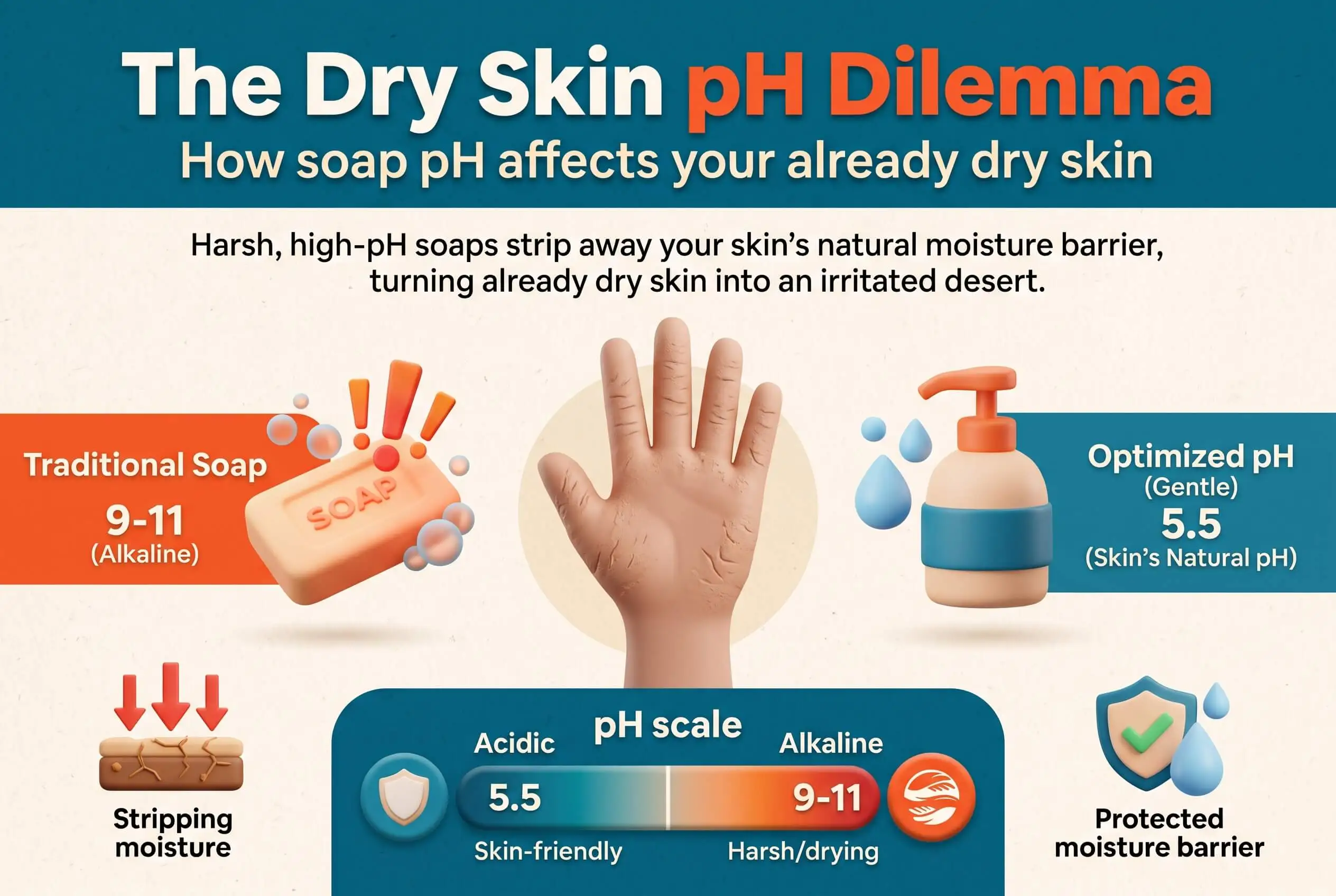
Healthy skin sits on the acidic side of the scale. Most true soap lands well on the alkaline side, a leftover from the lye-and-oil chemistry that makes a bar in the first place. Healthy skin shrugs that off within a few hours. Skin that's already dry has thinner reserves of its own oils, so each wash chips away at a barrier that never fully recovered from the one before.
When readers ask me whether their dry soap is making things worse, I usually tell them yes, probably. The fix is cheap, and you can check your own bar tonight with a few dollars' worth of test strips.
TL;DR Quick Answers
Dry Soap
Dry soap means one of two things. It's either a bar soap that dries out your skin, or a rinse-free soap you use on dry hands with no water at all. If your skin is already dry, the rinse-free kind is often the gentler choice, because it skips both the alkaline lather and the extra trips under the tap.
Soap that dries your skin: Most true bar soap tests around pH 9 to 10, while healthy skin sits near 4.6 to 5.8. Each wash pushes your skin's pH up and slows barrier repair.
Soap you use dry: A rinse-free formula goes onto dry hands, clumps around the dirt, and brushes off. You never turn on the faucet.
Why water matters too: Tap water also nudges skin pH upward, so cutting out a few rinses takes some strain off a barrier that's already dry.
What to look for: Plant-based, alcohol-free formulas like NOWATA's, made to clean without stinging or drying skin and safe enough for kids.
If your bar soap leaves your hands tight within minutes, switch to a pH-balanced wash at the sink. Keep a rinse-free dry soap for washes away from it.
Top Takeaways
Healthy skin is slightly acidic, at about pH 4.6 to 5.8, and that acidity helps the skin barrier hold onto moisture.
Most true bar soap tests around pH 9 to 10, simply because of how soap is made.
Alkaline soap pushes skin pH up after every wash, which slows barrier repair and lets more water escape.
Dry skin has less natural oil to absorb the shift, so it recovers more slowly than healthy skin.
Plain tap water raises skin pH too, which makes frequent rinsing part of the problem.
For dry skin, choose a sulfate-free, fragrance-free cleanser labeled pH 5.5 to 7 or "syndet."
Moisturize within minutes of washing, and on heavy-washing days a rinse-free cleanser can take some of the load off the faucet.
What pH Your Skin Actually Wants
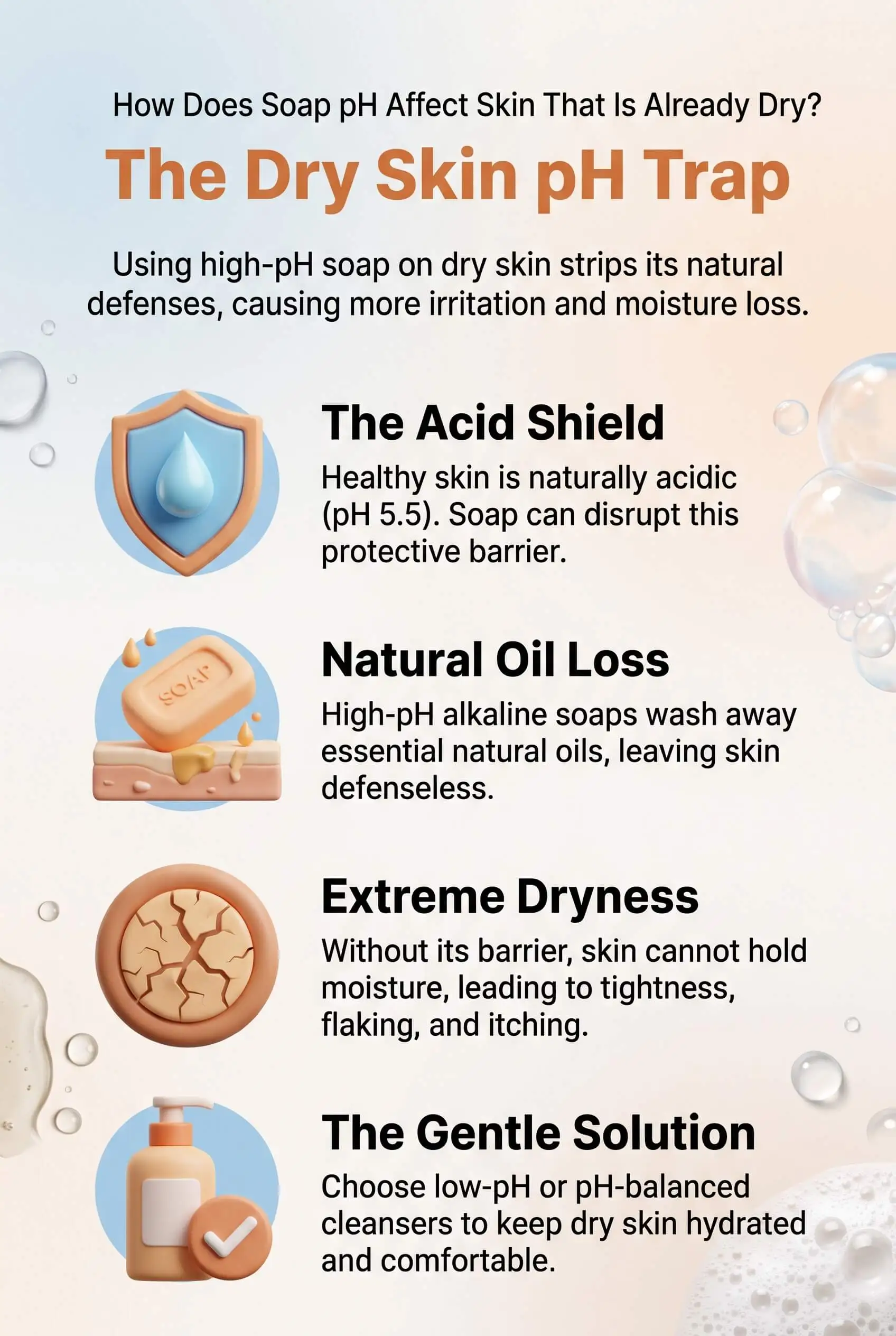
Healthy adult skin measures roughly pH 4.6 to 5.8, according to a 2017 study in Anais Brasileiros de Dermatologia. Dermatologists call that thin acidic layer the acid mantle, and it does real work. It keeps the enzymes that build your skin's protective fats running and gives the friendly bacteria on your skin a place they like to live.
I think of it as weatherstripping on a front door. You only notice it once it's worn out and the draft gets in.
Why Most Bar Soap Is Alkaline
Soapmakers react fats or oils with an alkali, a process called saponification, and the finished bar keeps an alkaline pH. When researchers writing in the Indian Journal of Dermatology measured common bathing soaps, only 3.125% of samples matched normal skin pH. Homemade soaps, the ones sold as the gentle choice at craft fairs, ran between 9 and 10.
The wrapper won't mention any of that. Every time you lather up, you're putting something several pH points away from your skin directly onto it.
What Alkaline Soap Does to Skin That Is Already Dry
Dry skin takes the hardest hit here. Once alkaline soap raises your skin's pH, a few things go wrong together:
Barrier repair slows, because the enzymes that rebuild your skin's fats prefer acidic conditions.
Water escapes faster. In a randomized trial of 60 adults with dry skin who washed with bar soap four times a day, skin pH and water loss both peaked right after washing.
Skin proteins swell and then tighten as they dry, which is the stretched feeling you notice at the sink.
The mix of bacteria on your skin shifts toward species that do better at a higher pH.
Plenty of people use alkaline bars for decades and never notice, because healthy skin resets within hours. Dry skin starts every wash already behind, which is why some people consider Waterless no rinse hand soap as an alternative. In a study of older adults with dry skin, published in Acta Dermato-Venereologica, higher skin pH went hand in hand with more water loss, lower hydration and fewer surface lipids. Wash six or eight times a day and your skin may never get back to baseline.
Is Your Dry Soap the Problem? Signs to Watch For
You can usually spot it without a lab. Look for:
Tightness within a minute or two of washing
Flaking or small cracks across the knuckles
Hand cream that stings going on
Dryness that flares every winter, or during weeks when someone at home is sick and you're washing constantly
Hands that feel fine on Saturday and rough by Thursday
If most of those sound like your hands, take a hard look at your cleanser before you blame the weather.
Tap Water Raises Skin pH Too
Most soap articles skip this part. Tap water usually sits at neutral or a little above, so even a plain rinse nudges acidic skin upward. Add a hot faucet and a dozen washes a day, and dry hands get worn down from two directions at once.
That's why rinse-free cleansing caught my attention. With rinse-free dry soap from NOWATA, you put a dime-sized drop on dry hands and rub until it forms little clumps that carry the dirt with them. Then you brush them away, and the faucet never comes on. The formula is plant-based and alcohol-free, so you skip the sting of sanitizer on cracked knuckles along with the extra trip under the tap. If constant washing is what's cracking your hands, using less water is a sensible place to start.
Soap vs. Syndet vs. Rinse-Free: How Cleansers Compare
True bar soap. Usually around pH 9 to 10. It cleans with alkaline soap and a water rinse, and it's the toughest on dry skin because it pushes pH up the most.
"Moisturizing" cream bar. Usually around pH 7 to 8 It's still soap with extra fats added, a little kinder but still above where your skin wants to be.
Syndet bar or liquid. Usually around pH 5.5 to 7. These synthetic cleansers rinse off and suit dry skin well when the formula is sulfate-free and fragrance-free.
Cleansing milk or cream. Acidic to neutral. You wipe or rinse away a blend of oils and emulsifiers, which works well for very dry skin.
Rinse-free plant-based soap. The pH depends on the brand. It lifts dirt off physically and brushes away without water, which helps on the go and on heavy-washing days.
The closer a cleanser stays to your skin's own pH, and the less time your hands spend soaking, the better dry skin tends to cope.
What to Look For in a Gentle Cleanser for Dry Skin
A labeled pH between 5.5 and 7, or the word "syndet" on the package.
No sodium lauryl sulfate. I've written about why sulfate-free formulas clean just as well without stripping your hands.
"Fragrance-free" rather than "unscented." The American Academy of Dermatology points out that unscented products can still contain masking chemicals that irritate dry skin.
Glycerin or plant oils near the top of the ingredient list.
A hypoallergenic soap if your skin reacts easily to new products.
After that, put on a moisturizer within a few minutes of every wash, while your hands are still a little damp. The AAD recommends it, and in the dry-skin handwashing trial it was the step that protected the barrier best.
How to Check Your Soap's pH at Home
You'll need distilled water, a clean glass and a pack of pH test strips from the pharmacy or a pool supply shop.
Shave a thin sliver off your bar, or squeeze in a few drops of liquid soap.
Stir it into a small amount of distilled water until it dissolves.
Dip a strip for a second or two.
Match the color against the chart on the package.
Solid soap is hard to measure precisely, so read the result as a ballpark. If the strip says 9 or higher, you've learned what you need to know.
"I've reviewed household products for this site for years, and the soap aisle still surprises me. Labels shout about scent and lather, and almost none of them print the one number your skin cares about. When I ran test strips on the soaps in our own house, every true bar came back well into the alkaline range, and the cream bar wasn't far behind. My husband's knuckles crack every January, and for years we blamed the furnace and the dry air. Once we swapped his bar for a sulfate-free, low-pH wash and parked a tub of cream next to the sink, the cracks closed up within a couple of weeks. A rinse-free cleanser in the car now covers errand days, when he'd otherwise be washing at every stop. My advice for anyone with dry skin is to stop asking whether a soap gets you clean, because nearly all of them do. Ask what it costs your skin barrier each time you use it."
7 Essential Resources
These are the sources I go back to whenever I write about soap, pH and dry skin. Each one is either the original research or an organization dermatologists actually rely on.
1. American Academy of Dermatology: Dermatologists' Top Tips for Relieving Dry Skin
The AAD's practical guide to dry skin, reviewed by board-certified dermatologists. It tells you to use a gentle, fragrance-free cleanser, steer clear of deodorant soaps, and put on hand cream after every wash.
Link: https://www.aad.org/public/everyday-care/skin-care-basics/dry/dermatologists-tips-relieve-dry-skin
2. Evaluation of pH of Bathing Soaps and Shampoos for Skin and Hair Care (PubMed Central)
Researchers measured the pH of everyday soaps and shampoos and found most of them far outside the skin's range. Read it if you want to know why high-pH soap leaves skin dehydrated and irritated.
Link: https://pmc.ncbi.nlm.nih.gov/articles/PMC4171909
3. The pH of the Main Brazilian Commercial Moisturizers and Liquid Soaps (Anais Brasileiros de Dermatologia)
This short study sets out the healthy skin pH range and then tests store-bought products against it. Half the liquid soaps missed the mark, which is a good reason not to trust the word "gentle" on a label.
Link: https://doaj.org/article/c64aaffb4c5044da9f447e69a70346f4
4. Protective Effects of Moisturizers on Skin Barrier During Regular Hand Washing (PubMed Central)
Sixty adults with dry skin washed their forearms with bar soap four times a day for a week. The researchers found barrier damage peaks right after washing, and that moisturizing immediately afterward protects it.
Link: https://pmc.ncbi.nlm.nih.gov/articles/PMC8208277
5. Alkaline Soap and Syndet on Dry Skin in Elderly Patients (Acta Dermato-Venereologica)
An older clinical study that compared acidic and alkaline cleansers on dry skin. It links higher skin pH with more water loss, less hydration and fewer surface lipids.
Link: https://medicaljournals.se/acta/content/abstract/10.2340/0001555568277283
6. The pH of Common Soaps in Nigeria and the Implications for Skin Health (Nigerian Journal of Dermatology)
A recent survey of 60 cleansers popular with dermatology patients. It shows just how common alkaline products are, and the authors spell out why that matters for sensitive and dry skin.
Link: https://mail.nigjdermatology.com/index.php/NJD/article/view/243
7. Wikipedia: Soap
A readable overview of how soap gets made and why true soap ends up alkaline. Worth ten minutes before your next trip down the soap aisle.
Link: https://en.wikipedia.org/wiki/Soap
3 Statistics
Whenever someone tells me soap is just soap, these are the numbers I point to.
Statistic #1: Healthy skin sits between pH 4.6 and 5.8, and half the liquid soaps tested landed above 5.5.
Brazilian dermatology researchers ran popular moisturizers and liquid soaps through a pH meter. Half of the liquid soaps and 63% of the moisturizers came in above 5.5, and the authors noted that this level works against barrier repair.
Source: Anais Brasileiros de Dermatologia
Statistic #2: Only about 3% of the bathing soaps tested matched the pH of healthy skin.
In a lab evaluation of everyday bathing soaps, just 3.125% of the samples fell inside the skin's own pH range. Homemade soaps, the ones usually sold as the gentle option, measured between 9 and 10.
Source: PubMed Central
Statistic #3: 75% of the cleansers dermatology patients used in one study were alkaline, between pH 9.0 and 11.1.
Researchers in Lagos and Ibadan tested 60 cleansers popular with clinic patients, and 45 of them came back alkaline. The authors flagged this as a real problem for anyone with sensitive skin or an inflammatory skin condition.
Source: Nigerian Journal of Dermatology
These three studies show that many everyday soaps have a higher pH than healthy skin, which can affect moisture retention and skin barrier protection. When planning home improvement projects, choosing gentler, pH-balanced soaps for bathroom sinks can be a simple way to support healthier skin and daily hand care.
Final Thoughts and Opinion
After going through this research, my opinion is simple. pH is the most ignored number in the soap aisle, and it's also the cheapest one to fix.
Soap isn't the villain for everyone. Healthy skin resets within a few hours, and lots of people will never feel a difference. If your skin is already dry, though, you don't have that cushion. Each alkaline wash and each extra rinse takes a little more of something your skin is already short on.
We already think this way about the rest of the house. Nobody keeps a furnace filter that strains the blower motor just because it technically catches dust. Hold your cleanser to the same standard. Pick one that cleans without fighting your skin, and moisturize while your hands are still damp. On the days you're washing nonstop, let a few of those washes skip the faucet. In my house, those habits have done more for dry hands than any "intensive repair" cream I've bought.
Frequently Asked Questions
Does soap pH really affect dry skin?
Yes. Alkaline soap raises your skin's pH after you wash, which slows the repair of its protective fats and lets more water escape. Healthy skin bounces back within hours. Dry skin has less in reserve, so the effect lasts longer and stacks up when you wash often.
What pH should soap be for dry skin?
Look for a cleanser between 5.5 and 7, which is close to your skin's natural range of about 4.6 to 5.8. Products labeled "syndet" or "pH-balanced" usually land there. Traditional bar soap typically tests around 9 to 10.
Is bar soap bad for dry skin?
Not always, but a traditional bar is alkaline and tends to dry skin more than gentler options do. If you prefer bars, try a syndet bar, which looks like soap but is formulated much closer to skin pH. Moisturize after every wash either way.
What is dry soap, and is it gentler than regular soap?
People use "dry soap" two ways. Sometimes they mean a soap that dries out their skin, and sometimes a soap you use without water. Rinse-free, plant-based cleansers like NOWATA fit the second meaning. You apply them to dry hands and brush them away, so your hands spend less time under the tap. That makes them handy when you're washing all day or nowhere near a sink. If you're wondering about kids, our guide to no-rinse hand soap covers safety.
Does tap water change your skin's pH?
Yes, a little. Tap water sits at or slightly above neutral, so rinsing nudges acidic skin upward for a while. For healthy skin that's minor. For dry skin it adds up, especially combined with alkaline soap and frequent washing.
How long does skin take to recover its pH after washing?
Healthy skin usually returns to its normal acidic range within a few hours. Dry or damaged skin can take longer, and washing several times a day may not leave enough time in between. Moisturizing right after you wash helps protect the barrier during that window.
Your Next Step
Tonight, pick up the soap by your sink and read the label, or run the strip test above. If it turns out to be a true bar soap, or your hands feel tight a minute after using it, you have your answer.
Swap it for a sulfate-free, fragrance-free cleanser closer to your skin's own pH, and keep a cream within reach of the faucet. For school pickups and the days when you're washing every hour, carry a tube of plant-based dry soap from NOWATA. Two parents who are also doctors made it, and it's alcohol-free and safe for kids. You put a drop on dry hands, rub until it clumps, and brush it away without any water. In independent Swiss lab testing using a modified ASTM E1174 method, NOWATA physically removed over 99.9% of E. coli and a human norovirus surrogate from skin. NOWATA is careful to say that's a hand-cleansing result, not a claim that it prevents disease.
Give your hands two weeks of gentler care, and I think you'll feel the difference.