So what makes it jump? A pollution source and a weather pattern have to show up at the same time. I keep coming back to four of those pairings, and between them they explain nearly every bad air day this city gets.
Each one has its own season and its own hour. Learn them, and the daily reading turns into a forecast you can act on for your family, your home and the HVAC system quietly filtering what you breathe.
TL;DR Quick Answers
air quality index Chicago
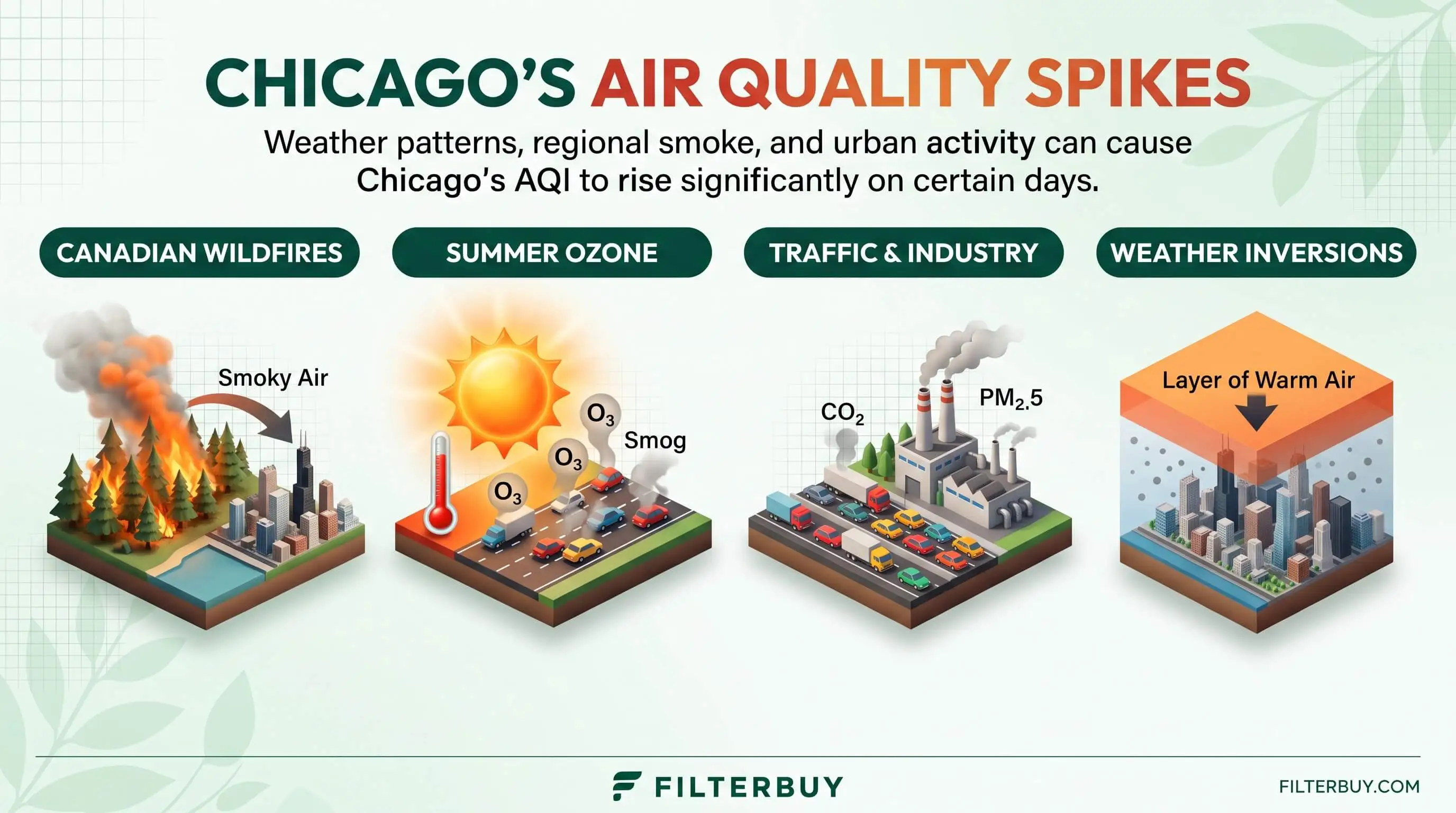
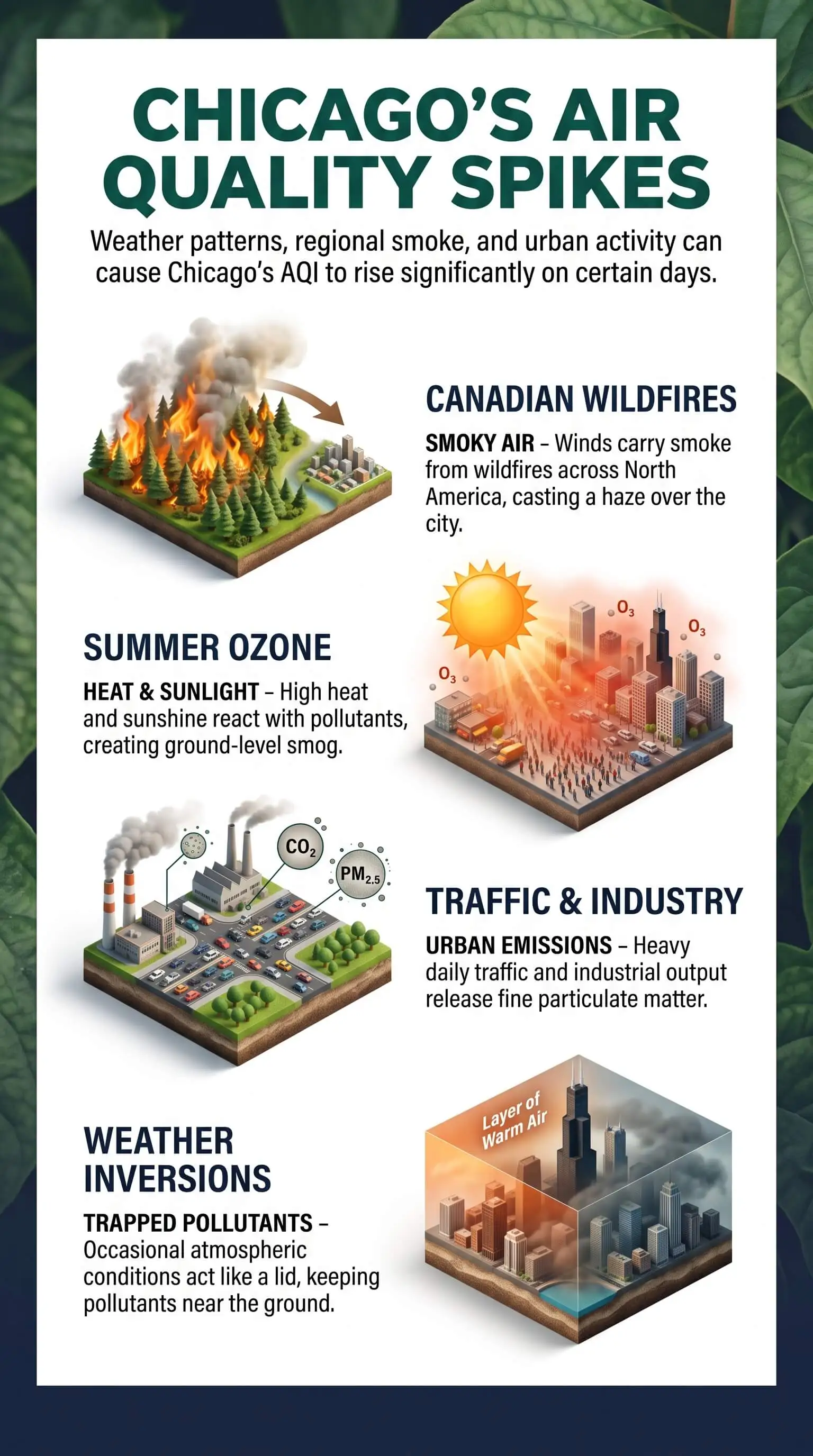
Chicago’s air quality index jumps when a pollution source and a weather pattern hit at the same time. Four pairings explain almost every bad air day here. The number alone won’t tell you which one you’re facing. The pollutant listed beside it will, and that decides whether closing the windows is enough or your filter has to do the work.
Wildfire smoke (PM2.5). It can arrive at any hour, mostly in summer, and now produces the city’s highest readings. On July 16, 2026, Chicago hit 366, more than double the previous worst of about 175.
Lake-breeze ozone. It peaks on hot afternoons from late spring through September. An afternoon lake breeze pushes ozone-rich air back onto the shoreline, so lakefront areas can read worse than inland ones.
Winter inversions (PM2.5). On calm, cold mornings, a warm air layer traps traffic and furnace emissions near the ground. It eases once the afternoon sun breaks the inversion.
Fourth of July fireworks (PM2.5). This is the most predictable short spike of the year. It peaks late on the night of July 4 and fades by midday on July 5.
What to do. For ozone, close the windows, because ozone breaks down indoors. For PM2.5, close up, run the HVAC fan continuously, and use the highest-rated filter your system can handle.
Top Takeaways
Chicago's AQI spikes when a pollution source and a weather pattern show up together.
The pollutant listed beside the number tells you more than the number does.
Ozone peaks on hot afternoons, and the lake breeze pushes it onto the shoreline.
Winter inversions trap PM2.5 overnight, and the afternoon sun breaks them up.
Wildfire smoke keeps no daily schedule and now produces the city's highest readings.
Closing the windows handles ozone well, while PM2.5 needs a good filter and a running fan.
What the Chicago Air Quality Index Is Actually Reporting
The AQI doesn't average everything floating in the air. The EPA scores each major pollutant on its own, and the worst one sets the number on your screen. In Chicago, that's nearly always ground-level ozone or fine particles, called PM2.5.
They couldn't be more different. Nothing emits ozone directly. It forms in the air when sunlight cooks tailpipe exhaust and chemical vapors on hot days. PM2.5 is smoke and soot in particles small enough to settle deep in your lungs, and you won't see most of it. Check the pollutant beside the number first. It names the trigger you're up against.
Spike Trigger One: Wildfire Smoke on Northwest Winds
Wildfire smoke now drives Chicago's worst readings. Big fires in Ontario or western Canada send plumes south on the northwest winds that trail a cold front. Then a stagnant high settles over the Midwest, presses the smoke down to street level and holds it there.
July 2026 showed how fast that piles up. On July 14, Illinois EPA and the state health department warned that the Chicago region was already under an ozone Action Day and that wildfire smoke could reach northeastern Illinois by Thursday. It arrived on the 16th, right behind the ozone, and set the record.
Smoke keeps no schedule. It can roll in at 3 a.m. or at noon, push the index up within a few hours, and clear out just as fast once the wind turns. PM2.5 is the pollutant behind it.
Spike Trigger Two: Hot Afternoons and the Lake Michigan Breeze
Ozone forms when nitrogen oxides from tailpipes and smokestacks react with chemical vapors in strong sun. Lake Michigan adds a step most people never notice.
After dark, a light land breeze nudges emissions from Chicago and Milwaukee out over the cool water, where they sit and react. By the next afternoon the land had warmed faster than the lake. The breeze flips around and carries that aged, ozone-heavy air right back onto the shoreline.
That's how a lakefront block or a North Shore suburb can read worse than an inland neighborhood on a July afternoon, even while the breeze feels clean on your face. University of Wisconsin-Eau Claire researchers studying the shoreline tied the lake breeze to most of the region's high-ozone days.
The Chicago area missed the federal 2015 ozone standard, so the EPA bumped it to Serious nonattainment in January 2025. Expect ozone days from late spring through September, with the worst hours in mid to late afternoon. Early morning is usually the cleanest stretch of a hot day.
Spike Trigger Three: Cold, Still Winter Mornings
Normally, air near the ground warms, rises and lifts pollution away with it. Calm, clear winter nights flip that. The ground loses heat fast, a warmer layer slides in overhead, and you get a temperature inversion sitting on the city like a lid.
Under the lid, PM2.5 from diesel trucks, rush-hour traffic, furnaces and fireplaces has nowhere to go. Readings climb overnight, peak around the morning commute, and fall back once the afternoon sun breaks the inversion and the wind returns.
These rarely make the news, since most land in the moderate or sensitive-groups range. They come back morning after morning, though, and homes near expressways and rail yards breathe the worst of them.
Spike Trigger Four: The Night of the Fourth
Fireworks bring the most predictable short spike of the year. WBEZ, the Sun-Times and MuckRock analyzed Microsoft's Chicago sensor data and found that 9 p.m. to midnight on July 4, 2021 were the most intensely polluted hours the city logged that entire year. Five South Side sensors topped 100 micrograms per cubic meter.
Calm, humid nights make it worse because the smoke hangs low. Across the country, the July 4 jump in fine particles fades to near normal by midday on July 5.
How to Tell Which Spike You're Dealing With
When the sky looks off, I pull up the live air quality index for Chicago and read past the number to the pollutant listed beside it. Then I check the clock and the calendar. Put those together and you can usually name the trigger, which tells you what to do next.
Ozone on a summer afternoon. Shut the windows by early afternoon and move your run or yard work to the morning. Ozone breaks down fairly fast indoors, so a closed-up house handles most of it for you.
PM2.5 with haze or a smoke smell, any season. Close up, switch the HVAC fan to On so it runs continuously, and use the highest-rated filter your system is built for. The EPA recommends MERV 8 filter or better during smoke when your equipment can handle it.
PM2.5 on a still winter morning. Wait until afternoon, when the inversion lifts, to air the house out.
PM2.5 on the night of the Fourth. Keep the windows shut overnight and open them the next afternoon.
Whatever's driving the reading outside, you decide what your family breathes inside. A running fan and a filter that fits your air conditioners and HVAC system do most of that work.
"After years of walking into homes on smoky mornings, my first question is always which pollutant is on the reading lists. Ozone usually clears out of a closed house by evening, but PM2.5 keeps circulating until a properly sized filter catches it, and most homeowners don't realize the fan has to be running for that to happen."
7 Essential Resources
Illinois EPA: Outdoor Air – daily AQI forecasts for 14 Illinois sectors, how Action Days work, and alert sign-up.
AirNow: Using the Air Quality Index – how to read the AQI and plan your outdoor time around it.
U.S. EPA: Tackling the Ozone Issue on Lake Michigan's Shores – the Lake Michigan Ozone Study and how lake breezes carry ozone to the shoreline.
CDC: How Wildfire Smoke Affects Your Body – who faces the most risk from smoke and how to prepare.
National Weather Service: Why Air Quality Is Important – how air quality forecasts work and why ozone and particles matter.
American Lung Association: State of the Air, Chicago-Naperville – where the metro area ranks nationally for ozone and particle pollution.
WBEZ: Chicagoans Breathe in Extra Air Pollution on July 4 – sensor data showing how unevenly fireworks smoke spreads across Chicago neighborhoods.
3 Statistics
The Chicago area's ozone design value for 2021 to 2023 reached 0.077 ppm, above the 0.070 ppm federal standard, so the EPA reclassified the area to Serious nonattainment effective January 16, 2025. Federal Register, 89 FR 101901
NOAA researchers tracking 315 U.S. monitoring sites found that average 24-hour PM2.5 rises 42 percent on July 4, from 12.0 to 17.0 micrograms per cubic meter. NOAA Air Resources Laboratory, Seidel and Birnbaum (2015)
University of Wisconsin-Eau Claire research found a lake breeze present on as many as 85 percent of high-ozone events along the western Lake Michigan shoreline. Great Lakes Now
Chicago's air quality is influenced by ozone pollution, Fourth of July fireworks, and lake breezes that can trap pollutants along the shoreline. These findings highlight why monitoring outdoor pollution and maintaining proper indoor airflow both matter. If your AC is running but no air comes through the vents, checking for clogged filters or airflow problems can help you identify issues that may affect your home's indoor air quality.
Final Thoughts and Opinion
My advice is simple. Stop treating the AQI as a single verdict on your day and start reading it as a clue.
While checking the number more often helps a little, reading the pollutant beside it is the habit that pays off. An August ozone afternoon and a July smoke morning can post similar numbers, yet they call for different responses and clear on very different schedules.
I'd also argue that smoke has quietly taken over from ozone as this city's biggest worst-day risk. You can plan around ozone, since it follows the sun and the lake. Smoke follows nothing, which leaves preparation as your only dependable defense, making proper air filtration a worthwhile home improvement, and a filter already in place will do more for your family that morning than any app.
Frequently Asked Questions
Why is Chicago's air quality bad today?
Start with the pollutant behind the reading. Ozone on a hot afternoon usually points to strong sun and a lake breeze. PM2.5 points to wildfire smoke, a calm winter inversion, or fireworks. Each has its own cause and clears on its own timeline.
What time of day is Chicago's AQI usually the worst?
That depends on what's driving it. Ozone tends to peak in mid to late afternoon from late spring through September. Winter PM2.5 builds overnight and tops out around the morning commute. Wildfire smoke can show up at any hour, which makes it the one pattern you can't plan around with a clock.
Does Lake Michigan make Chicago's air quality worse?
On summer afternoons, it can. Overnight breezes carry city emissions out over the water, where sunlight turns them into ozone. The afternoon lake breeze then pushes that air back onshore, so lakefront areas sometimes read worse than inland neighborhoods even when the air feels cooler and fresher.
Is Chicago's air quality worse in summer or winter?
Summer brings the highest numbers, from ozone and wildfire smoke. Winter brings a quieter problem, PM2.5 trapped under morning inversions. Those winter spikes run smaller, but they show up often, and homes near expressways and rail yards take the brunt of them.
Why was Chicago's AQI so high in July 2026?
Smoke from Ontario wildfires rode northwest winds into northern Illinois and settled close to the ground on July 16. The region had just come off an ozone Action Day, so two triggers hit back to back, pushing readings into the hazardous range and setting a new local record.
Before Chicago's Air Quality Index Climbs Again
Once you understand the four patterns that influence Chicago air quality, the next pollution spike will tell you what is causing it and roughly how long it might last. One look at the pollutant, the hour and the season is enough to decide whether to open the windows or keep the house closed and the air moving through a filter you trust.